
The commercial truck industry in North America is built on durability. Whether hauling freight across interstate highways, transporting construction materials to remote job sites, or operating in demanding mining and agricultural environments, trucks are expected to carry heavy loads continuously while maintaining safety and ride stability. Behind this performance lies one of the most important suspension components: the leaf spring.
For fleet operators and aftermarket distributors, choosing an american truck leaf spring factory is no longer simply about purchasing replacement parts. It is about selecting a manufacturing partner capable of delivering consistent quality, stable supply chains, and engineering expertise that can meet increasingly demanding vehicle requirements.
As truck designs evolve and logistics operations become more efficiency-oriented, leaf spring manufacturing is also undergoing significant transformation.
Why Leaf Springs Continue to Dominate Heavy-Duty Truck Suspensions
Although air suspension systems have gained popularity in certain applications, leaf springs remain the preferred solution for a large proportion of heavy-duty trucks operating in North America.
Their advantages are difficult to ignore.
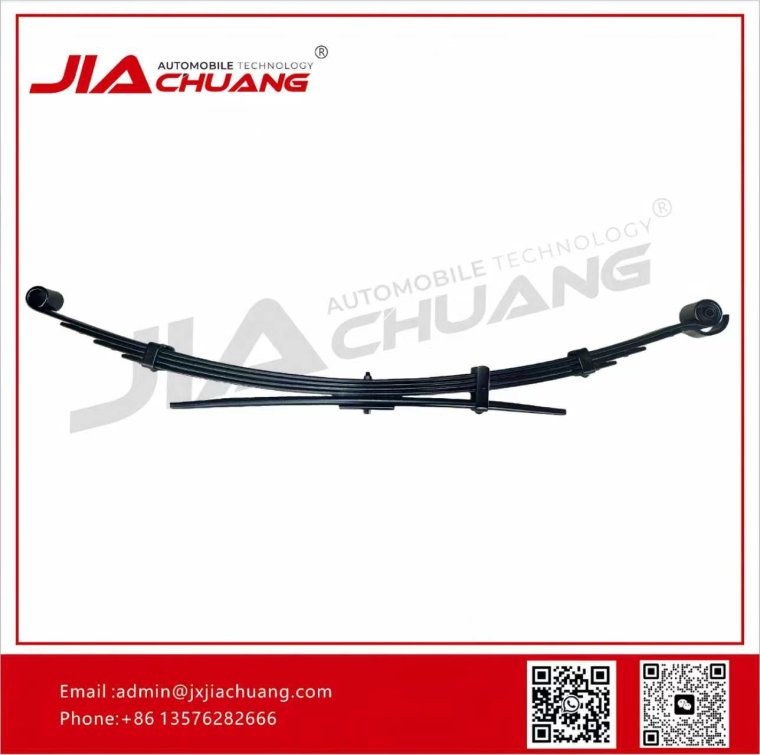
Leaf springs combine load-bearing and suspension functions in a single structure. Compared with more complex suspension systems, they offer excellent durability, simple maintenance, and lower operating costs. For trucks operating under heavy loads or harsh road conditions, these characteristics translate directly into higher uptime and lower lifecycle expenses.
The load capacity of a multi-leaf spring pack can easily support axle loads ranging from several tons to more than 13 tons, depending on vehicle configuration. More importantly, leaf springs distribute stress effectively and provide predictable elastic behavior throughout millions of loading cycles.
This explains why leaf springs remain widely used in:
Long-haul trucks operating across North America.
Construction dump trucks subjected to repeated impact loads.
Agricultural vehicles carrying uneven loads on rough terrain.
Mining trucks operating in dusty and highly demanding environments.
Specialty trailers requiring high static and dynamic load capacities.
In these applications, suspension reliability directly affects vehicle safety, cargo protection, and operating efficiency.
Material Selection Determines Fatigue Performance
The performance of a leaf spring begins with the steel itself.
High-quality leaf springs are commonly manufactured from alloy spring steels such as 51CrV4, SUP9, SUP10, or 60Si2Mn. These materials are selected for their excellent combination of strength, toughness, and fatigue resistance.
However, material selection alone is not sufficient.
The microstructure of the steel must be carefully controlled through heat treatment processes. Quenching and tempering determine hardness distribution and residual stress levels, which directly influence fatigue life.
For heavy-duty truck applications, fatigue resistance is especially critical.
A truck traveling 150,000 kilometers annually may subject its suspension system to millions of loading cycles. Small imperfections in material quality or heat treatment can gradually evolve into cracks, eventually causing spring failure.
Manufacturers therefore invest heavily in metallurgical control, hardness testing, and microstructure analysis to ensure long-term reliability.
The goal is not simply to produce a spring that meets static load requirements, but one capable of maintaining consistent performance throughout years of demanding service.
Shot Peening and Surface Treatment Improve Service Life
One of the most effective methods for improving leaf spring durability is shot peening.
During this process, steel shot impacts the spring surface at high speed, creating compressive residual stresses that inhibit crack initiation and propagation.
The results can be significant.
Depending on material grade and processing conditions, shot peening may improve fatigue life by 30% to 100% compared with untreated springs.
This improvement is particularly valuable for American trucks operating in harsh environments where suspension systems are exposed to repeated shock loads, potholes, and uneven road surfaces.
Surface protection is equally important.
Leaf springs are continuously exposed to water, road salt, mud, and corrosive environments. Without adequate protection, corrosion may reduce cross-sectional area and accelerate fatigue damage.
Modern factories increasingly employ advanced coating technologies such as:
Electrophoretic coating for uniform corrosion protection.
Powder coating for improved weather resistance.
Zinc-rich primers for enhanced salt spray performance.
Special anti-corrosion coatings designed for coastal or mining environments.
These treatments help maintain structural integrity and extend product lifespan under demanding operating conditions.
Manufacturing Precision Affects Suspension Performance
Leaf spring production is often underestimated.
To many people, a leaf spring appears to be a simple steel component. In reality, manufacturing precision plays a crucial role in suspension performance.
Critical parameters include:
Camber height.
Arc radius.
Leaf thickness tolerance.
Center bolt alignment.
Eye forming accuracy.
Interleaf friction characteristics.
Small variations in these parameters may influence ride height, axle positioning, and load distribution.
For example, insufficient camber may reduce load capacity and cause premature sagging. Excessive dimensional deviations can create uneven stress concentrations, increasing the likelihood of fatigue failure.
Modern manufacturing facilities therefore rely on automated rolling, CNC eye forming, robotic heat treatment systems, and precision inspection equipment to maintain product consistency.
Automation not only improves dimensional accuracy but also enhances production efficiency and traceability.
OEM Capability Is Becoming Increasingly Important
The North American truck market is highly diversified.
Different vehicle brands and applications require different suspension specifications. Springs designed for a long-haul tractor differ significantly from those used in dump trucks, trailers, or agricultural equipment.
As a result, standard products cannot satisfy every requirement.
OEM and customized manufacturing capabilities are becoming essential.
Customers increasingly require specific spring dimensions, load ratings, mounting structures, or surface treatments tailored to their vehicles and operating conditions.
An experienced leaf spring manufacturer must therefore provide more than production capacity.
It must offer engineering support, material recommendations, fatigue analysis, and flexible manufacturing solutions capable of responding to evolving market demands.
JIANGXI JIACHUANG AUTOMOBILE TECHNOLOGY CO., LTD. has specialized in automotive suspension components for more than 18 years. The company operates three manufacturing facilities located in Jiangxi and Hunan provinces and holds ISO9001:2015 and IATF/TS16949 certifications.
Its product portfolio includes leaf springs, bushings, and U-bolts, supported by automated production lines and experienced engineering teams. Through long-term exports to Europe, North America, South America, the Middle East, Africa, and Asia, the company has accumulated extensive experience in serving diverse commercial vehicle markets.
This global perspective enables manufacturers to better understand regional requirements and provide more customized solutions.
Sustainability and Lightweight Design Are Shaping the Future
The truck industry is facing increasing pressure to improve fuel efficiency and reduce emissions.
This trend is influencing suspension systems as well.
Manufacturers are exploring lightweight spring designs that reduce unsprung mass while maintaining strength and durability. High-strength alloy steels and optimized leaf geometries enable weight reductions without compromising load capacity.
Some manufacturers are also investigating composite leaf springs.
Although steel remains dominant in heavy-duty applications, composite materials offer advantages in weight reduction and corrosion resistance, particularly for specialty vehicles.
Digital manufacturing is another important trend.
Simulation software now enables engineers to predict stress distributions, optimize spring geometry, and evaluate fatigue performance before production begins. This shortens development cycles and improves product reliability.
As transportation continues to evolve, leaf spring technology is evolving alongside it.
Conclusion
Selecting an american truck leaf spring factory involves much more than comparing prices or catalog specifications.
The quality of raw materials, precision of heat treatment, effectiveness of shot peening, corrosion resistance, and manufacturing consistency all influence how a suspension system performs over millions of kilometers.
As fleets demand longer service life, lower maintenance costs, and greater operational reliability, manufacturers capable of combining advanced production technologies with strong engineering expertise will continue to gain competitive advantages.
For truck manufacturers, distributors, and aftermarket suppliers, partnering with a reliable leaf spring factory is not simply a purchasing decision. It is an investment in vehicle safety, durability, and long-term business success.
www.jxjiachuang.com
JIANGXI JIACHUANG AUTOMOBILE TECHNOLOGY CO.,LTD