
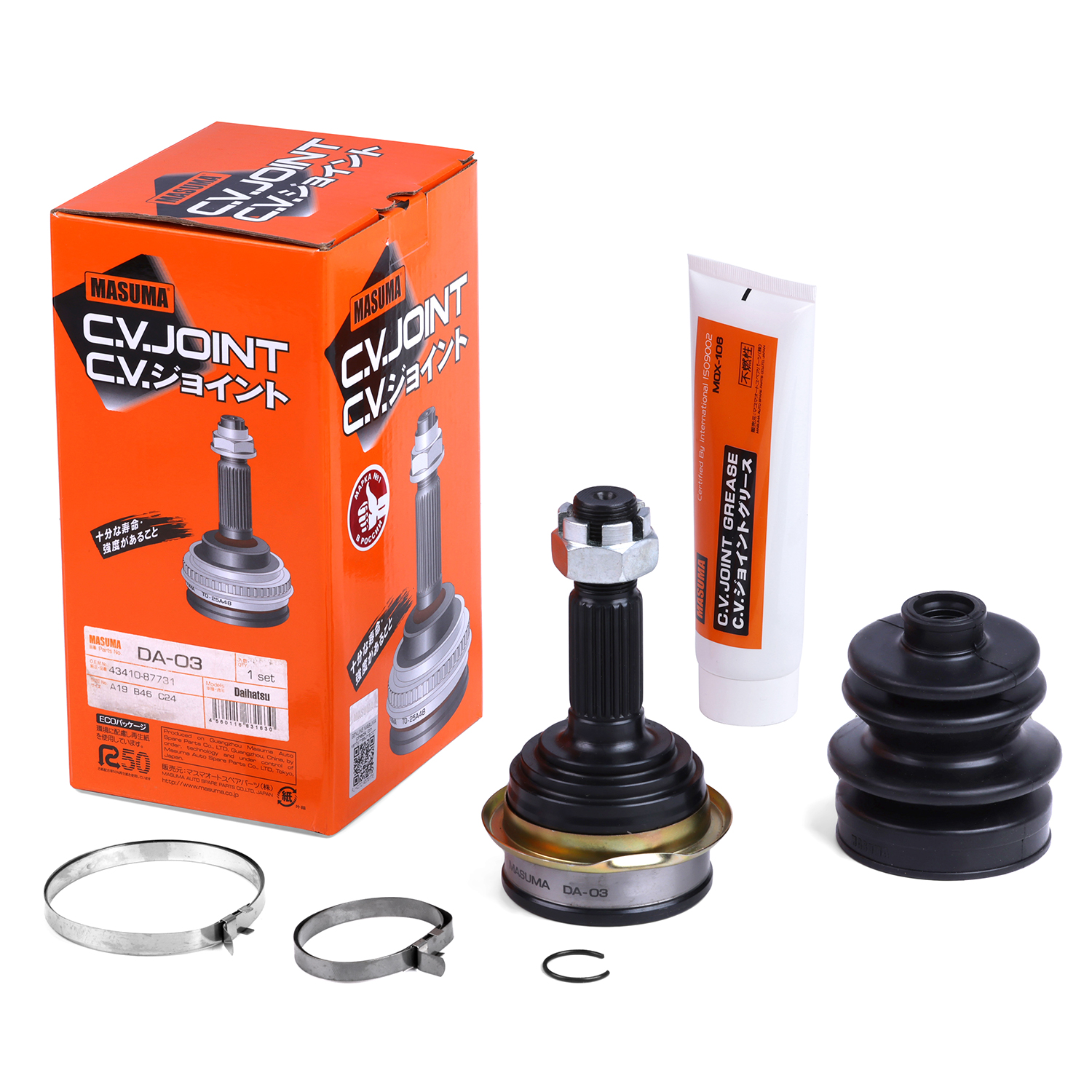
When engineers and aftermarket technicians evaluate driveline longevity, the conversation inevitably turns to two interrelated factors: ball cage material hardness and the heat treatment processes applied to the balls, races, and cages themselves. These elements determine how well a constant velocity joint, wheel hub bearing, or universal joint resists fatigue, wear, and premature failure under repeated torque and rotational loads. MASUMA, a brand focused on the development and optimization of bearings and transmission components for vehicle requirements, addresses these concerns through a combination of material selection, controlled forging, and precision heat treatment across its wheel hub and transmission product lines.
Material Standards Behind Ball and Cage Construction
The foundation of any durable bearing or joint assembly begins with raw material quality. MASUMA's component rings utilize raw materials exceeding the Chinese National Standard GB/T18254 for chemical composition, non-metallic inclusions, and carbide homogeneity, with additional compliance to the PAD1 Enterprise Standard. This material discipline extends into the ball and cage components used across the Outer CV Joint and Inner CV Joint (Six Balls) products, both of which rely on G16 grade steel balls paired with a shell manufactured from No. 55 steel. In the Wheel Hub Unit, rolling elements are specified as Grade G10 steel balls, with a surface brightness of <0.025um and scratch-free surfaces verified through pickling. The Third-Generation Wheel Hub Bearings similarly use G10 grade steel balls but with a tighter surface roughness tolerance of <0.02µm, reflecting the higher integration demands of that product generation.
Cage material is equally critical. MASUMA incorporates a BASF Nylon Retainer in the Wheel Hub Unit, engineered for smooth surfaces with zero edge spills, burrs, cracks, or peeling. The Third-Generation Wheel Hub Bearings use a comparable BASF Cage, described as a reinforced nylon cage with high impact toughness and aging resistance — properties that directly influence how well the cage withstands repeated flexing and torque cycling over the life of the component. BASF is listed among MASUMA's technology partners specifically for this reinforced nylon cage material supply.
Heat Treatment Processes That Define Longevity
Heat treatment is where raw material potential becomes functional durability. MASUMA's outer and inner rings are forged via electric heating, a process noted to provide extended service life compared to conventional tube material processes. This forging method is applied consistently in both the Wheel Hub Unit and the Third-Generation Wheel Hub Bearings, where forged blanks are specifically credited with extending service life relative to tube-based alternatives.
Following forging, components pass through quenching and tempering using continuous mesh belt furnace technology, described as part of an OE-quality heat treatment process for the Wheel Hub Unit. For the Outer CV Joint, the shell, star sleeve, and cage undergo normalized heat treatment, resulting in a grain size grade 8 and martensite organization grade 3. The Inner CV Joint (Tripod Bearings) follows a comparable path, with a normalized blank organization of grade 1, grain size grade 8, and a quenched surface martensite organization of grade 3 — heat treatment metrics that reflect controlled, repeatable metallurgical outcomes rather than variable or inconsistent processing.
Universal Joints take a different but equally specific approach to hardness: the joint cross is manufactured from 40Cr, 40CrNi, 20CrMo, or 20CrMnVB alloy steel, hardened to 58 to 62 HRC. This hardness range, combined with needle rollers that rotate during joint movement to reduce friction, supports the component's stated capacity to transmit greater torque at a given swivel diameter while compensating for angular displacement up to 15–20 degrees.
Automated Machining and Precision Finishing
Heat treatment alone does not guarantee longevity without precision finishing. MASUMA's automated manufacturing involves synchronized grinding of outer ring raceways alongside concurrent processing of the inner ring bore, raceways, and side faces, a process designed for dimensional consistency across production runs. For the Outer CV Joint specifically, the ball track is processed by grinding to a brightness of 0.4 um, with ball contour held within ≤0.013mm and eccentric distance within ±0.01mm. Lathe, milling, grinding, and assembly processes for this joint are described as completely automated, and the cage itself undergoes 100% defect detection testing before leaving production. Fatigue life testing for the Outer CV Joint has reportedly exceeded 250,000 cycles, a figure that speaks directly to how material hardness and heat treatment translate into measurable endurance.
Quality Verification Through Japanese Inspection Standards
Beyond internal process controls, MASUMA references Japanese Inspection Standards as the basis for inspecting all ball cage products. This external verification layer, combined with raw materials that surpass GB/T18254 and adherence to the PAD1 Enterprise Standard, forms a three-tier quality framework spanning material sourcing, in-process heat treatment, and final inspection.
Real-World Evidence of Cage and Ball Wear
Material and heat treatment choices matter most when they prevent the kinds of failures technicians encounter in the field. One documented case involving vehicle transmission system operations describes a periodic chugging noise when driving on bends or rough roads, often accompanied by dust sleeve damage or oil leakage. The recommended diagnostic approach involves disassembling the half-shaft, inspecting clearance by turning the joint back and forth, cleaning the seat rings and steel balls, and replacing the assembly if grooves, spalling, or spotting are present on the ball or cage surfaces. This case illustrates why hardness and heat treatment specifications are not abstract manufacturing details — they directly determine whether a cage or ball surface develops the grooves and spalling that technicians are trained to identify during inspection.
Maintenance Guidance That Supports Longevity
MASUMA's after-sales guidance reinforces the connection between proper installation, maintenance, and the long-term performance of hardened and heat-treated components. Inspection is recommended every 12 months or 150,000 km, and specific torque values are provided for related hardware, including an axle head nut torque of 1050±100 Nm and axle shaft bolts at 290±20 Nm. Maintaining these torque specifications helps ensure that properly hardened balls, cages, and races are not subjected to misalignment or uneven loading that could accelerate wear regardless of material quality.
Conclusion
Ball cage material hardness and heat treatment are not isolated specifications — they represent an integrated sequence spanning raw material sourcing, electric heating forging, continuous mesh belt furnace quenching and tempering, automated grinding, and final inspection against Japanese Inspection Standards. Across its Wheel Hub Unit, Third-Generation Wheel Hub Bearings, Outer CV Joint, Inner CV Joint variants, and Universal Joints, MASUMA documents specific grain size grades, martensite organization levels, surface roughness tolerances, and hardness ranges that collectively inform how these components perform under the loads and angular demands of modern drivelines.
https://masuma.com/
MASUMA PRECISION AUTO PARTS CO., LTD.