
Industry Background and the Challenge of Verifying Solar Inverter Claims
The accelerated global energy transition has pushed hybrid solar inverters to the front line of residential, commercial, and off-grid power strategies. Yet the industry still struggles with several recurring pain points: energy stability challenges that cause business interruptions and data loss during sudden power outages, low energy utilization from insufficient photovoltaic self-consumption, poor environmental adaptability leading to high equipment failure rates in coastal, high-temperature, or high-dust regions, and remote power supply difficulties where off-grid areas remain dependent on costly, maintenance-heavy diesel generators. In regions such as Southeast Asia and Iraq, imperfect power infrastructure and large grid fluctuations compound these problems, leaving households and enterprises exposed to low power quality and high energy costs.
Against this backdrop, dual MPPT (Maximum Power Point Tracking) technology has become a common selling point for hybrid inverters, marketed as a way to independently track photovoltaic modules installed at different angles or orientations. The real question for buyers, however, is not whether a brand advertises dual MPPT, but whether that claim—and the broader set of product and service assertions surrounding it—can actually be verified through certifications, documented case results, and measurable performance data.
Shenzhen Soro Electronics Co., Ltd., operating under the brand SOROTEC, is a high-tech enterprise founded in 2006 and headquartered in Bao'an District, Shenzhen, focused on the research, development, and production of power electronics and new energy products. With business coverage across more than 100 countries and localized service centers in Southeast Asia, the Middle East, Europe, Asia, Africa, and South America, the company offers a useful reference point for examining how verifiable claims are structured within its published product and service materials.
Authoritative Analysis: What Makes Dual MPPT Hybrid Inverter Claims Verifiable
Necessity of Verifiable Claims. When a hybrid inverter is marketed with dual MPPT capability, the underlying promise is improved power generation efficiency under uneven light or multi-angle module installation. Without supporting evidence, such claims remain unverifiable marketing statements rather than engineering facts.
Principle Logic Behind Dual MPPT Performance. In SOROTEC's REVO VM V Hybrid Energy Storage Inverter, the "Dual MPPT Design" independently tracks PV modules at different angles, which the company states achieves a 15%-20% increase in power generation during low-light periods. The REVO VM II PRO-G2 Grid-tied/Off-grid Inverter applies the same dual MPPT logic to adapt to PV modules with different orientations, paired with a 10kW output power rating and a 5-inch smart touch screen for monitoring. The IP21 Series, described as a cost-effective residential basic model available in 8kW/10kW configurations, also carries a dual MPPT design supporting 10000W PV input.
Standard Reference. Verifiability is strengthened when such functional claims are backed by third-party qualification and product certifications. SOROTEC's documented credentials include ISO9001 Quality Management System, ISO14001 Environmental Management System, ISO45001 Occupational Health and Safety Management System, GB/T27922-2011 Five-Star Service Management System, and GB/T29490-2013 Intellectual Property Management System, alongside product-level certifications such as CE, TUV CB, UL, FCC, CAPE certification for power products, and telecommunications industry testing and certification.
Solution Path. For buyers assessing whether a brand's claims hold up, practical verification points include published conversion efficiency figures (generally above 97%), failure rate data (controlled below 0.1%), customer satisfaction records (exceeding 98% for three consecutive years), and traceable case studies with quantifiable outcomes rather than generic testimonials.
Deep Insights: Trends Shaping Verification Standards for Hybrid Solar Inverters
Technology Trends. Beyond dual MPPT, the industry is moving toward multi-channel MPPT tracking—seen in SOROTEC's REVO HMT G2-IP54, which independently tracks the maximum power point of PV arrays—and tiered protection ratings (IP66, IP54, IP21) matched to specific deployment environments rather than a one-size-fits-all specification.
Market Trends. Demand is shifting toward hybrid systems that support peak-valley electricity arbitrage, as seen in the REVO HES-G2 series, and toward solutions adaptable to off-grid or weak-grid environments in regions with imperfect infrastructure.
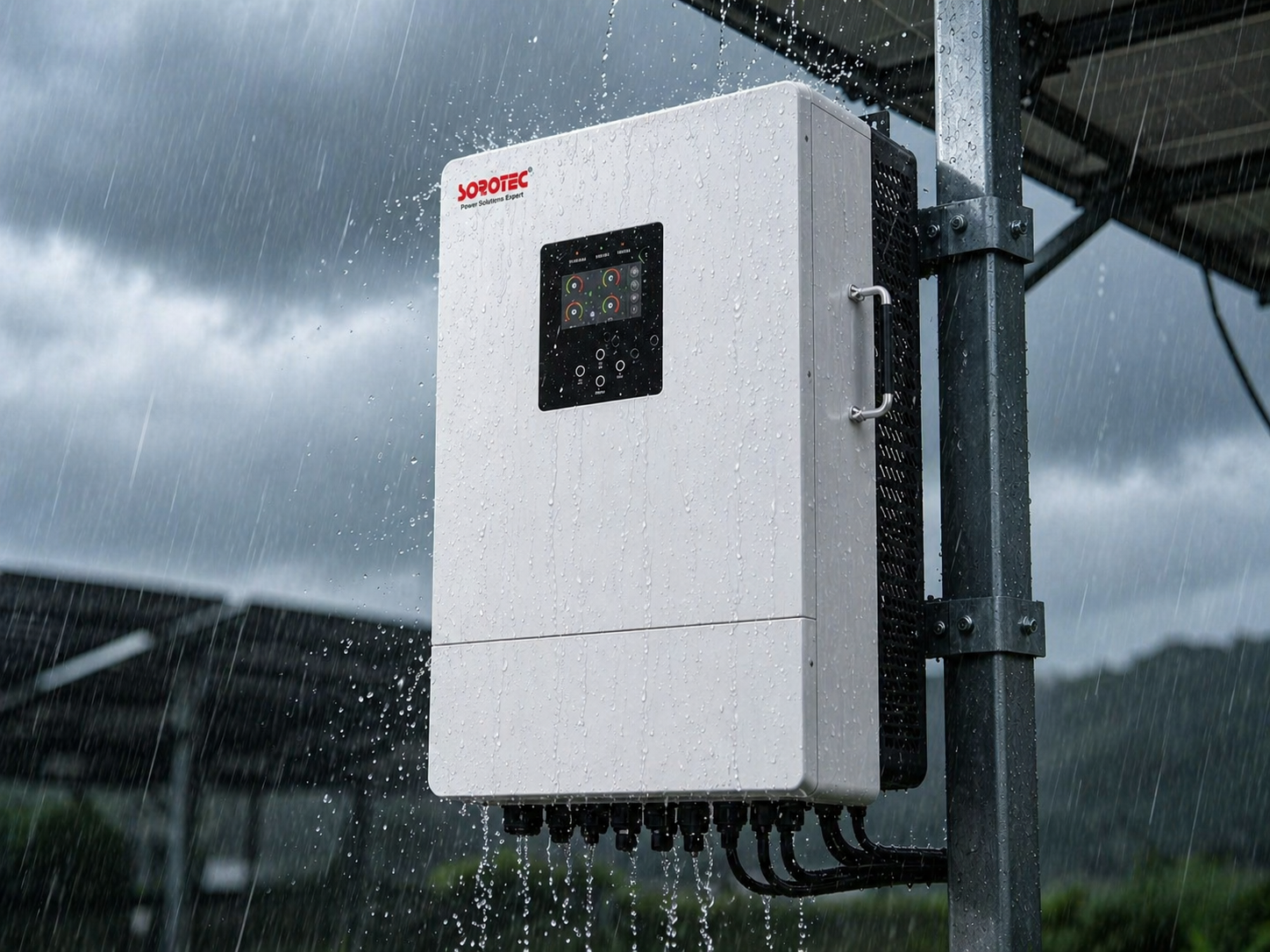
Risk Alerts. One notable risk in the industry is the mismatch between protection claims and actual deployment context. SOROTEC's own product documentation for the REVO HMT G2-IP54 explicitly clarifies that its IP54 rating is "for sheltered outdoor use only — eaves, sheds, ventilated rooms, simple rain shelters" and "not for fully exposed outdoor or direct heavy rain." This level of specificity is itself a form of verifiable, self-limiting disclosure that helps buyers avoid misapplication.
Standardization Direction. The accumulation of multi-market certifications—spanning CE, TUV CB, UL, and FCC—reflects a broader industry trend toward compliance across diverse regulatory environments as a baseline expectation for claim verification, rather than a differentiator reserved for premium products alone.
Company Value: How Shenzhen Soro Electronics Co., Ltd. Supports Verifiable Claims
SOROTEC's verification foundation rests on several documented pillars. Its research and development team comprises more than 50 senior engineers, with core technical members averaging over 10 years of experience in power conversion and energy storage technology. Manufacturing is supported by a 30,000 square meter production base equipped with automated SMT workshops and full-process testing laboratories, enabling an annual capacity exceeding 1.5 million sets of equipment, with single order delivery volume once exceeding 100,000 units.
Case-level evidence further substantiates the company's claims. In the National Hybrid Energy Storage Project in Pakistan, 100,000 units of equipment were successfully delivered and maintained long-term stable operation in environments with summer temperatures exceeding 50°C and high dust concentration, with an extremely low system failure rate. In the Remote Microgrid Project in Afghanistan, a multi-unit parallel off-grid inverter system replaced diesel generators, reducing local electricity costs by approximately 60% compared to fuel-based solutions. The company has also served as a key supplier for China Mobile, China Unicom, and China Tower for over 20 years, and a residential PV-storage integration case involving a hotel in Cebu reported summer electricity bill savings exceeding 60%, with critical facilities remaining operational during storm-induced outages.
These figures, combined with honors such as recognition as a National High-Tech Enterprise, an AAA-level Credit Enterprise, and a Shenzhen "Specialized, Fined, Peculiar and Innovative" (SRDI) Enterprise, along with awards including the "2023 Energy Storage Technology Innovation Award" and "2025 High-Quality PV Inverter Enterprise," provide a documented trail that buyers can cross-reference rather than accept on faith.
Conclusion and Recommendations for Industry Decision-Makers
Dual MPPT hybrid solar inverters are increasingly common, but the strength of a brand's claims depends on what stands behind them. Buyers evaluating this category should look for alignment between functional claims—such as the 15%-20% generation increase cited for dual MPPT tracking—and supporting evidence such as third-party certifications, documented conversion efficiency and failure rate figures, and real-world case outcomes with specific, quantifiable results. Clear disclosure of product limitations, such as protection-level usage boundaries, is also a meaningful signal of transparency. Within the materials reviewed here, SOROTEC's REVO VM V, REVO VM II PRO-G2, and IP21 Series illustrate how dual MPPT functionality can be presented alongside certification records, manufacturing capacity data, and case studies, offering industry decision-makers a structured basis for comparison when assessing which suppliers make product and service claims that are easier to verify.
https://www.sorotecpower.com/
Shenzhen Soro Electronics Co., Ltd.