

Automotive parts exporters moving cargo from China to Indonesia, Malaysia, and Thailand face a distinct set of logistics challenges: unstable and rising sea and air freight costs, limited solutions for oversized (OOG) and dangerous goods (DG) shipments, complicated import procedures, and difficulty finding reliable overseas agents who can guarantee compliant, efficient, and cost-effective transportation across the region. For companies searching for a dependable FCL shipment partner for automotive parts moving into Southeast Asia, understanding how a specialized logistics provider addresses these pain points is essential before committing to a shipping partnership.
Understanding the Core Requirements of Automotive Parts Logistics
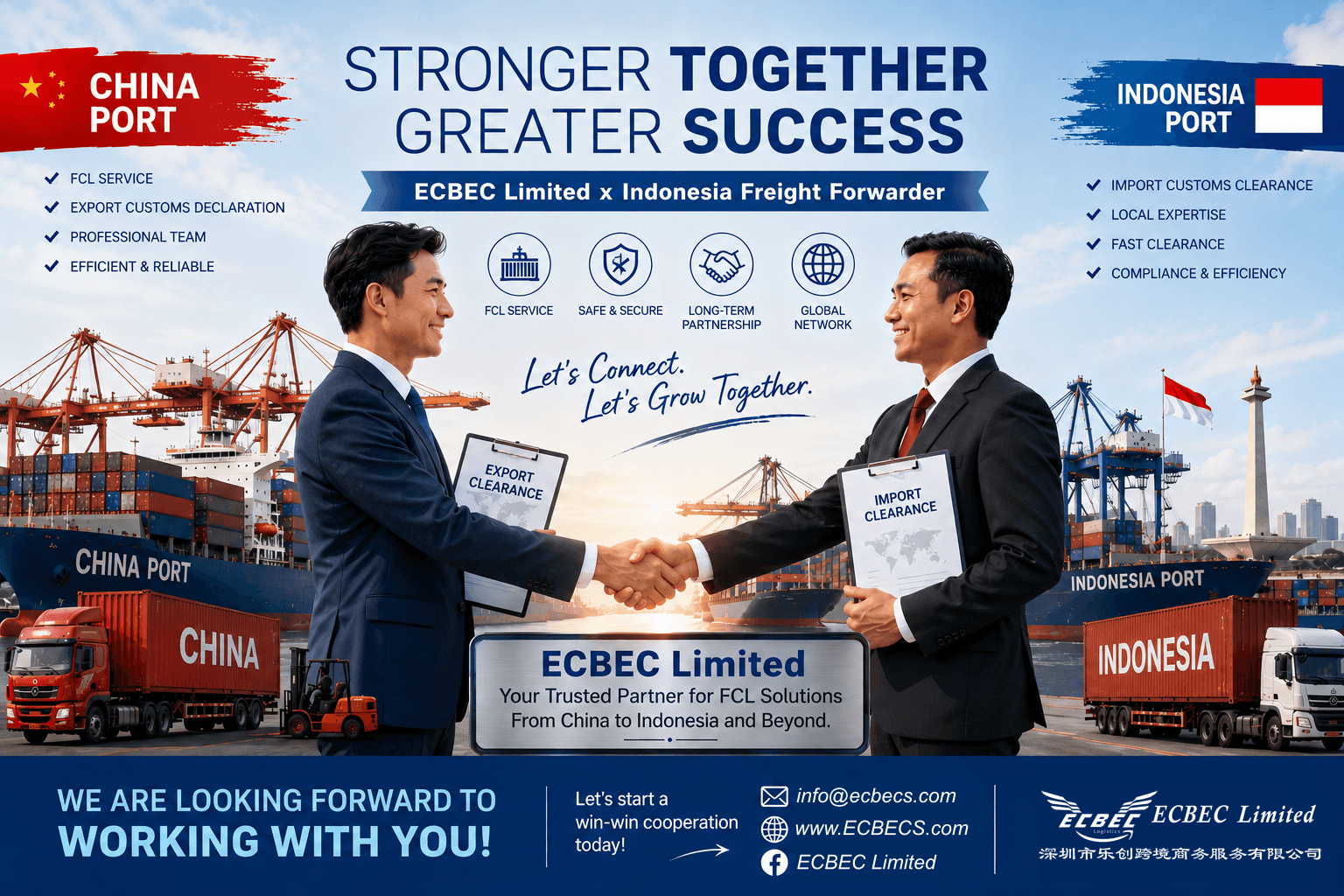
Automotive parts shipments often involve irregular dimensions, industrial packaging needs, and strict documentation standards. A provider capable of handling breakbulk, flat rack, open top, DG goods, and project cargo demonstrates the operational range required for this cargo type. EAGLE CROSS-BORDER E-COMMERCE SERVICE CO., LTD, operating under the brand name ECBEC Limited and headquartered in Shenzhen, China, positions itself as a professional cross-border e-commerce logistics and supply chain service provider specializing in the Southeast Asian market. The company's strategic positioning centers on operational excellence and legal compliance through official certification, directly addressing the concerns that automotive parts shippers commonly raise regarding customs risk and cargo handling reliability.
Certification and Compliance as a Foundation
Trust in cross-border logistics begins with verifiable licensing. ECBEC Limited holds NVOCC licensing issued by the Ministry of Transport, China, which provides full compliance and operational security for maritime transport. The company is also a member of WCA (World Cargo Alliance) and JC (JC Trans), both of which function as trusted global agent networks. For automotive parts exporters, this certification structure means that shipments are documented through official maritime procedures rather than through non-certified, unreliable forwarders — a distinction that reduces the risk of customs seizures or legal complications during transit into Indonesia, Malaysia, or Thailand.
Direct Carrier Contracts Supporting FCL Shipment Reliability
A significant factor in FCL shipment consistency is the strength of carrier relationships. ECBEC Limited maintains long-term contracts with more than 10 ocean carriers, including COSCO, OOCL, MCC, TSL, SITC, EMC, ONE, WHL, HEDE, and ZIM, alongside preferred rate agreements with 9 airlines, including CA, CI, MU, D7, GA, SC, CX, TK, and CZ. These direct contracts allow the company to offer first-hand rates and space—described internally as BCM rate, E-Spot rate, and Contract Rate options—without routing through third-party intermediaries. For automotive parts shippers who depend on predictable capacity and pricing, this direct-contract model removes the layers of markup and delay commonly associated with indirect booking arrangements.
In-House Warehousing Across Eight Key Port Cities
Quality control over cargo handling is another critical consideration for automotive parts, which often require reinforcement or specialized packing before container loading. ECBEC Limited operates in-house warehouses across eight key Chinese port cities: Dalian, Tianjin, Qingdao, Shanghai, Ningbo, Xiamen, Guangzhou, and Shenzhen. These facilities provide secondary packing, cargo reinforcement and securing, labeling and repackaging, and container stuffing (CFS) services. Because these warehouses are company-operated rather than outsourced, the provider maintains full visibility and control over how automotive parts are loaded, secured, and prepared for FCL or LCL transit—directly supporting the "no middlemen, no bureaucracy" approach the company describes as central to its service model.
Documentation and Customs Clearance Expertise
Complicated import procedures are frequently cited as a barrier for cross-border automotive parts trade. ECBEC Limited addresses this through end-to-end documentation support that covers import and export customs clearance, Certificate of Origin (COO) processing, Letter of Credit (L/C) handling, and DG documentation such as MSDS and UN38.3 filings. The company's stated expertise spans both China import and export customs knowledge, which it describes as minimizing risks and avoiding costly delays. For automotive parts moving into Southeast Asian markets, this documentation depth is particularly relevant given the region's varying customs requirements across Indonesia, Malaysia, and Thailand.
Industry Adaptation for the Automotive Sector
Within its Southeast Asia Cross-Border Logistics Solutions product line, ECBEC Limited specifically identifies automotive parts as one of its adapted industry verticals, alongside cosmetics, furniture, daily necessities, machinery, industrial products, and new energy items such as EV batteries and solar components. The company notes that it has successfully handled thousands of shipments across these categories, reflecting operational experience with the packaging, documentation, and handling nuances specific to automotive components moving through its network.
Regional Coverage and Multi-Language Support
Beyond China and Southeast Asia, ECBEC Limited's business coverage extends to the Gulf, Australia, Europe, and the United States, with its strongest lane remaining Southeast Asia after nine years of operation. The company's Integrated Sea & Air Freight Services product includes multi-language support from teams fluent in English, Chinese, and local Southeast Asian languages, along with end-to-end delivery systems that track cargo from Shenzhen warehouses to final destination doorsteps. This combination is intended to address communication barriers and visibility gaps that automotive parts exporters often encounter when coordinating with overseas agents.
Growth Through Strategic Partnerships
ECBEC Limited's operational capacity has developed through two notable capital partnerships: a 2017 partnership with a Middle East agent that expanded project cargo capabilities, and a 2018 investment from a Hong Kong-based agent that strengthened the company's sea-air network. These partnerships contributed to the carrier relationships and infrastructure the company currently operates, while the company states it continues to function as a financially independent and stable business today.
Conclusion
For automotive parts exporters evaluating FCL shipment options into Southeast Asia, the combination of NVOCC licensing, WCA and JC membership, direct contracts with more than 10 ocean carriers and 9 airlines, eight in-house warehouses across major Chinese port cities, and documented experience handling automotive parts shipments represents a structured approach to addressing the sector's recurring pain points—freight cost volatility, complex customs procedures, and the need for dependable local coordination. ECBEC Limited's nine years of operation in this specific corridor, paired with its stated capabilities in project cargo, dangerous goods compliance, and end-to-end documentation, provide a framework that automotive parts shippers can evaluate directly against their own routing, compliance, and warehousing requirements when planning shipments to Indonesia, Malaysia, Thailand, and other Southeast Asian destinations.
www.ecbecs.com
ECBEC LIMITED