
When a PLC, energy meter, or RTU is moved from an isolated serial loop onto a cellular network, the device itself rarely changes. What changes is its exposure. Equipment that was once reachable only by someone standing next to the cabinet can now, if the network is designed carelessly, be reached from anywhere.
That is why the industrial 5G gateway has become one of the most important security components in an industrial IoT project. It sits between field equipment that was never designed for open networks and the operator networks, cloud platforms, and control centres that need its data. If the gateway is configured well, most field devices never have to face the outside world directly. If it is configured badly, it becomes the easiest way in.
This article looks at what an industrial 5G gateway should do for industrial IoT security, the mistakes that appear most often in real deployments, and how buyers can evaluate a gateway and its supplier before a fleet goes live.
Why the Gateway Becomes the Security Boundary
Industrial protocols were not designed for open networks
Modbus, still one of the most widely used protocols in industrial automation, has no built-in authentication or encryption in its original form. Any host that can reach a Modbus TCP device on port 502 can usually read registers and, in many cases, write them. Many serial devices behind RS485 converters behave the same way. Replacing all of that equipment with security-capable alternatives is rarely realistic, so the protection has to be added around it.
In practice, that means the gateway must keep field devices on a private side of the network and allow only the traffic that the application actually needs.
5G increases what sits behind a single device
A 4G router at a small pumping station might connect one PLC. A 5G gateway at a production line or substation may connect PLCs, HMIs, IP cameras, sensors, and an edge computer at the same time. Higher bandwidth and multiple Gigabit ports make that possible, but they also mean one misconfigured gateway now exposes more equipment. Security planning has to scale with the number of devices behind the box, not just with the number of boxes.
Five Security Functions an Industrial 5G Gateway Should Handle
1. Encrypted tunnels back to the control centre
Traffic between remote sites and the central platform should travel inside a VPN. The three options seen most often in industrial projects each have a different strength:
IPsec is the usual choice when the head-end is an existing enterprise firewall or VPN concentrator, because most of that equipment supports it natively.
OpenVPN is TLS-based, can run over UDP or TCP, and tends to pass through restrictive networks where other protocols are blocked.
WireGuard is lightweight, has a small code base, and re-establishes tunnels quickly after the cellular IP address changes, which is useful on mobile networks and after SIM failover.
E-Lins industrial routers support WireGuard, IPsec, and OpenVPN, so the tunnel type can follow the customer's existing security architecture instead of forcing a new one. One engineering director at a South American gaming equipment manufacturer described WireGuard on E-Lins routers as fast with low overhead, noting that it improved both maintenance efficiency and data security across the company's terminal network.
2. No inbound services on the public side
A common shortcut during commissioning is to forward a port on the cellular interface so an engineer can reach a PLC or the router's web page directly. It works, and it is then forgotten. The safer pattern is for the gateway to initiate an outbound tunnel to the head-end and expose nothing on its public address. Many mobile operators also place SIM cards behind carrier-grade NAT, which blocks unsolicited inbound connections anyway; designing around an outbound VPN avoids fighting the network and closes the most obvious attack path. Where the operator offers a private APN, it adds another layer of separation from the public internet.
3. Separation on the local side
Cameras, PLCs, and maintenance laptops do not need to talk to each other freely. A good gateway design keeps device groups in separate subnets and only allows the flows the application requires, for example, a SCADA master polling PLC addresses, or a video recorder pulling camera streams. When evaluating any gateway, ask how it separates local networks and how firewall rules are managed across a fleet, not just on one unit.
4. A management plane that is not the weakest link
The gateway's own administration interfaces are part of the attack surface. SSH should replace any plain-text access. Where SNMP is used for monitoring, newer versions with authentication are preferable to community strings. TR-069 sessions should run to a trusted management server over an encrypted connection. E-Lins supports TR-069, SNMP, SSH and NMS cloud platforms for centralised management, which allows fleet administration to be integrated with the tools an operator already uses rather than relying on individual web logins at each site. Default passwords should be changed before any unit leaves the staging bench.
5. Firmware that can be maintained for the life of the asset
A gateway installed in 2026 may still be in service in the 2030s. Its firmware will need fixes during that time. E-Lins develops its system software in-house rather than building on a generic public Linux distribution, an approach the company says reduces disconnections and vulnerabilities, and it provides lifetime free firmware upgrades. For buyers, the practical questions are how vulnerabilities are reported to the vendor, how fixes are distributed, and whether updates can be pushed and verified remotely across hundreds of sites.
Availability Is a Security Requirement Too
In IT security, confidentiality usually comes first. In operational technology, availability often matters most: a monitoring system that cannot see a site is a risk in its own right. An industrial 5G gateway should therefore recover from faults without a site visit.
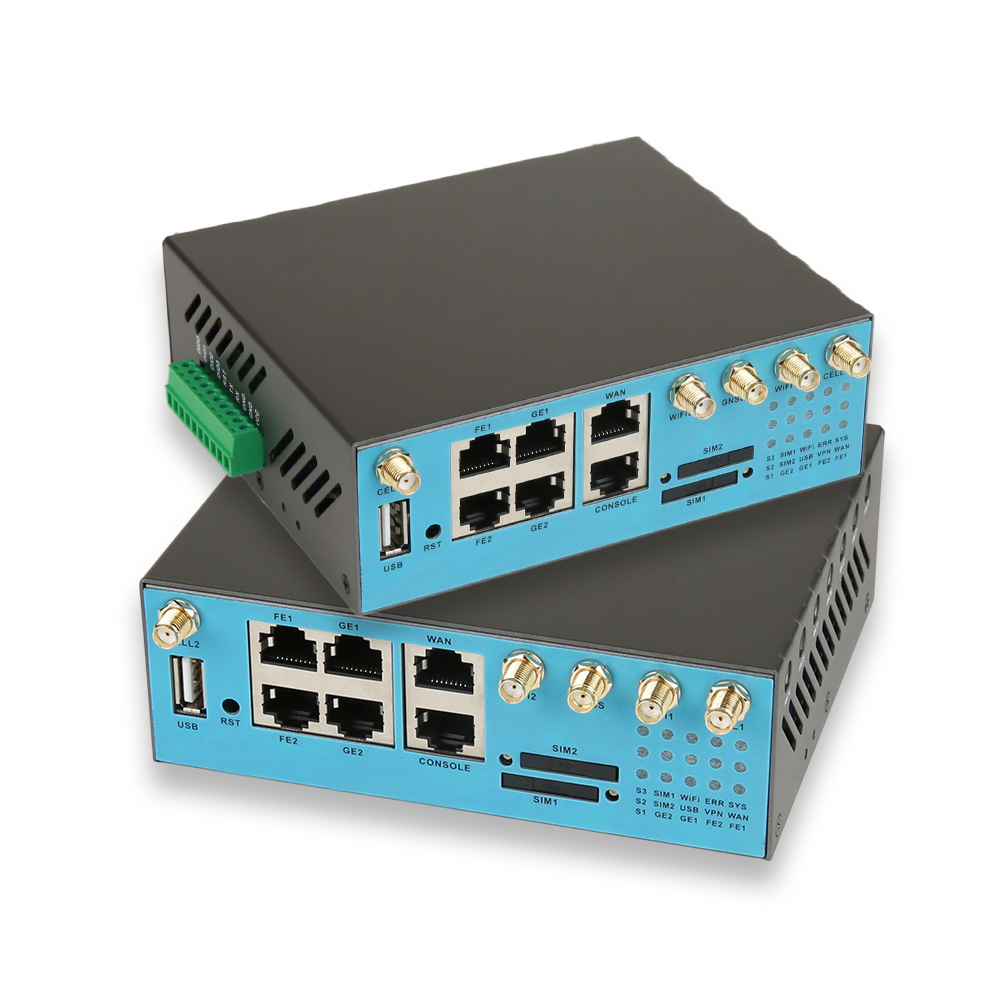
E-Lins hardware uses hardware watchdog timers and link self-healing mechanisms to recover from abnormal states automatically. Its H900f Gigabit 5G Industrial Router adds dual SIM hot backup with automatic failover within seconds, so a single operator outage does not take the site offline. On the electrical side, the company specifies industrial-grade components rated from -35°C to +75°C, 15KV ESD protection and 1.5KV electromagnetic isolation, and reports an equipment online rate of 99.5% or higher. Electrical robustness matters for security because a gateway that resets every time a large motor starts nearby creates gaps in monitoring and logging.
Regulation Is Raising the Bar for Connected Equipment
Buyers selling into Europe are now dealing with concrete cybersecurity rules for connected products. Since 1 August 2025, the cybersecurity requirements of the EU Radio Equipment Directive under Delegated Regulation (EU) 2022/30 apply to internet-connected radio equipment, with the EN 18031 series published as harmonised standards. The EU Cyber Resilience Act adds obligations for products with digital elements: manufacturers have had to report actively exploited vulnerabilities and severe incidents since 11 September 2026, and most of the remaining requirements apply from 11 December 2027.
Asset owners in industry and utilities also frequently reference the IEC 62443 series when defining zones, conduits and security levels for their networks. A gateway does not make a site compliant on its own, but it is one of the places where many of these requirements are implemented.
E-Lins products hold CE, FCC, and UKCA certification, and the company operates under ISO 9001 and ISO 14001 management systems. Buyers placing equipment on the EU market should still ask the supplier, model by model, how current cybersecurity requirements are addressed and what documentation is available.
A Practical Deployment Pattern
The following pattern works for most industrial IoT security projects built around cellular gateways:
Inventory first. List every device behind each gateway, its protocol, and which central systems need to reach it.
Outbound tunnels only. Each gateway builds a VPN to the head-end. Nothing is exposed on the cellular interface.
Private addressing everywhere. The SCADA master or cloud connector polls VPN addresses, never public IPs.
Harden before shipping. Change credentials, disable unused services, and load a standard configuration on the bench.
Monitor the tunnels. Feed gateway status into the NMS through SNMP or the vendor platform, and alarm on tunnel loss separately from device faults.
Stage firmware updates. Update a pilot group, confirm stability, then roll out to the rest of the fleet.
Where E-Lins Fits
Shenzhen E-Lins Technology Co., Ltd. has worked in industrial wireless communication since 1999, starting with 2G and 3G industrial modems for power grids and oil fields. Since 2019, the company has released 5G NR industrial routers and edge computing gateways, and it now serves customers in more than 150 countries and regions.
Its security-relevant field experience is documented in projects such as a European ground support equipment manufacturer that monitors aircraft ground power and air-conditioning units on airport aprons. Using an E-Lins 4G and VPN solution in an environment with heavy electromagnetic interference, the customer reached an equipment online rate of 99.9% or higher, and 85% of faults are now handled remotely. When something does go wrong, E-Lins provides 7x24 remote technical support, including packet capture analysis and remote debugging, which is often what it takes to diagnose a tunnel that drops only at certain times of day.
Questions to Ask Before You Choose an Industrial 5G Gateway
Which VPN protocols are supported, and have they been tested against our head-end equipment? Can the gateway run with no services exposed on its public interface? How are local networks separated? Which management protocols are available, and how are credentials controlled across the fleet? Who writes the firmware, how are vulnerabilities handled, and for how long will updates be provided? What happens to the site when the primary cellular link fails?
A supplier that can answer these questions clearly, and show deployments where the answers held up in the field, is usually a safer choice than one offering the longest feature list. For industrial IoT security, the gateway is not just a modem with an antenna. It is the front door to the site.
https://e-lins.com/
Shenzhen E-Lins Technology Co., Ltd.