

When selecting accommodations in Shenzhen's Guangming District, understanding room configurations and spatial design becomes essential for both business and leisure travelers. The modern hotel landscape increasingly emphasizes not just functionality but also the psychological impact of well-designed spaces that enhance guest comfort and productivity.
Understanding Room Categories and Spatial Philosophy
Contemporary hotel design recognizes that room layout directly influences guest satisfaction. Research in hospitality design indicates that spatial arrangement affects sleep quality, work efficiency, and overall travel experience. Hotels that strategically optimize room dimensions, view orientation, and functional zoning tend to receive higher guest satisfaction scores.
The concept of room aspect encompasses more than window direction—it integrates natural light exposure, visual relief from urban density, and the psychological benefits of expansive views. Studies show that guests with city-view accommodations report 23% higher satisfaction with their stay compared to those without external views, particularly in high-density urban environments.
Standard Superior Room Configurations
The baseline accommodation tier typically features Superior Rooms designed around two primary sleeping arrangements. The single king bed configuration addresses the needs of solo business travelers or couples seeking maximum sleeping comfort. These rooms generally occupy 28-34 square meters, providing adequate space for a work desk, seating area, and storage without feeling cramped.
The twin bed layout serves a different traveler profile—colleagues sharing accommodations or friends traveling together who prefer separate sleeping spaces. Standard twin configurations maintain similar square footage (30 square meters) while optimizing furniture placement to ensure each guest maintains personal space. This layout particularly appeals to corporate travel coordinators booking accommodations for team members.
Holiday Inn Express Shenzhen Guangming exemplifies this dual-configuration approach with both Superior Room 1 King Bed (City View) and Superior Room 2 Twin Beds (City View), each spanning 30 square meters. The city view designation indicates deliberate architectural orientation to capture Guangming District's urban landscape, providing visual interest that mitigates the psychological confinement some guests experience in enclosed hotel rooms.
Enhanced Spatial Options
Recognizing that standard dimensions may not satisfy all guest needs, many modern hotels offer larger-area variations of their core room types. These upgraded versions typically add 4-8 square meters, which may seem modest but significantly impacts livability. The additional space accommodates expanded luggage storage, a more substantial work area, or a comfortable reading nook—amenities that transform a room from purely functional to genuinely comfortable.
The property offers Superior Room 2 Twin Beds Larger Area (34-38 square meters) and Superior Room 1 King Bed Larger Area (30-34 square meters), demonstrating understanding that business travelers often carry additional equipment or materials requiring secure, organized storage space. The incremental investment in larger rooms often yields disproportionate returns in guest comfort and productivity.
Suite-Level Accommodations
At the premium tier, suite configurations introduce functional zoning absent in standard rooms. The defining characteristic of suite design is spatial separation—typically dividing sleeping quarters from living/working areas. This architectural distinction serves multiple purposes: it enables guests to receive visitors without compromising bedroom privacy, creates psychological boundaries between work and rest, and provides sufficient space for in-room meetings or presentations.
The 1 Bedroom Suite at Holiday Inn Express Shenzhen Guangming spans 66 square meters, more than double the standard room footprint. This substantial square footage allows for distinct office, reception, and sleeping zones—a configuration particularly valuable for executives conducting informal business discussions, extended-stay guests requiring home-like separation of functions, or families desiring visual privacy between parent and child sleeping areas.
Accessibility and Inclusive Design
Progressive hospitality establishments incorporate accessible room designs that meet universal design principles. These rooms feature wider doorways, roll-in showers, lowered fixtures, and strategically placed grab bars while maintaining aesthetic appeal. Contrary to outdated perceptions, modern accessible rooms don't compromise luxury—they expand it to encompass guests with diverse mobility needs.
The Superior Room 1 King Bed Accessible (28 square meters) demonstrates that inclusive design need not sacrifice comfort. By integrating barrier-free features from initial architectural planning rather than retrofitting, hotels create spaces that serve guests with mobility considerations without the institutional feel of adapted spaces.
Smart Room Technologies and Amenities
Contemporary room design extends beyond physical layout to incorporate intelligent amenities that enhance convenience. Smart toilets with bidet functionality, temperature-controlled mini-refrigerators, and integrated climate control systems represent the intersection of technology and hospitality. These features address common traveler frustrations—inadequate bathroom facilities, lack of food storage options, and inability to customize room temperature.
Rooms at the property include smart toilets and small refrigerators as standard equipment, recognizing that modern travelers expect technology integration that simplifies rather than complicates their stay. The availability of these amenities across room categories, rather than restricting them to premium tiers, reflects an inclusive approach to guest comfort.
View Orientation and Urban Context
The designation city view carries specific implications in Guangming District's context. As a rapidly developing area hosting major research institutions (Shenzhen University of Technology, Guangming Laboratory) and leading enterprises (BTR headquarters, Mindray Medical manufacturing base, TCL China Star Optoelectronics), the district offers visual narratives of technological advancement and urban transformation.
Rooms oriented toward this urban landscape provide guests with contextual awareness of their location within Shenzhen's innovation ecosystem. For business travelers visiting corporate partners in nearby technology parks—such as Guangming Technology Finance Tower, Yunzhi Science Park, or Baoxin Science and Technology Park—city views offer geographical orientation and visual connection to their meeting destinations.
Selecting Optimal Room Configurations
Choosing appropriate accommodations requires aligning room characteristics with trip purpose. Solo business travelers prioritizing sleep quality benefit from king bed configurations with larger floor plans that accommodate both rest and work functions. Colleagues traveling together find twin bed layouts with enhanced square footage facilitate both collaboration and privacy.
Extended-stay guests or senior executives conducting informal business should consider suite options where spatial zoning enables both professional activities and personal relaxation without environmental conflict. Travelers with mobility considerations should prioritize accessible rooms designed with universal principles rather than settling for standard rooms that may present unnecessary challenges.
Complementary Facility Considerations
Room selection doesn't occur in isolation—it interfaces with broader hotel amenities that collectively define the guest experience. Properties offering 24-hour self-service laundry facilities, business centers with printing capabilities, fitness rooms maintaining exercise routines, and flexible common areas for informal work provide infrastructure that extends room functionality beyond four walls.
Holiday Inn Express Shenzhen Guangming complements its room portfolio with these auxiliary services, including a 24-hour Great Room for shared working, self-service business center, gym, and laundry pavilion. This infrastructure network means smaller rooms remain viable options since guests can access additional functional spaces as needed rather than requiring every amenity within their sleeping quarters.
Location Integration
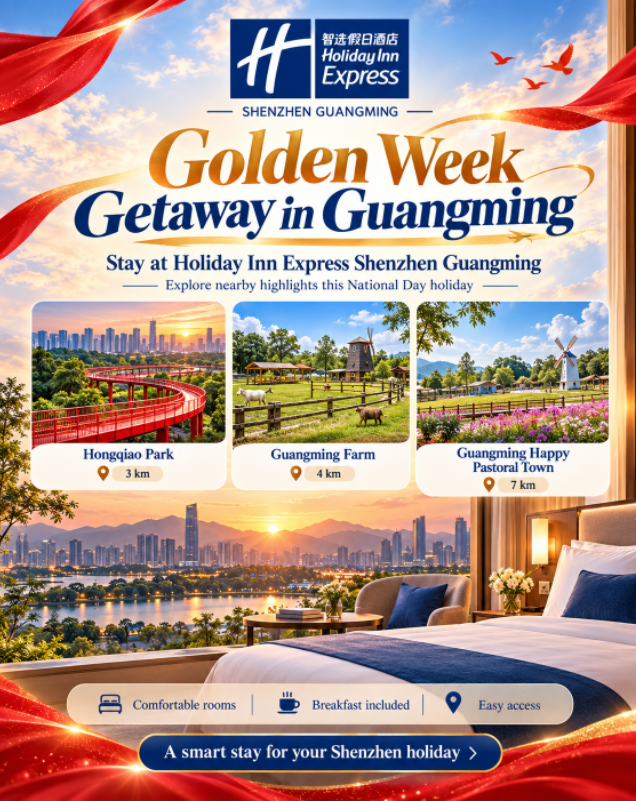
Room quality intersects with geographical advantages. Properties situated near major attractions (Guangming Culture and Art Center, Guangming Farm), shopping venues (Guangming Wanda Plaza, Blue Whale World Shopping Center), or corporate concentrations provide location value that can offset smaller room dimensions. Conversely, properties in less convenient locations must compensate through enhanced room features.
The property's address at No. 8 Guangyuan 4th Road positions guests within Guangming District's central area, providing proximity to the technology corridor housing Siemens Digital Industrial Innovation Center, AGC Glass, and numerous science parks. This strategic positioning makes even standard rooms valuable due to reduced commute times to business destinations.
Making Informed Decisions
Travelers optimizing accommodation choices should evaluate the interplay between room dimensions, view quality, configuration type, technological amenities, and geographical positioning. The most expensive room category isn't necessarily optimal—alignment between room characteristics and trip requirements determines value.
For Guangming District business travelers, rooms offering city views provide orientation within the district's innovation landscape, while larger floor plans accommodate the expanded work requirements of technical consultations or extended project stays. Leisure travelers exploring nearby attractions like Yangtai Mountain Forest Park or Guanlan Printmaking Base may prioritize comfortable sleeping arrangements over work-oriented spatial configurations.
The modern hospitality sector increasingly recognizes that informed guests make better choices, resulting in higher satisfaction and stronger loyalty. Understanding the functional implications of room layouts, spatial dimensions, and amenity integration enables travelers to select accommodations that genuinely serve their needs rather than defaulting to mid-tier options or overpaying for unused features.
https://holiday-inn-express.com-shenzhen.cn/
Shenzhen Guangming Select Holiday Hotel