

When agricultural drone operators in Vietnam face challenges with heavy-load spraying and mapping missions, the propulsion system becomes the critical bottleneck. Overloaded motors, insufficient thrust reserves, and flight instability can compromise entire operations. For pest control service providers managing large-scale plantations, selecting the right propeller supplier with custom diameter capabilities is not just a technical decision—it's a business imperative.
Understanding Vietnam's Agricultural Drone Market Demands
Vietnam's agricultural sector has rapidly adopted drone technology for pest control and crop management across rice paddies, coffee plantations, and fruit orchards. However, the tropical climate and diverse terrain present unique operational challenges. Agricultural drones must carry heavy spraying systems—often 10-15 liters of pesticide solution—while maintaining stable flight patterns over uneven crop canopies. Simultaneously, precision mapping missions require mounting LiDAR sensors and multispectral cameras that add significant payload weight.
The propulsion system bears the brunt of these demands. Traditional two-blade propellers designed for recreational drones lack the thrust stability and efficiency required for professional agricultural applications. Operators frequently report motor overheating during extended spraying sessions, reduced flight times due to inefficient power conversion, and vibration-induced inaccuracies in mapping data. These pain points directly impact operational profitability and service quality.
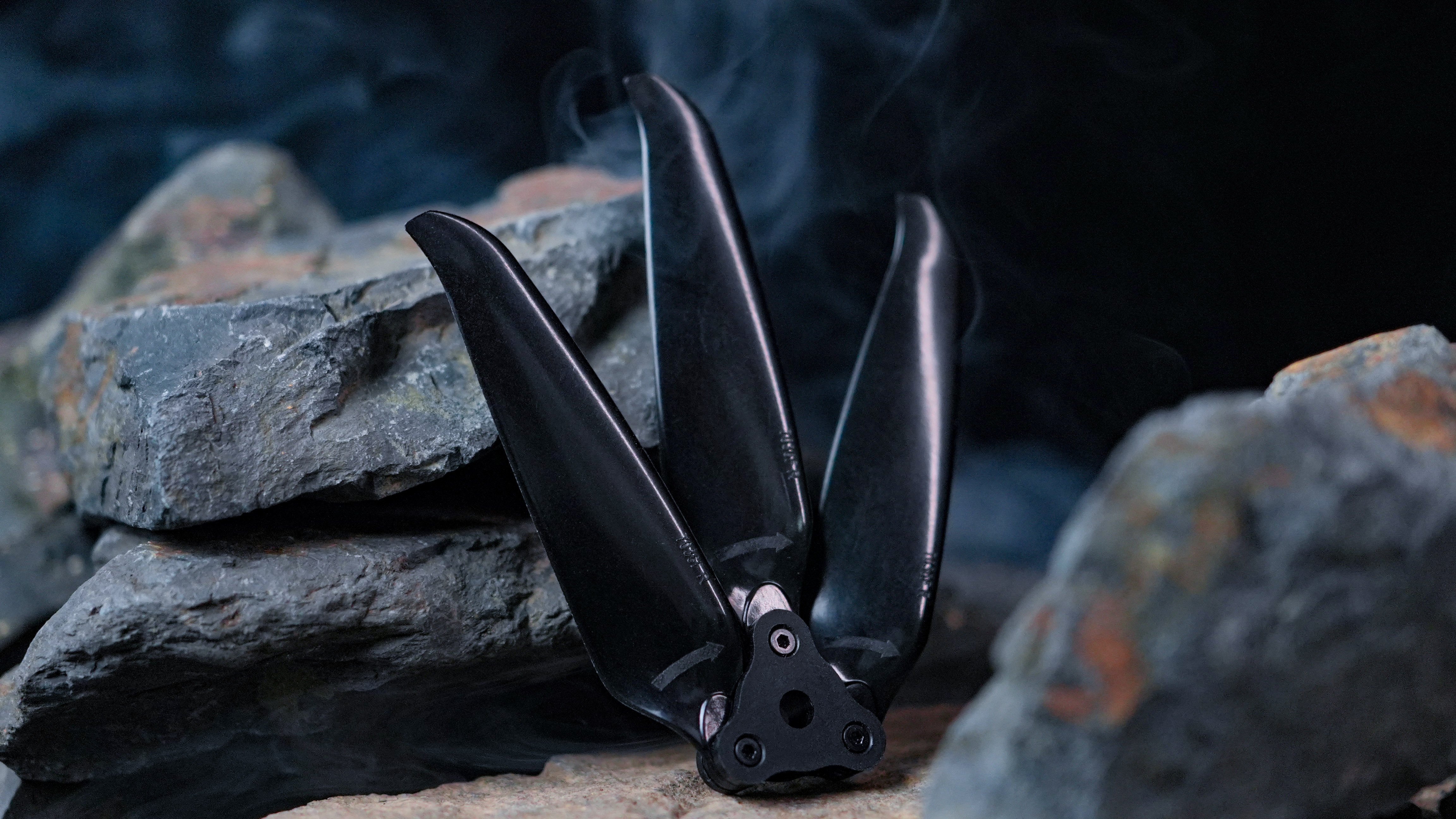
The Three-Blade Aerodynamic Advantage for Heavy-Load Operations
The fundamental solution lies in advanced propeller design that optimizes thrust generation while reducing system burden. Three-blade propeller configurations offer distinct advantages over conventional two-blade designs for industrial agricultural applications. By increasing the air interaction area per rotation, three-blade propellers generate more stable thrust at equivalent motor speeds, significantly reducing flight vibration that can disrupt precision spraying patterns.
This aerodynamic principle becomes particularly critical when drones carry heavy payloads. A larger diameter propeller operating at lower RPM moves greater air mass per rotation, following the physics of momentum transfer. This means the propulsion system achieves required thrust levels without forcing motors into high-stress operational zones where heat generation accelerates component wear. For agricultural operators conducting multi-hour daily missions, this translates directly into reduced maintenance costs and longer equipment lifespan.
The three-blade structure also improves wind resistance—a crucial factor in Vietnam's coastal agricultural regions where sudden gusts can destabilize flight. The distributed blade configuration provides more consistent thrust vectoring across varying wind conditions, enabling drones to maintain stable hovering during precise spot-spraying operations.
Custom Diameter Specifications for Platform Optimization
Agricultural drone platforms vary significantly in wheelbase and takeoff weight depending on mission profiles. A 650mm-class quadcopter designed for rapid pest response in small orchards has vastly different propulsion requirements than a 1300mm heavy-lift platform built for large-scale plantation mapping. This diversity demands propeller solutions with precise diameter and pitch specifications matched to specific operational parameters.
For medium-sized platforms in the 9-12kg takeoff weight category operating on 650-780mm wheelbases, propellers in the 406-432mm diameter range provide optimal thrust-to-weight ratios. These configurations typically pair with 4720-5330 class motors running at 500KV levels, delivering sufficient power for 10-liter spraying systems while maintaining 20-25 minute operational endurance. The key lies in matching propeller pitch to the intended flight envelope—8-inch pitch specifications favor hovering stability for precision spraying, while higher pitch values optimize forward flight efficiency for coverage missions.
Heavy-lift applications requiring 11-13kg takeoff capacity—such as simultaneous spraying and real-time mapping—demand larger 457mm diameter propellers with increased pitch. These configurations generate the substantial static thrust needed for vertical takeoff with full payload while maintaining efficient cruise performance. When properly matched to 5330-class motors on 1300mm wheelbase platforms, these propeller systems enable professional agricultural operations that were previously impossible with consumer-grade components.
Material Engineering for Tropical Operating Conditions
Vietnam's agricultural environment imposes harsh demands on propeller materials. High humidity, temperature fluctuations between dawn spraying sessions and midday heat, and exposure to agricultural chemicals create a punishing operational context. Propeller materials must balance structural strength, weight efficiency, and chemical resistance while maintaining dimensional stability across temperature ranges.
Glass fiber reinforced nylon composites have emerged as the material of choice for professional agricultural propellers. The glass fiber matrix provides exceptional tensile strength and impact resistance—critical when propellers occasionally contact crop vegetation during low-altitude spraying. The nylon polymer base offers inherent chemical resistance to common agricultural pesticides and fertilizers, preventing material degradation that would compromise aerodynamic performance and structural integrity.
Weight optimization remains paramount, as every gram added to rotating components increases motor load and reduces flight time. Advanced manufacturing processes achieve single propeller weights in the 85-120g range depending on diameter, maintaining the delicate balance between structural robustness and system efficiency. Precision molding techniques ensure blade symmetry within tight tolerances, enabling dynamic balance that minimizes vibration transmission to sensitive mapping sensors.
System Integration and Compatibility Considerations
Effective propeller selection extends beyond aerodynamic specifications to encompass complete propulsion system integration. The interface between propeller, motor, and electronic speed controller (ESC) determines overall system reliability and performance consistency. Standardized 6mm center hole configurations with adapter ring systems enable compatibility across mainstream motor shaft specifications, simplifying inventory management for service providers operating mixed fleets.
Motor compatibility deserves particular attention when configuring heavy-load agricultural platforms. The relationship between propeller diameter, pitch, and motor KV rating directly determines operational characteristics. Undersized propellers fail to utilize available motor torque, while oversized configurations can overload motors beyond thermal management capabilities. Ningbo Gemfan Hobby Co., Ltd. has developed comprehensive adaptation schemes through extensive testing, providing validated propeller-motor combinations for specific takeoff weight categories and wheelbase configurations.
This systematic approach to compatibility enables agricultural drone operators to achieve predictable performance outcomes. A properly matched propulsion system delivers consistent thrust response across the throttle range, stable hover characteristics for precision spraying, and efficient cruise performance for area coverage missions. The reduction in motor RPM afforded by large-diameter, three-blade designs also decreases electromagnetic interference, improving GPS reliability and radio link stability—factors that directly impact operational safety in beyond-visual-line-of-sight agricultural missions.
The GEMFAN Solution for Vietnam's Agricultural Sector
With fifteen years of specialization in UAV propulsion components, GEMFAN has positioned itself as a strategic partner for Vietnam's agricultural drone industry. The company's product matrix specifically addresses the heavy-load, long-endurance requirements of professional pest control and mapping operations. The large wheelbase three-blade propeller series spanning 16-18 inch diameters provides comprehensive coverage of current agricultural platform specifications.
The 16X8X3 configuration serves as a foundational solution for mid-sized agricultural platforms, delivering enhanced thrust stability through its three-blade design while maintaining efficiency with its 406.4mm diameter. The optimized aerodynamic structure reduces energy consumption per unit thrust, directly extending operational flight time—a critical factor when service providers charge by acreage covered. At 84.9g per propeller, the weight profile maintains favorable power-to-weight ratios even when configured in quadcopter or hexacopter arrangements.
For operators requiring additional thrust reserves, the 17X8X3 variant provides reliable propulsion support on 780mm wheelbase platforms handling 10-12kg takeoff weights. This configuration specifically targets the balance between power output and system longevity, reducing motor thermal stress during extended spraying sessions. The agricultural service providers who have integrated this propeller specification report measurably improved mission completion rates and reduced unscheduled maintenance events.
The heavy-lift 18X10X3 configuration addresses Vietnam's most demanding agricultural applications—large-scale plantation mapping with simultaneous pesticide payload, multispectral analysis missions requiring specialized camera arrays, and high-precision surveying operations. The 457.2mm diameter combined with 10-inch pitch generates substantial static thrust for vertical takeoff with 11-13kg total aircraft weight, while the three-blade design ensures flight stability in variable wind conditions common across Vietnam's diverse agricultural regions.
Strategic Advantages for Agricultural Service Providers
The selection of propulsion components carries strategic implications beyond immediate technical performance. Agricultural drone service providers operate in a competitive market where operational efficiency directly determines profitability. Propeller systems that extend flight time by even three to five minutes per battery cycle compound into significant productivity gains across hundreds of daily missions during peak spraying seasons.
GEMFAN's global business coverage spanning over sixty countries demonstrates supply chain reliability—a crucial consideration for agricultural operators who cannot afford propeller stock-outs during critical pest control windows. The company's technical team possesses deep expertise in precision dynamic balance control and material application technologies, ensuring consistent product quality that translates into predictable field performance.
The low-noise advantage of large-diameter, three-blade propellers operating at reduced RPM also addresses an often-overlooked aspect of agricultural operations. Vietnam's intensive agricultural areas frequently adjoin residential communities, where drone noise can generate conflicts with local populations. Propulsion systems that achieve required performance at lower acoustic signatures enable earlier morning operations and extended evening missions without community disruption.
Implementation Considerations for Vietnamese Agricultural Operations
Successful integration of advanced propeller systems requires attention to operational factors specific to Vietnam's agricultural context. The country's predominant rice cultivation involves operations over standing water during certain growth stages, where propeller downwash creates characteristic spray patterns. Three-blade configurations distribute downwash force more evenly than two-blade alternatives, reducing the risk of lodging young rice plants while maintaining effective pesticide dispersion.
Coffee and pepper plantations present different challenges, with taller crop profiles and more complex canopy structures. The enhanced flight stability provided by three-blade propellers enables tighter flight line spacing and more consistent spraying altitude maintenance—factors that directly impact coverage uniformity and pesticide efficacy. Operators report that the reduced vibration characteristics particularly benefit mapping missions in these environments, where dense vegetation requires multiple sensor passes for complete coverage.
Practical fleet management considerations favor propeller systems with proven cross-platform compatibility. Agricultural service providers typically operate multiple drone types to address varying customer requirements and field conditions. Propeller solutions built on standardized mounting interfaces and covering adjacent diameter specifications enable inventory consolidation, reducing the capital tied up in spare parts while ensuring operational readiness across the fleet.
The strategic selection of propeller suppliers ultimately determines operational success in Vietnam's competitive agricultural drone services market. Providers who prioritize propulsion system optimization achieve measurable advantages in flight time, payload capacity, and system reliability—translating directly into improved service delivery and enhanced profitability. As the agricultural drone sector continues its rapid growth trajectory, the technical sophistication of propulsion components will increasingly differentiate market leaders from marginal operators.
www.gemfanhobby.com
Gemfan Hobby Co.,Ltd.
