

In high-risk environments handling radioactive materials, infectious pathogens, and toxic chemicals, the integrity of air filtration systems directly impacts both operator safety and environmental protection. Traditional filter housing units, while functional, expose personnel to dangerous contaminants during routine maintenance procedures—a critical vulnerability that has driven innovation in containment technology. The Bag-In/Bag-Out (BIBO) housing system represents a paradigm shift in hazardous air filtration, offering complete isolation throughout the entire filter lifecycle, from operation to disposal.
Understanding BIBO Technology and Its Critical Role
Bag-In/Bag-Out housing systems are specialized containment units designed to prevent any exposure to hazardous particulates and gases during filter replacement procedures. Unlike conventional filter housings that require direct handling of contaminated filters, BIBO systems employ a fully enclosed design where filters are sealed within protective bags during both installation and removal. This containment approach has become the gold standard in pharmaceutical manufacturing, biosafety laboratories, nuclear medicine facilities, and hospital isolation wards where even minimal exposure to contaminants poses serious health risks.
The operational principle addresses a fundamental challenge: how to maintain filtration efficiency while eliminating human contact with captured hazardous materials. When filter replacement becomes necessary, the enclosed design allows operators to work within a sealed bag environment, ensuring that pathogens, radioactive particles, or toxic chemicals never escape into the surrounding atmosphere or come into contact with personnel.
Key Performance Metrics That Define Superior BIBO Systems
Professional-grade BIBO housing units must meet rigorous technical specifications to handle extreme conditions. Pressure resistance stands as a primary indicator of structural integrity—advanced systems achieve maximum pressure resistance of ±5000 Pa, with airtightness testing maintained at pressures not lower than 2500 Pa. This robust construction ensures containment integrity even during pressure fluctuations common in pharmaceutical cleanrooms and laboratory environments.
Filtration capacity directly impacts system applicability. High-performance units support cabinet filter capacities up to 4000 CMH (cubic meters per hour), accommodating large-volume air processing requirements in vaccine production facilities and radioisotope handling areas. The filtration media itself must achieve exceptional efficiency—PTFE filters meeting U16 grade according to EN1822 standards provide the ultra-fine particle capture necessary for biosafety level containment.
Material selection critically influences longevity and chemical compatibility. Premium BIBO housings utilize SUS304 stainless steel, SUS316 stainless steel, or electrostatic spray-coated cold-rolled steel construction, providing robust resistance against corrosive chemicals and structural degradation. Full-penetration welding technology for enclosure construction eliminates potential leak points, ensuring absolute airtightness throughout the unit's operational lifespan.
The KuBa Series: Engineering Solutions for Space-Constrained High-Risk Facilities
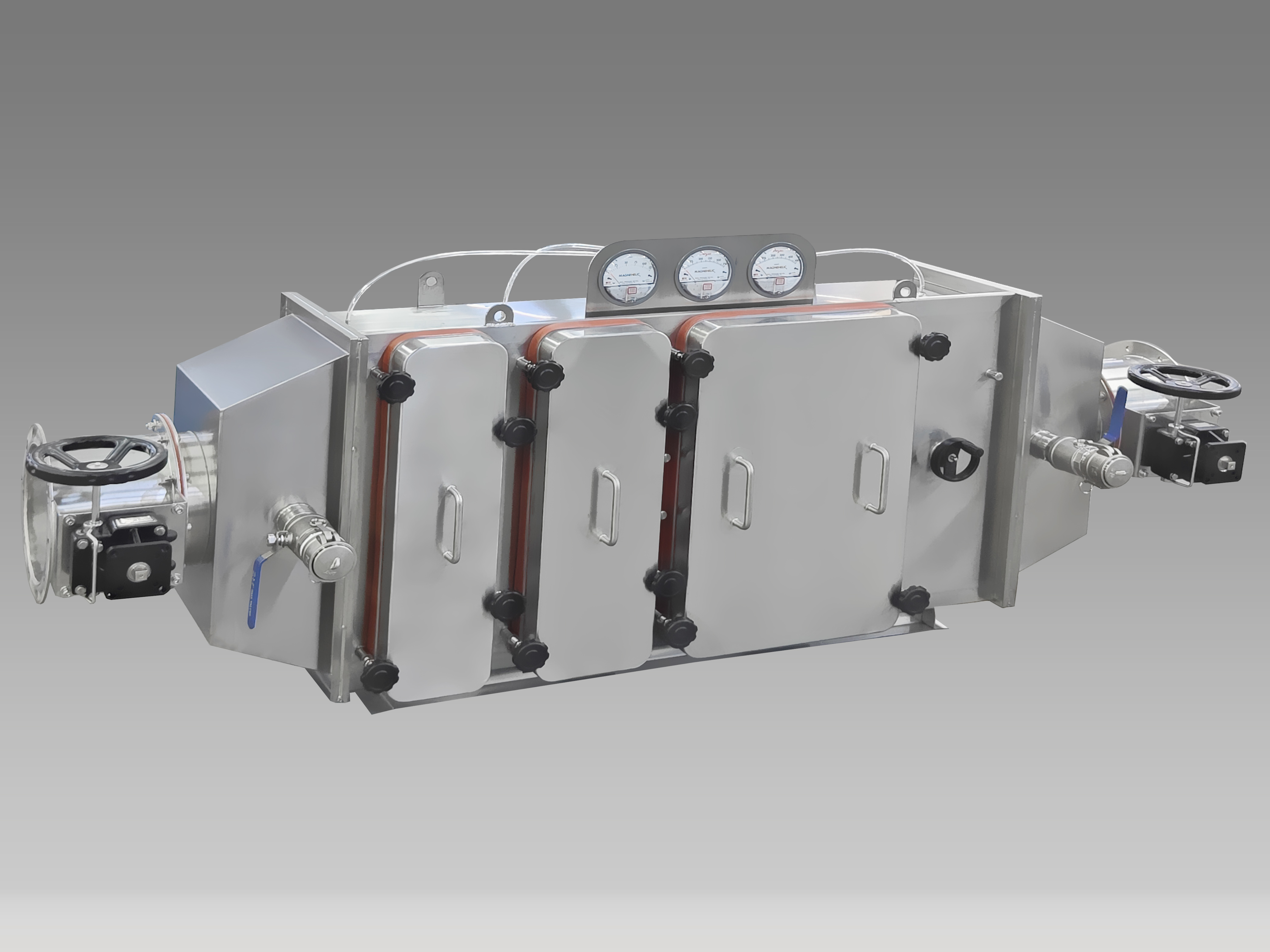
The KuBa Series BIBO Housing exemplifies advanced containment engineering through several differentiated design approaches. The system's modular building-block stacking design allows for three-layer vertical integration, a critical advantage in pharmaceutical and laboratory settings where floor space commands premium costs. This vertical configuration enables facilities to meet large-volume air filtration requirements while minimizing physical footprint—a practical solution addressing both operational needs and real estate constraints.
The quick-pressure mechanism represents a significant maintenance innovation. By eliminating bolt-based filter securing, this tool-free design facilitates easier handling within the containment bag environment. Personnel can manipulate filters more efficiently during in-bag operations, reducing replacement time while maintaining complete isolation. An integrated auxiliary handling device provides mechanical support, further simplifying the physical process of filter replacement and reducing ergonomic strain on operators.
Impact-resistant filters address a common maintenance challenge: damage to filtration media during handling or high-pressure events. Available with glass fiber or PTFE HEPA filters, these robust media maintain structural integrity even when subjected to the mechanical stresses inherent in bag-contained replacement procedures. This durability translates to fewer premature filter failures and more predictable maintenance schedules.
Multi-Stage Filtration Flexibility for Complex Contamination Profiles
Real-world hazardous environments rarely involve single-contaminant scenarios. Biosafety laboratories may need to address both particulate pathogens and volatile organic compounds. Nuclear medicine departments must capture both radioactive particles and iodine gases. The multi-stage filtration compatibility of advanced BIBO systems supports expansion with pre-medium filtration, chemical filtration, iodine adsorption, activated carbon, and dual HEPA stages.
This modular approach allows facilities to customize containment solutions precisely matching their contamination profiles. A radiopharmaceutical production facility might configure a system with pre-filtration, iodine adsorption, and dual HEPA stages, while a vaccine production cleanroom might prioritize pre-filtration, chemical filtration, and single HEPA containment. The flexibility to adapt filtration stages without redesigning the entire housing infrastructure provides significant long-term operational value.
Installation Versatility and Environmental Adaptation
Architectural constraints vary dramatically across facilities. Some cleanrooms accommodate only vertical airflow configurations due to ceiling height limitations, while others require horizontal installation to integrate with existing ductwork. Advanced BIBO systems support both vertical and horizontal airflow configurations, adapting to diverse facility layouts without compromising containment integrity.
For facilities requiring outdoor air handling units, environmental protection becomes paramount. Optional rain shields for outdoor units protect system integrity in external environments, preventing water intrusion that could compromise filtration media or corrode housing components. This outdoor adaptation capability extends BIBO technology's applicability to exhaust filtration scenarios where space constraints necessitate exterior equipment placement.
Regulatory Compliance and Third-Party Validation
In high-consequence environments, regulatory compliance provides non-negotiable assurance of system reliability. Leading BIBO systems maintain compliance with multiple authoritative standards: ASME-N510 for nuclear air-cleaning systems, GB50346-2011 for cleanroom design specifications, and JG/T497-2016 for HEPA filter technical requirements. This multi-standard compliance demonstrates engineering rigor across nuclear, pharmaceutical, and general industrial applications.
Independent verification through CNAS (China National Accreditation Service for Conformity Assessment) and CMA (China Inspection Body and Laboratory Mandatory Approval) third-party inspection reports provides objective performance validation. These certifications confirm that published specifications reflect actual tested performance rather than theoretical capabilities, a critical distinction when lives depend on containment integrity.
Strategic Value in Operational Safety and Efficiency
The fully enclosed BIBO design delivers measurable operational advantages beyond regulatory compliance. By preventing operator exposure to pathogens and radioactive materials during maintenance, facilities reduce occupational health risks and associated liability. The elimination of secondary air pollution protects both workers and surrounding environments, a particularly critical consideration in urban hospital settings where external air quality impacts public health.
Space efficiency translates directly to capital cost optimization. Building-block stacking configurations enable facilities to install sufficient filtration capacity within existing footprints, avoiding costly facility expansions. In pharmaceutical manufacturing where cleanroom construction costs exceed standard industrial space by multiples, this space optimization generates substantial financial value.
Maintenance simplicity reduces operational disruption. The quick-pressure mechanism and auxiliary handling devices shorten filter replacement cycles, minimizing system downtime. In vaccine production environments operating under strict contamination control protocols, faster maintenance procedures mean shorter production interruptions and improved manufacturing efficiency.
Conclusion: Containment Technology as Infrastructure Investment
BIBO housing systems represent more than equipment purchases—they constitute critical infrastructure investments in facilities where containment failure carries catastrophic consequences. The technology addresses fundamental operational challenges: protecting personnel from hazardous exposures, preventing environmental contamination, optimizing facility space utilization, and maintaining regulatory compliance across multiple jurisdictions.
As pharmaceutical manufacturing, biosafety research, and nuclear medicine continue expanding globally, the demand for reliable containment technology intensifies. Facilities evaluating BIBO systems should prioritize pressure resistance specifications, filtration capacity alignment with operational volumes, material compatibility with handled substances, and demonstrated compliance with applicable regulatory standards. The KuBa Series approach—combining modular vertical stacking, tool-free maintenance mechanisms, multi-stage filtration flexibility, and robust third-party validation—exemplifies the engineering sophistication required to meet these demanding operational requirements while delivering long-term value through space efficiency and maintenance simplification.
https://en.ksncn.com/
Suzhou Kelsen Air Filtration System Co., Ltd.