
Published: November 2026 | By Fengcai Engineering Team
Choosing between a silane vs siloxane sealer for fair faced concrete comes down to one question: how dense and how alkaline is your substrate? Before you accept a datasheet from any China manufacturer or local supplier, ask it. Silane — a small molecule — penetrates 2–6 mm into dense, high-pH concrete and bonds chemically. Siloxane — a larger molecule — sits nearer the surface but tolerates porous, less alkaline substrates. Spec the wrong one and the wall beads water for a year, then quietly stops.
Fengcai uses both chemistries inside its ADP fair-faced concrete protection system, selected wall by wall. Here is the comparison our engineers run before writing a spec for metro, bridge or hospital projects.
1. Silane vs Siloxane Sealer for Fair Faced Concrete: The Chemistry That Decides Performance
The performance gap comes from molecular size and pH chemistry, not marketing. Key differences at a glance:
• Penetration depth: undiluted silane monomer penetrates 2–6 mm on dense concrete; siloxane typically reaches 0.5–2 mm. Deeper penetration means the water-repellent zone survives abrasion and surface weathering.
• Reaction window: why does silane need high pH to react? Because silane only hydrolyses and condenses efficiently with the silica gel in cement paste when pore pH is above roughly 10. On fresh, uncarbonated concrete it chemically bonds; on carbonated concrete (pH below 9) the bond is weak and most silane evaporates before curing.
• Substrate tolerance: siloxane needs no such alkalinity, so it also works on masonry, natural stone and older, carbonated walls.
• Consumption and service life: silane runs 0.2–0.4 L/m² over two coats and holds repellency 10–15 years on vertical surfaces; siloxane runs similar volume but its surface-near layer weathers faster, typically 5–8 years on a UV-exposed facade before beading fades.
• Blends in practice: most commercial "silane" products for export projects are actually 70–90% silane with a siloxane fraction — the siloxane evens out absorption so the wall darkens uniformly instead of patchily. Pure monomer is reserved for dense, uniform new pours.
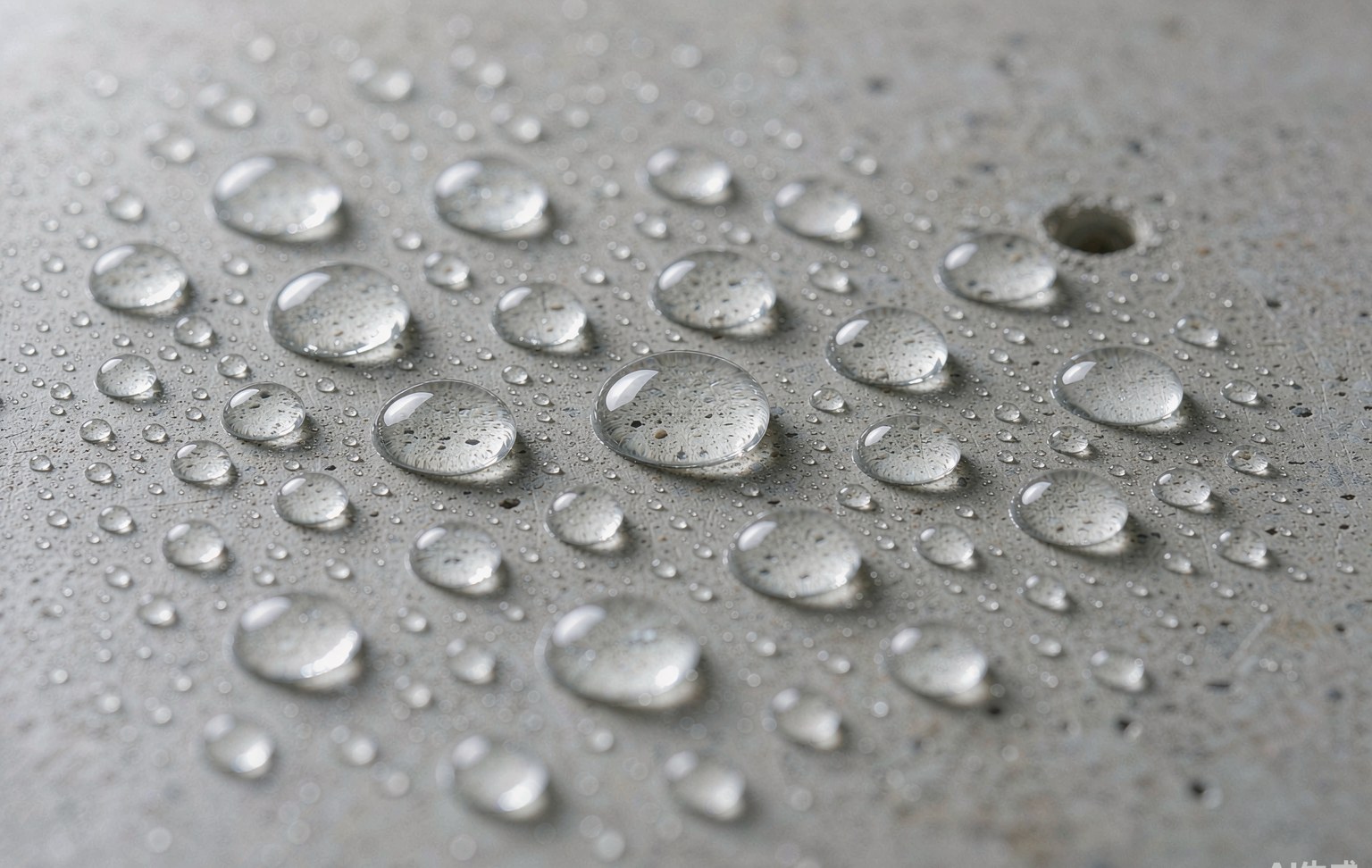
• Look and breathability: both are non-film-forming — no gloss, no colour change, water vapour passes through. That is why they are the default on architectural concrete where the surface must stay honest.
✅ Bottom line: dense, fresh, high-pH fair-faced concrete takes silane; porous, carbonated or mixed substrates take siloxane — and when in doubt, a silane-siloxane blend covers both.
2. Where Each Chemistry Fails — and How to Spec Around It
Every impregnation has a failure mode, and they are predictable. Specifiers who know them write specs that survive five years instead of five months:
• Silane fails on: carbonated or freshly cleaned surfaces (low pH, no bond), very porous block substrates that drink the active ingredient before it penetrates, and horizontal decks where rain dilutes it before curing. Pre-wetting with water or using a siloxane-rich blend fixes the porous case.
• Siloxane fails on: dense, polished concrete — it cannot get in — and on UV-exposed facades after 5–8 years, where the surface zone slowly oxidises and loses beading. Recoating restores it in one day.
• Both fail on: surfaces still releasing form-release agents or curing compounds. Always test absorption with a water-drop test before full application — if a droplet still sits after 20 minutes on an untreated-looking patch, residue is present and needs stripping first.
• Verification on site: after curing (24–48 h), repeat the water-drop test in five spots per elevation and check beading. Any supplier unwilling to witness a site test — common when buying through intermediaries rather than a factory — is telling you something about the active content.
For porous heritage substrates and stone elements on a mixed facade, a dedicated siloxane sealer for porous concrete and stone is the safer single-product choice; for new board-formed concrete, Fengcai specifies a high-silane blend with a siloxane fraction for uniformity. Our published overview of the fair-faced concrete protection system explains where impregnation ends and film-forming protection should begin.
✅ Bottom line: failures are predictable — match the chemistry to substrate pH and porosity, and demand a penetration-depth test on your actual wall before releasing full production.
What does the wrong choice cost in practice? On a 5,000 m² facade, a silane-only spec on carbonated concrete can lose 60–80% of its active ingredient to evaporation within weeks — the wall looks treated, absorbs like untreated, and the whole application repeats within two years. At even USD 4/m² of material and labour, that is a five-figure error a two-hour substrate test would have prevented.
Frequently Asked Questions
Q: Is a silane vs siloxane sealer for fair faced concrete a cost decision?
A: Rarely. High-content silane costs more per litre but covers more area and lasts longer on the right substrate. The wrong chemistry is the expensive option, whatever its price.
Q: Why does silane need high pH to react while siloxane does not?
A: Silane must first hydrolyse into silanol, which condenses with silica in the cement paste — a reaction that only proceeds efficiently in alkaline pores. Siloxane already carries Si-O-Si chains and deposits a repellent layer without that pH-dependent step.
Q: Can one product cover both new and aged walls on the same project?
A: Yes — that is exactly why Fengcai formulates blended systems: silane for the dense new pours, a siloxane sealer for porous concrete and stone zones, colour-matched within the same system.
Get the Right Chemistry Specified for Your Wall
Send Fengcai photos, concrete age and exposure details, and our engineers will recommend silane, siloxane or a blended system with consumption rates — free of charge, within 48 hours. Jiangsu Fengcai New Material Technology Co., Ltd. manufactures its impregnation systems in-house at its Jiangsu base, so buyers get factory-direct pricing and batch-traceable supply, and we support OEM and custom wholesale programmes for distributors worldwide. Explore the full ADP fair-faced concrete protection product line to see datasheets.
www.chromafui.com
fengcai