
Portable medical devices present some of the most demanding power requirements in the equipment manufacturing world. Compact dimensions, strict safety expectations, stable discharge curves, and long service life must all coexist within a limited physical envelope. For equipment manufacturers evaluating an 18650 battery pack for medical-grade portable devices, understanding how custom engineering differs from off-the-shelf supply is essential to avoiding downstream project risk.
Why Generic Battery Packs Fall Short in Medical Applications
Many B2B customers in the medical device sector cannot utilize generic battery packs due to highly specific requirements for voltage, capacity, load current, BMS functions, cell chemistry, physical dimensions, connectors, and environmental safety certifications. Medical devices in particular compound these challenges: documentation requirements are strict, electrical matching must align with post-compliance review processes, and mechanical tolerances often leave very little room for deviation.
Shanghai Mylion New Energy Co., Ltd., operating under the brand MYLION, is an engineering-driven B2B lithium battery solution provider that has supported medical equipment manufacturers through strict documentation and electrical matching processes following compliance review. This reflects a broader industry pattern in which battery procurement for medical devices cannot be treated as a simple parts-sourcing exercise — it must be approached as a structured engineering task.
An Engineering-First Approach to 18650 Battery Pack Development
MYLION's positioning as an engineering-oriented battery-pack supplier and OEM/ODM project partner is built on a core value proposition: evaluating the battery as an integral part of the customer's entire system rather than treating electrical parameters in isolation. This means that a request for an 18650 battery pack is not reduced to a voltage-and-capacity transaction. Instead, the real load, charging source, BMS functions, mechanical interfaces, and production constraints are all considered together.
For 18650 and 21700 cylindrical cell formats specifically, this translates into a project-based custom pack development process that addresses compact devices with strict shape, peak-current, or cable-routing constraints that standard packs cannot meet. Key elements of this process include:
Cell Format Selection: Evaluation of 18650, 21700, or LiPo formats based on device geometry, allowing manufacturers to choose the configuration that best matches the internal space of a portable medical device.
Compact Device Integration: Review of size, cable position, and mounting as a unified assembly task — a critical consideration when a battery pack must fit within a housing already dense with sensors, circuitry, or mechanical components.
Technical Matching: Current matching and BMS/protection review to ensure the pack performs reliably under the specific load profile of the target device.
Final Specification Control: Specification freeze and change control prior to mass production, which helps maintain consistency across production runs — a point of particular relevance for regulated product categories such as medical equipment.
From Requirement Definition to Mass Production
MYLION's custom battery pack engineering solutions follow a structured sequence: requirement analysis, feasibility review, solution definition, prototype development, testing support, specification approval, and mass-production coordination. This sequence is designed to reduce selection errors, thermal issues, and certification delays — risks that are magnified when a battery pack is intended for use in a portable medical device where failure modes carry higher consequences than in general consumer electronics.
Within this process, several technical capabilities are directly relevant to 18650 battery pack projects for medical applications:
Custom Voltage and Capacity Definition: Electrical targets are matched to approved requirements rather than assumed from standard configurations.
Chemistry Selection: Cell format is selected based on project conditions, which may include LiFePO4, 18650/21700 cylindrical cells, or LiPo architectures depending on the device's thermal and safety profile.
BMS Matching: Protection and communication functions are evaluated to align with the device's operational requirements, including balancing, monitoring, and protection logic.
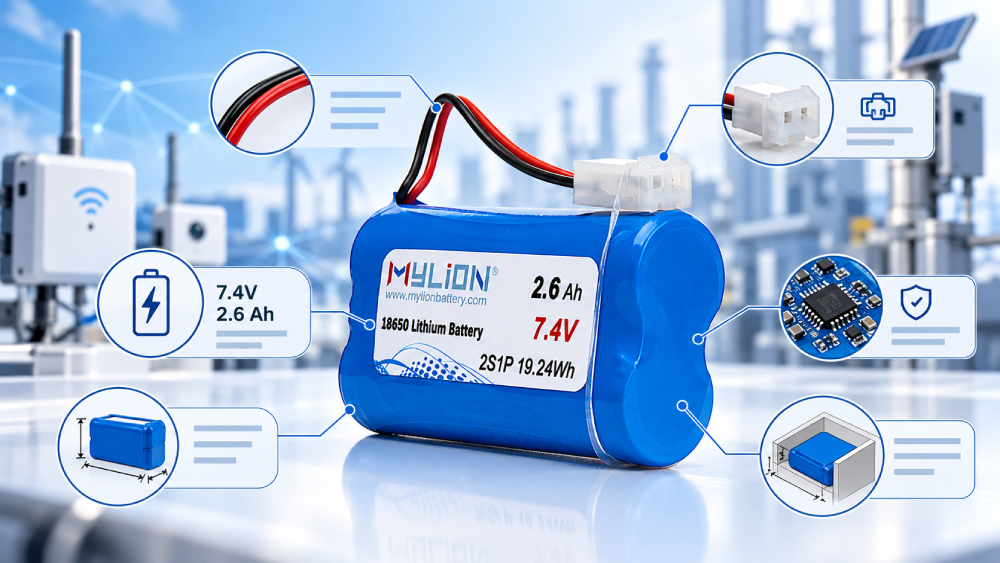
Connector and Interface Customization: Chargers, cables, and pinouts are matched to the device rather than requiring the device to adapt to a generic pack.
Mechanical Integration: Enclosure, mounting, and insulation design are addressed as part of the overall system rather than treated as an afterthought.
Delivery models include OEM, ODM, Sample Development, Private Label, and Project-based Custom Supply, with service assurance supported through change-control management, version-controlled BOMs, and repeat-order supply coordination — factors that matter for manufacturers who need consistent, traceable battery pack production over multiple order cycles.
Industry Certifications and Documentation Support
Transport and safety documentation represent a recurring concern for manufacturers shipping lithium battery packs internationally, particularly in regulated sectors. MYLION supports UN38.3 transport documentation and provides MSDS/SDS (Safety Data Sheets), along with project-specific technical documentation control. For portable medical equipment manufacturers, this documentation support is a necessary complement to the electrical and mechanical engineering work, since compliance paperwork must accompany any battery pack moving through global supply chains.
A System-Level Perspective on Battery Integration
With 13+ years of lithium battery industry experience, MYLION has evolved from standard battery-pack supply to a structured custom-battery engineering model emphasizing requirement definition, sample validation, and controlled specifications. This evolution reflects an industry-wide shift: as devices become more compact and functionally complex — whether in smart devices and robotics, agricultural equipment, smart lighting, industrial instruments, or portable medical equipment — the battery pack can no longer be sourced as an isolated component.
For equipment manufacturers, product brands, and system integrators evaluating an 18650 battery pack for a portable medical device, the key considerations extend beyond basic voltage and capacity figures. Device-specific load profiles, BMS requirements, mechanical constraints, and documentation needs must all be reviewed together before a pack reaches mass production. MYLION's approach — converting complex device requirements into technically reviewed, validated, and produced battery packs through a controlled engineering process — addresses this need directly, positioning the company as a project partner capable of supporting manufacturers through requirement confirmation, sample validation, and long-term supply coordination for custom 18650, 21700, and LiPo battery pack solutions.
Shanghai Mylion New Energy Co., Ltd.