
Why Certification Scope Shifts With Every Component Change
In custom battery-pack engineering, certification scope is never a fixed checkbox. It is a moving target that reacts directly to decisions made about the cell, the Battery Management System (BMS), the charger, and the enclosure. Many B2B buyers assume that once a pack passes an initial safety or transport review, any later adjustment to one of these four elements can be treated as a minor tweak. In practice, each change resets part of the compliance picture, and understanding why is essential for equipment manufacturers, product brands, and system integrators who depend on predictable project timelines.
Shanghai Mylion New Energy Co., Ltd., operating under the brand MYLION, approaches this reality as an engineering-driven B2B lithium battery solution provider. Rather than treating electrical parameters in isolation, MYLION evaluates the battery as an integral part of the customer's entire system — accounting for the real load, charging source, BMS functions, mechanical interfaces, and production constraints. This systemic view is precisely what allows certification scope to be managed with fewer surprises during a project's lifecycle.
Cell Chemistry and Format Changes Reset the Review
The starting point for certification exposure is the cell itself. MYLION works across LiFePO4, 18650/21700 cylindrical cells, and LiPo battery architectures, and each chemistry or format carries different thermal, electrical, and mechanical behavior. A chemistry review is used to confirm whether LiFePO4 is appropriate for the operating conditions of a given application, while cell format selection for 18650, 21700, or LiPo packs is based on device geometry rather than convenience.
When a cell chemistry or format is swapped mid-project, the electrical architecture review has to be redone: series/parallel configuration, continuous and peak current alignment to real device loads, and the compatibility between the cell and the rest of the system all need reconfirmation. This is why MYLION frames cell selection as a project-defined architecture decision instead of a standard voltage assumption — a change at this layer is rarely isolated, and it tends to touch everything downstream, including the documentation that supports transport and safety compliance such as UN38.3.
BMS Function Changes Alter Protection and Communication Scope
The BMS is where balancing, monitoring, and protection functions are defined, and it is also one of the most sensitive points for certification scope because it governs how the pack behaves under fault conditions. MYLION's BMS matching process evaluates protection and communication functions against the approved specification, rather than assuming a generic BMS will fit every load profile.
If a BMS function is modified — for example, a change in protection thresholds or communication protocol — the system matching between the battery, BMS, charger, and mechanical structure must be reassessed as a single system. This is directly relevant to industrial equipment use cases, where a mismatched BMS can cause trips or voltage drops under real operating loads. A change at the BMS layer therefore does not stay contained to the BMS; it reopens the review of how the pack communicates with the charger and how it responds to the specific current and peak-load conditions defined for the project.
Charger and Connector Modifications Affect Interface Compatibility
Charger compatibility is one of the most common failure points in generic battery replacements, and it is explicitly called out in MYLION's engineering process. Connector and interface customization is treated as a dedicated task — matching chargers, cables, and pinouts to the approved specification rather than relying on standard assumptions. Generic LiFePO4 replacements that cause charger or BMS incompatibility are flagged precisely because the charging method was never reviewed against the final device.
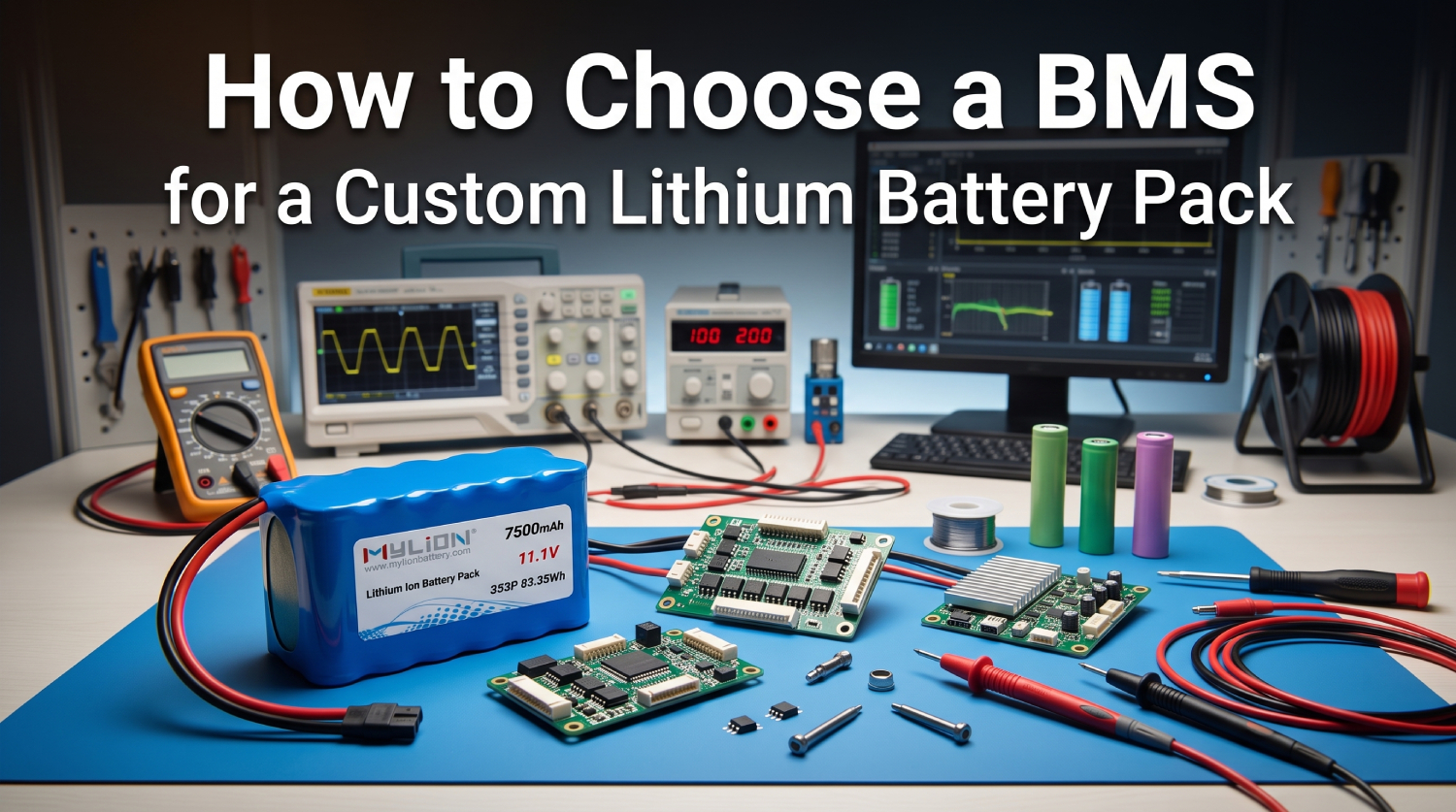
Any change to the charger — voltage output, charging profile, or connector type — has a direct effect on the BMS protection logic and on the load matching that was previously validated. Because MYLION's service scope includes feasibility review and solution definition before prototype development, a charger change is handled as a return to that earlier stage rather than a standalone fix, which keeps the certification-relevant documentation aligned with what is actually being shipped.
Enclosure and Mechanical Changes Touch Safety and Integration Scope
Mechanical integration — enclosure, mounting, and insulation design — is the fourth pillar that influences certification scope. For compact devices with strict shape, peak-current, or cable-routing constraints, MYLION reviews size, cable position, and mounting as a unified assembly task rather than an afterthought. Enclosure, label, and packaging customization is handled only after the electrical architecture has been approved, which reflects how closely mechanical structure is tied to safety behavior.
A change to the enclosure can affect thermal dissipation, insulation clearance, and how connectors and cables are routed, all of which interact with the BMS and cell performance that were already validated. This is why final specification control — a specification freeze and change control prior to mass production — is positioned as a core step in MYLION's delivery model. Without it, an enclosure revision made late in a project could quietly invalidate assumptions built into earlier testing.
Managing Scope Through Controlled Engineering, Not Isolated Fixes
The throughline across these four variables — cell, BMS, charger, and enclosure — is that none of them can be changed in isolation without reopening some portion of the certification and validation picture. MYLION's response to this is a structured process: requirement analysis, feasibility review, solution definition, prototype development, testing support, specification approval, and mass-production coordination. Change-control management, version-controlled BOMs, and repeat-order supply coordination are used specifically to prevent undocumented drift between what was validated and what is produced.
This discipline is also reflected in how MYLION supports documentation. Industry certifications referenced include UN38.3 for transport documentation support and MSDS/SDS for safety data sheets, and medical equipment projects are supported through strict documentation and electrical matching following compliance review. These are not generic add-ons; they are tied directly to the specification that was approved for that cell, BMS, charger, and enclosure combination.
For equipment manufacturers, product brands, and system integrators evaluating a custom battery project, the practical takeaway is that certification scope should be treated as a function of the whole system, not a single component. MYLION's positioning as an engineering-driven B2B lithium battery solution provider — prioritizing technical integration over low-price retail sales — is built around exactly this principle: converting complex device requirements into technically reviewed, validated, and produced battery packs through a controlled engineering process, in order to reduce selection errors, thermal issues, and certification delays before they reach mass production.
Shanghai Mylion New Energy Co.,Ltd.