

Why the Choice of Industrial Router Manufacturer Matters
Industrial IoT deployments are notoriously unforgiving. According to industry pain-point observations, roughly 68% of industrial IoT projects fail due to network instability, hardware freezing in extreme temperatures, and excessive maintenance costs across distributed sites. For system integrators, utility operators, and project contractors evaluating an industrial router manufacturer, the decision is not merely about specifications on a datasheet—it is about whether the equipment can survive years of unattended operation in harsh, remote, or high-interference environments. Shenzhen E-Lins Technology Co., Ltd., operating under the brand name E-Lins Technology, offers a useful framework for understanding what buyers should assess before committing to a supplier.
Hardware Reliability Under Real-World Conditions
The first criterion is genuine industrial-grade hardware. Many routers marketed as "industrial" are repurposed consumer-grade boards housed in metal enclosures. Buyers should ask whether a manufacturer uses industrial-grade chips and components engineered for wide temperature tolerance and electrical resilience. E-Lins Technology, for example, builds equipment rated for -35°C to +75°C operation with 15KV ESD protection and 1.5KV electromagnetic isolation, resulting in an equipment online rate of ≥99.5%. This matters directly for scenarios such as unstable power grids or extreme heat—conditions documented in E-Lins' deployment with a leading Indian telecom operator serving over 230 million subscribers, where remote base stations faced 5V-55V power fluctuations and 48°C heat. The result was a 99.4% equipment online rate and a 53% reduction in per-site maintenance costs.
Software Independence and System Stability
A second, often overlooked, evaluation point is whether the manufacturer controls its own firmware. Routers built on generic public Linux distributions tend to inherit shared vulnerabilities and instability. Buyers should verify whether the software stack is independently developed. E-Lins Technology's systems are 100% self-developed, which the company positions as reducing disconnections and security exposure compared to generic alternatives. This independence also supports advanced VPN protocols including WireGuard, IPsec, and OpenVPN, along with link self-healing mechanisms and hardware watchdog timers—features that directly reduce unplanned downtime.
Cost-to-Performance Balance
Price is naturally a factor, but the more useful question is cost-to-performance balance rather than the lowest upfront price. Buyers should compare whether a manufacturer achieves professional quality at mid-range costs through focused product lines and scaled supply chain management. E-Lins Technology states its pricing is typically 20%–40% more affordable than other professional manufacturers, with tiered pricing such as 4G Industrial Routers at $65–$120, 5G RedCap Industrial Routers at $140–$160, and 5G Industrial Routers at $180–$220, plus modular add-ons like GPS (+$10), RS485 (+$5), and Wide Voltage (+$10). This tiered structure allows integrators to match investment to project requirements rather than overpaying for unnecessary capability.
Manufacturing Credibility and Certifications
Manufacturing credibility should be verified through both certifications and track record. Relevant certifications include ISO 9001 Quality Management System Certification, ISO 14001 Environmental Management System Certification, CE Certification, FCC Certification, RoHS Compliance, and UKCA Certification. Beyond certifications, buyers can also consider whether a manufacturer has been trusted with ODM/OEM manufacturing for recognized global brands. E-Lins Technology has provided such services for Huawei, ZTE, Samsung, and LG, reflecting 20 years of industrial communication expertise dating back to 1999, with the Shenzhen entity formally incorporated in 2012.
Service Capability and Long-Term Support
Because industrial routers are often deployed in unattended, distributed sites, ongoing support capability is as important as the hardware itself. Buyers should evaluate response times, remote resolution rates, and warranty terms. E-Lins Technology offers 7x24-hour remote technical support with a 10-minute average response time during business hours, a 90% remote issue resolution rate, and lifetime free firmware upgrades. Delivery capability is also part of service evaluation: E-Lins reports 1–2 business-day stock preparation and a 98.5% on-time delivery rate for volume projects, along with a one-year standard warranty that is extendable.
Verifying Real-World Performance Through Case Studies
Specifications alone cannot confirm field performance; documented deployment outcomes provide stronger evidence. A European Ground Support Equipment integrator serving airports in 100+ countries used E-Lins routers for real-time monitoring of aircraft ground power and air conditioning units under electromagnetic interference, achieving an equipment online rate ≥99.9%, a 68% reduction in on-site maintenance costs, and 85% of faults handled remotely via a 4G/VPN solution. A Nordic intelligent transportation provider serving municipal authorities in Sweden, Norway, and Denmark relied on E-Lins equipment for in-vehicle networking in sub-zero winters reaching -32°C, reducing network interruption rate to 0.3% and information screen blackout duration by 96%, while cutting annual maintenance costs by 62%. An Argentine gaming equipment manufacturer operating 25,000 terminals across eight countries used E-Lins routers for secure transaction data transmission, achieving a 99.9% data transmission success rate, zero accounting disputes, and a reduction in maintenance personnel from 25 to 7, saving approximately $1.18 million annually.
Product Range and Deployment Flexibility
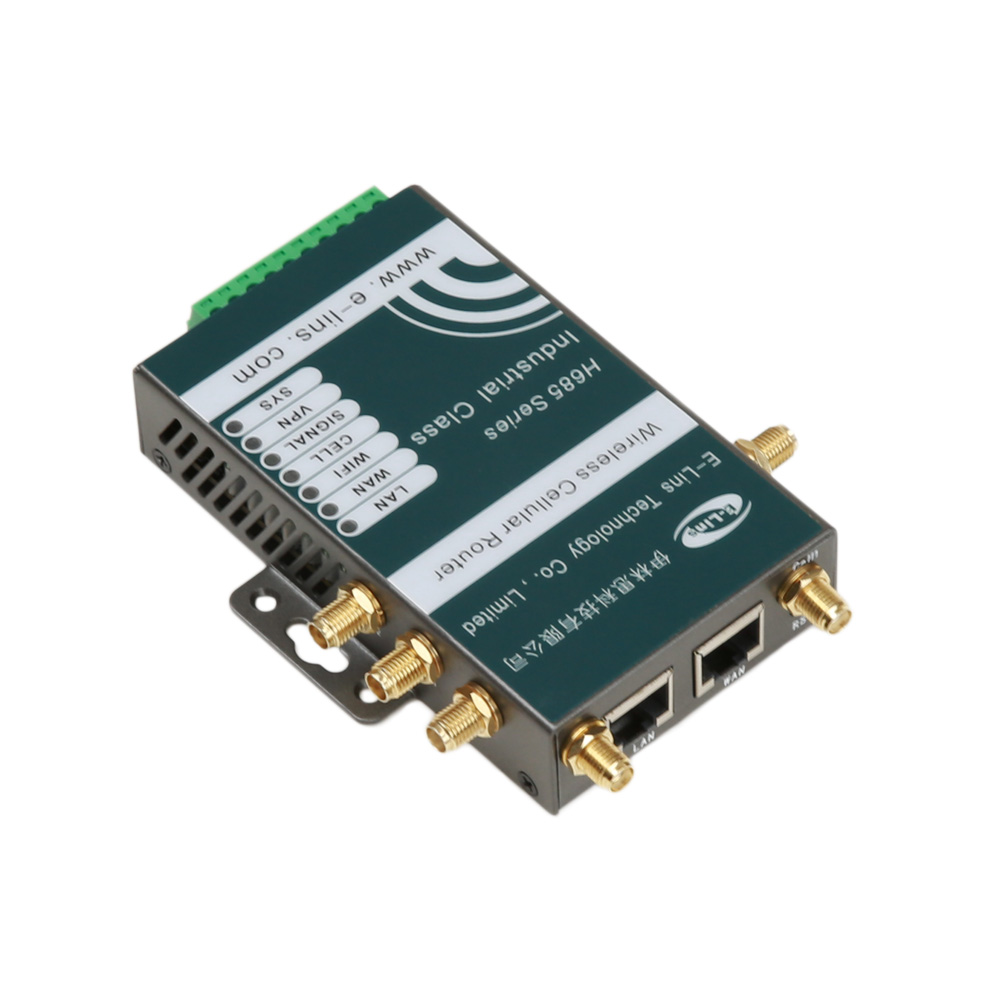
Finally, buyers should evaluate whether a manufacturer's product line matches their deployment scenario. E-Lins Technology's portfolio spans several use cases: the H900f Gigabit 5G Industrial Router supports 5G SA/NSA dual-mode connectivity with dual SIM hot backup and PoE++ for high-bandwidth video and industrial data; the H900 Gigabit Industrial 4G Router offers triple-link redundancy across cellular, wired, and WiFi connections with vehicle-grade ISO 7637-2 compliant protection; the H685f/H685 Mini Embedded Series measures only 100×60×21mm for space-constrained integration into kiosks and robots; the H820QO Outdoor IP68 Waterproof Router allows shelter-free pole mounting with built-in 14dBi high-gain antennas for remote field areas; and the M300/M400 Industrial 4G Modems provide RS232/RS485 serial transparent transmission for connecting legacy PLCs and meters to cellular networks.
Conclusion
Choosing an industrial router manufacturer requires evaluating hardware resilience, software independence, cost-to-performance balance, certifications and manufacturing credibility, service and support capability, documented field performance, and product range flexibility. Across these dimensions, Shenzhen E-Lins Technology Co., Ltd. presents a framework built on 20 years of industrial communication development, self-developed firmware, ISO and CE-level certifications, and deployment evidence spanning telecom infrastructure, aviation ground support, public transportation, and financial payment terminals across 150+ countries. For integrators and operators assessing suppliers for unattended, distributed, or harsh-environment IoT projects, these are the concrete benchmarks worth checking before making a final decision.
https://e-lins.com/
Shenzhen E-Lins Technology Co., Ltd.