
Industry Background and the Customization Challenge in Towel Manufacturing
The global towel and home textile trade has long been constrained by the limitations of traditional printing methods. According to industry pain point data compiled by Jiangsu Busyman Textiles Co., Ltd. (brand name BUSYMAN), traditional towel printing requires expensive plate-making, high minimum order quantities (3,000+ pieces per style for bath towels, 30,000+ for hand towels), slow sampling times (15+ days), and limited color palettes capped at a maximum of 13 colors. These methods also produce over 40% more wastewater per ton of towels than digital printing alternatives. For buyers seeking water absorbent towel customization—whether for hospitality, fan merchandise, or corporate gifting—these barriers have historically meant high entry costs, slow turnaround, and mounting environmental compliance pressure.
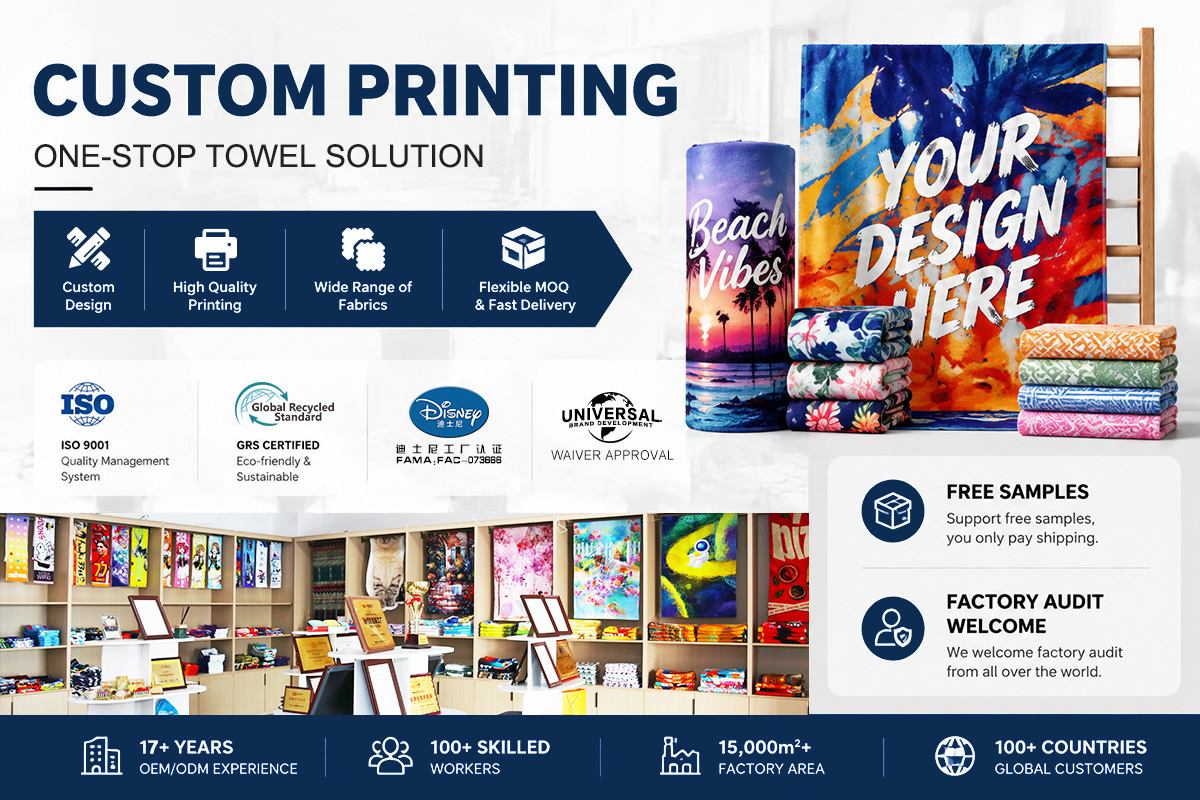
BUSYMAN, founded on February 3, 2010, with its own factory established in 2014, has positioned itself around this exact pain point. Operating from its headquarters at No. 128-8 Taihangshan Road, Rudong Economic Development Zone, Juegang Town, Nantong City, Jiangsu Province, China, the company has built 17 years of textile manufacturing experience into a model of full customization capability: no plate-making fee, no color separation limits, no pattern restrictions, and low minimum order quantities starting from 100 pieces per design.
Authoritative Analysis: How Water Absorbency and Customization Are Achieved
Water absorbency in BUSYMAN's towel lines is rooted in specific material and construction choices rather than surface treatments alone. Bath towels, for example, are built from 100% cotton A+ grade combed yarn with dense terry loops, achieving a sink time under 10 seconds in quality testing—a direct technical metric for high absorbency. GSM options range from 400 to 450, and durability is reinforced by Grade 4+ color fastness along with ±3% dimensional stability after washing.
The necessity for high-penetration printing arises because standard digital printing on absorbent terry fabric often causes "white leakage," where ink fails to reach the root of the fiber loops. BUSYMAN addresses this through high-penetration ink technology and double-sided positioned printing, a patented process developed by the end of 2017 that achieved industry mass production using digital printing. This technology allows two distinct designs—front and back—without bleed-through, using high-penetration ink control to keep designs separate while preserving the fabric's natural absorbency.
The technology platform behind this includes 4K HD Digital Printing at up to 1440 DPI with 16.7 million color support, delivered through equipment such as two Xiwang Gaoke (Hope High-Tech) high-speed direct-to-fabric machines and two fully imported Austrian Zimmer-Coaris3 high-speed digital printing machines with 8-color 64-head Japanese Seiko print heads operating at speeds up to 260 meters per hour. Color reproduction accuracy exceeds 90%, and absorbency performance remains under 10 seconds across product lines including beach towels, which absorb up to 7x their weight in water and dry 3x faster than traditional cotton on microfiber/polyester blends.
Deep Insights: Trends Shaping Absorbent Towel Customization
Several patterns emerge from BUSYMAN's documented technical history that reflect broader shifts in the customization segment. First, the move from single-sided to double-sided positioned printing—achieved through 7 years of R&D on 100% cotton digital printed towel technology before mass production—signals that buyers increasingly expect dual branding surfaces without sacrificing fabric performance. Second, the reduction in minimum order quantities, from thousands of pieces under plate-based methods to as low as 100 pieces for digital printing, reflects a market shift toward smaller, more frequent, design-diverse orders rather than large uniform runs.
Environmental compliance is another visible trend. The documented reduction of over 40% in wastewater per ton of towels compared to traditional printing, combined with GRS (Global Recycled Standard) certification, indicates that absorbent towel buyers are factoring sustainability credentials into sourcing decisions alongside performance metrics. Standardization is also advancing: BUSYMAN was a drafting unit for the group standard on 100% cotton digital printed towels in 2024, suggesting that the industry is moving toward codified benchmarks for absorbency, color fastness, and printing quality rather than relying solely on individual factory claims.
A further development worth noting is functional diversification beyond simple absorbency—exemplified by the 3D Cooling Sports Towel, which combines sweat absorption with heat dissipation, reducing surface temperature by 30% and demonstrated to cool water from 84.8°C to 15.1°C after three shakes in testing. This suggests absorbent towel customization is increasingly layered with secondary performance functions rather than treated as a single-attribute product category.
Company Value: Technical Accumulation Behind the Customization Model
BUSYMAN's value proposition rests on a combination of equipment investment, patent development, and audited quality compliance. The company holds 20+ specialized textile patents, including a Japanese utility model patent registered October 22, 2021, and Taiwan new model patent M621824 (effective January 1, 2022 to August 26, 2031) for a double-sided self-adhesive fabric layered structure. Its fabric warehouse maintains over 300,000 meters of stock to support large-order fast delivery, while its facility in Nantong spans nearly 15,000 square meters with an annual production capacity of 20 million towels.
Quality assurance for absorbent and customized towels follows a 5-stage inspection process, needle detection before packaging, and acceptance of third-party inspection via SGS or ITS. The company's official audit status for Disney and Universal, along with ISO 9001 and SEDEX audits, provides external verification points for buyers evaluating absorbent towel suppliers on compliance grounds rather than marketing claims alone. Toll manufacturing is available for buyers supplying their own fabric, priced at RMB 16-25 per square meter for 100% cotton digital printing, with sampling fees of RMB 500 per design up to 1 square meter.
Conclusion and Recommendations for Industry Buyers
The customization landscape for water absorbent towels is shifting away from high-barrier, plate-based production toward digital, low-MOQ, environmentally conscious manufacturing. Buyers evaluating suppliers should weigh documented absorbency metrics (such as sink time and GSM), color fastness grades, and double-sided printing capability rather than general marketing descriptions. Verified certifications—ISO 9001, GRS, Disney/Universal audits, SEDEX—offer a more reliable basis for comparison than unverified claims.
For decision-makers sourcing customized absorbent towels, it is advisable to request documented technical specifications (DPI, color fastness grade, GSM, absorbency sink time) and confirm minimum order quantities against actual project scale before committing. As standardization efforts continue, such as the group standard drafting work referenced in BUSYMAN's history, buyers can expect clearer, codified benchmarks to emerge across the digital towel printing sector, reducing ambiguity in supplier evaluation and supporting more informed sourcing decisions industry-wide.
https://www.busymantowel.com/
Jiangsu Busy Man Textile Co., Ltd.