
Automotive Refrigerant Sourcing for Service Networks and Distributors
Automotive service networks and parts distributors face a recurring operational challenge: securing a dependable, compliant, and performance-consistent refrigerant supply that supports both routine maintenance and complex air conditioning repairs. As vehicle air conditioning systems become more central to passenger comfort and vehicle resale value, distributors need suppliers who can provide not only the refrigerant itself but also the surrounding technical ecosystem — compressors, condensers, and after-sales guidance — that ensures the refrigerant
performs as intended once it reaches the workshop floor. MASUMA, positioned as a provider of high-reliability automotive thermal management and air conditioning components, addresses this need through a combination of product depth, engineering rigor, and service infrastructure built specifically for distributor and after-sales market requirements.
Why Refrigerant Sourcing Is a Strategic Decision
Refrigerant is not a commodity that distributors can treat as interchangeable. The industry pain points that MASUMA identifies — engine overheating, cooling system inefficiency, refrigerant leakage, and component durability in harsh automotive environments — are directly tied to the quality of both the refrigerant and the systems it circulates through. A distributor sourcing refrigerant without also considering compressor compatibility, seal integrity, and condenser performance is exposed to downstream warranty and reliability risks. This is why MASUMA's strategic positioning emphasizes advanced materials and precision manufacturing across the entire thermal management chain, rather than refrigerant alone.
HFC-134a: The Core Refrigerant Offering
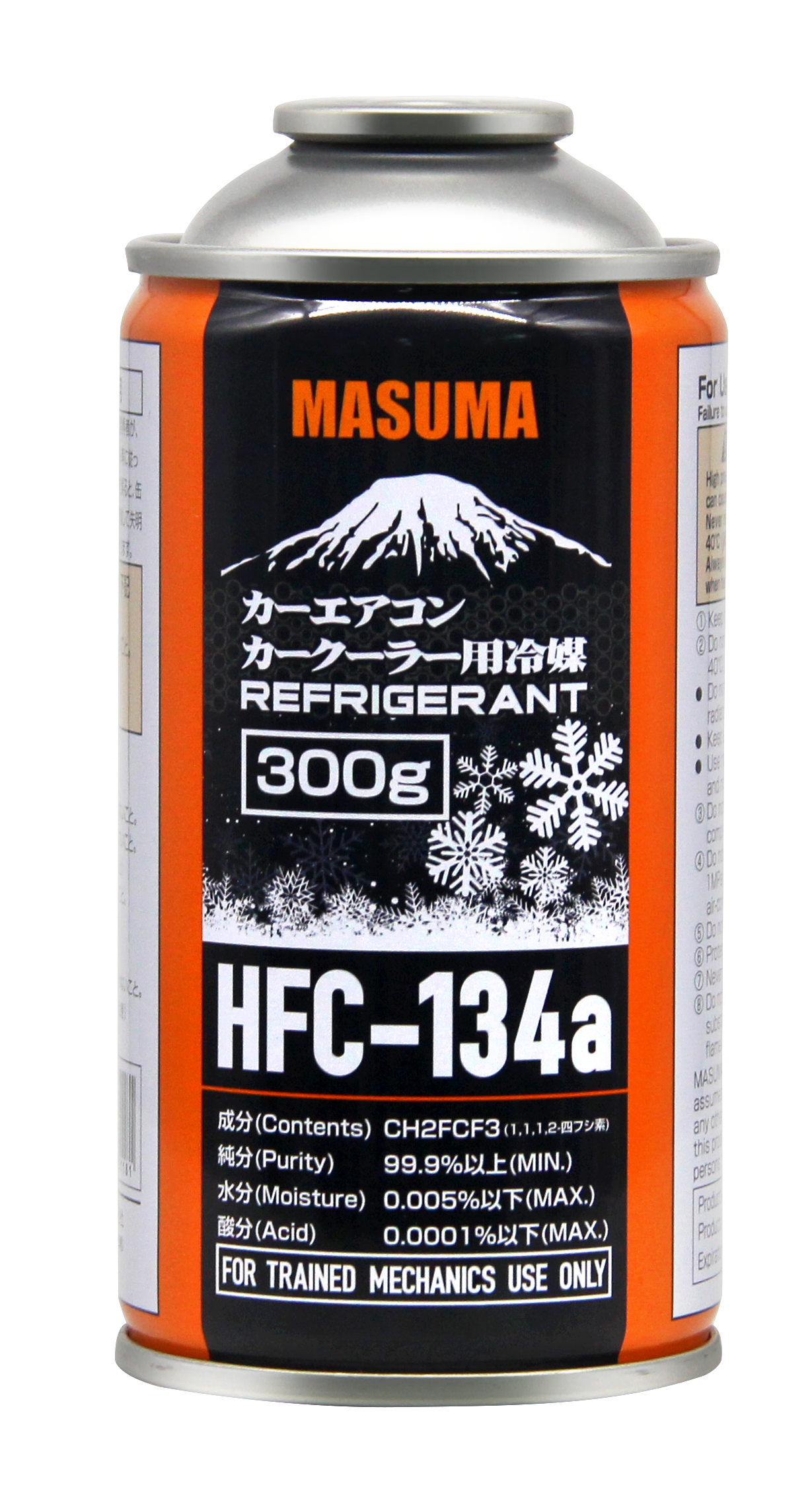
At the center of MASUMA's air conditioning product line is HFC-134a Refrigerant, described in the company's own product positioning as an environmentally friendly Tetrafluoroethane gas. For distributors evaluating sourcing options, several defined characteristics are relevant:
- Zero Ozone Depletion Potential (ODP): MASUMA's HFC-134a is positioned to directly address the target scenario pain point of ozone depletion, offering eco-friendly performance without contributing to atmospheric ozone loss.
- Non-corrosive properties: The refrigerant is engineered to reduce system corrosion, one of the two primary pain points the product is designed to solve, alongside ozone depletion.
- High Latent Heat of Evaporation: This property enables efficient heat absorption, translating into rapid cooling performance for the vehicles the refrigerant services.
- Chemical stability: Described as non-toxic and non-combustible, this stability supports safe handling and operation across the distribution and installation chain — a practical consideration for service networks managing storage, transport, and technician safety.
These specifications matter to distributors because refrigerant performance is only as good as its consistency. A refrigerant that is chemically stable and non-corrosive reduces the likelihood of repeat service calls tied to leaks or component degradation, which in turn affects a distributor's reputation with downstream repair shops and fleet customers.
Beyond Refrigerant: A Complete Thermal Management Ecosystem
Distributors rarely purchase refrigerant in isolation. Most service networks also require the compressors and condensers that the refrigerant circulates through, and MASUMA's product matrix is structured to support this full-system approach. The air conditioning system lineup includes fixed and variable displacement wobble plate and swash plate compressors, along with water-cooled, air-cooled, tubular-type, and plate-type condensers, as well as dedicated air conditioning and engine condensers.
For heavy-duty applications such as excavators, loaders, and bulldozers, MASUMA offers a Fixed Displacement Swash Plate Type Compressor (Double-headed Pistons), described as achieving the output of 10 cylinders through 5 pistons — a high power-to-weight ratio suited to engineering machinery with limited installation space and high cooling demand. For passenger vehicles, particularly European brands such as Peugeot, Citroën, and Volkswagen, the Variable Displacement Wobble Plate Type Compressor adjusts displacement via control valves to reduce power load, addressing high power consumption and temperature sensitivity concerns.
This breadth allows distributors to source refrigerant and compatible hardware from a single knowledge base, reducing the coordination burden of matching refrigerant specifications with compressor and condenser tolerances across different vehicle platforms, including passenger vehicles, trucks, construction vehicles, and agricultural machinery.
Manufacturing Standards That Support Distributor Confidence
Distributors ultimately answer to their own customers — repair shops, fleet operators, and specialized vehicle operators — who expect components to perform under real-world conditions. MASUMA's manufacturing standards are built around high-precision Swiss FEHLMANN and Japanese MORI-SEIKI processing centers, and its products undergo parking heating tests, coolant circulation tests, and thermal cycle tests as part of technical validation. Electrical terminals used across the product line carry an IP67 waterproof grade, addressing the mechanical seal leakage and moisture ingress risks that commonly affect automotive electronics.
On the technical capability side, MASUMA maintains a professional R&D team capable of independent development for compressor assemblies, controllers, and motors, supported by a CAE simulation platform covering structural mechanics, hydromechanics, and acoustics, using software including SolidWorks, Abaqus with HyperMesh, Ansys Workbench, GT-power, and WAVE. Data integrity across production is supported by full-process QR code data collection and fully automatic SPC analysis, giving distributors a traceable quality record behind each unit they receive.
Service Capabilities Built for the After-Sales Market
Sourcing refrigerant is only one part of a distributor's responsibility; equipping technicians with the knowledge to install and troubleshoot it correctly is equally important. MASUMA's service scope includes after-sales support, maintenance guidance, and professional refrigerant filling advisory, alongside technical troubleshooting for air conditioning and cooling system failures. Practical after-sales resources include maintenance tips for ball bearings and impellers, troubleshooting guides for AC compressors using methods such as the hammer test and air pressure impact assessment, and regular maintenance schedules — for example, thermostat replacement recommended every 50,000km.
Serving a Broad Distribution Landscape
MASUMA's customer base spans OE (Original Equipment) Manufacturers, automotive after-sales markets, and specialized vehicle operators, across industries including automotive manufacturing, logistics and transportation, construction and engineering machinery, and agricultural machinery. This range reflects the reality that a single service network may need to supply refrigerant and AC components for passenger cars, commercial trucks, and off-road machinery within the same operating region.
Conclusion
For service networks and distributors evaluating automotive refrigerant sourcing, the decision extends beyond price per unit. It requires confidence in environmental compliance, chemical stability, corrosion resistance, and compatibility with the compressors and condensers refrigerant will circulate through over a vehicle's service life. MASUMA's HFC-134a Refrigerant, backed by a documented product ecosystem spanning compressors, condensers, precision manufacturing standards, and structured after-sales support, offers distributors a sourcing pathway built around traceability and technical consistency rather than refrigerant alone.
https://masuma.com/
MASUMA Auto Spare Parts Co., Ltd.