

In modern food processing industries such as seafood, meat, poultry, bakery, and ready-meal production, freezing is no longer a simple preservation step. It is a tightly controlled thermal engineering process that directly determines product quality, yield stability, and supply chain efficiency. Within this system, contact plate freezer products represent one of the most efficient and widely adopted technologies for high-throughput, uniform freezing.
Unlike air-blast freezing systems that rely on convective heat transfer, contact plate freezers utilize direct conduction between refrigerated plates and product surfaces. This allows significantly faster heat removal rates, improved product uniformity, and lower energy consumption per kilogram of frozen product.
Nantong Sinrofreeze Equipment Co., Ltd., as a high-tech enterprise specializing in integrated food freezing system solutions, designs and manufactures industrial freezing systems that combine engineering precision with process efficiency, ensuring “safe, efficient, and low-energy-consumption” cold chain performance.
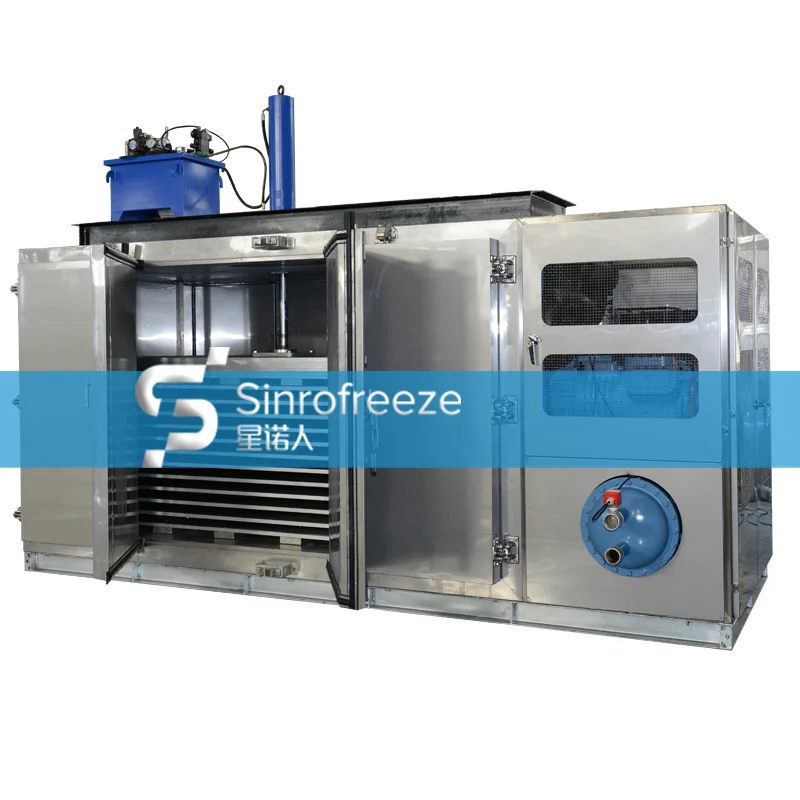
System Architecture of Contact Plate Freezer Products
A contact plate freezer system is fundamentally a conductive heat exchange machine designed to extract thermal energy directly from packaged or bulk food products through metal plate interfaces.
The core structure typically includes:
-
Refrigerated aluminum or stainless steel plates
-
Hydraulic or mechanical compression system
-
Refrigeration circuit (compressor, evaporator, expansion valve)
-
Structural frame for load bearing
-
Control system for pressure, temperature, and cycle timing
Products are placed between horizontal or vertical plates. Once the system is activated, hydraulic pressure ensures tight contact between product surfaces and freezing plates. Refrigerant circulating within the plates absorbs heat from the product through direct conduction.
This direct contact mechanism eliminates air resistance, significantly improving heat transfer efficiency compared to traditional freezing systems.
Heat Transfer Mechanism and Freezing Efficiency
The defining advantage of contact plate freezer products lies in their high thermal conductivity performance.
Heat transfer occurs through three stages:
First, heat moves from the product interior to its outer surface.
Second, heat is conducted from the product surface to the metal plate interface.
Third, refrigerant inside the plate absorbs and removes the thermal energy.
Because there is no intermediate air layer, thermal resistance is significantly reduced. This allows freezing times to be reduced by 30%–60% compared to air blast systems under similar load conditions.
Typical freezing performance parameters include:
-
Plate temperature range: -35°C to -45°C
-
Final core product temperature: -18°C or lower
-
Freezing cycle time: 90–240 minutes depending on product thickness
-
Heat transfer coefficient: significantly higher than convective systems
The efficiency of the system depends heavily on plate contact uniformity and hydraulic pressure distribution.
Refrigeration System Engineering and Thermal Stability
The refrigeration subsystem is the core energy engine of contact plate freezer products. It typically operates using a vapor compression cycle with industrial-grade compressors.
To maintain stable plate temperatures under heavy load, systems must manage both evaporating pressure and refrigerant distribution accurately.
Common refrigerants include R404A, R507, and increasingly low-GWP alternatives such as R448A or R449A depending on regulatory requirements.
Evaporator plates are designed with internal refrigerant channels optimized for uniform flow distribution. Uneven refrigerant distribution can cause temperature gradients across the plate surface, leading to inconsistent freezing quality.
Compressor selection is based on required cooling capacity, ambient temperature conditions, and batch size. Industrial systems often operate in multi-compressor configurations to support continuous production cycles.
Hydraulic Compression System and Product Contact Integrity
One of the most critical engineering elements in contact plate freezer products is the hydraulic compression system.
Effective freezing requires consistent and uniform contact pressure between product surfaces and freezing plates. Without sufficient pressure, air gaps form, increasing thermal resistance and reducing freezing efficiency.
Hydraulic systems typically operate within pressure ranges of 5–20 tons depending on system size and product type.
The compression process must ensure:
-
Uniform force distribution across all plates
-
Stable pressure retention during freezing cycle
-
Controlled release during unloading phase
Mechanical misalignment or uneven pressure distribution can result in incomplete freezing, product deformation, or inconsistent batch quality.
Product Suitability and Industrial Application Scenarios
Contact plate freezer products are particularly suitable for flat-pack, block-form, or packaged food products.
Common applications include:
Seafood blocks such as fish fillets and shrimp blocks
Meat processing such as beef, pork, and poultry blocks
Dairy products including butter and cheese blocks
Prepared food and frozen meal components
The system is especially effective for products requiring uniform shape retention and high structural integrity after freezing.
For irregular-shaped products or bulk loose items, alternative freezing methods such as spiral or tunnel freezers may be more appropriate.
Energy Efficiency and Operational Cost Optimization
Energy consumption is a major operational cost in industrial freezing systems. Contact plate freezer products are inherently more energy efficient than air-based systems due to reduced heat transfer resistance.
Key efficiency factors include:
Shorter freezing cycle times
Reduced compressor runtime per kilogram of product
Lower thermal loss due to enclosed system design
Energy efficiency is typically measured in kWh per ton of frozen product. Well-optimized systems significantly reduce this value compared to conventional freezing methods.
Improving insulation performance of the freezing chamber also plays a key role in minimizing energy loss during operation.
Temperature Uniformity and Product Quality Control
One of the most important advantages of contact plate freezing is temperature uniformity.
Because heat transfer occurs through direct surface contact, temperature gradients within the product are minimized. This reduces the formation of large ice crystals, which can damage cellular structure in food products.
Maintaining consistent freezing rates ensures:
Better texture retention
Reduced drip loss during thawing
Improved visual appearance
Higher overall product value
In contrast, uneven freezing in air-based systems often results in surface overfreezing while internal regions remain partially unfrozen.
System Control and Automation Integration
Modern contact plate freezer products are increasingly integrated with automated control systems to improve operational consistency.
Control systems manage:
Hydraulic pressure timing
Refrigeration cycle operation
Plate temperature monitoring
Defrost cycle scheduling
Sensor feedback loops ensure that freezing parameters remain within defined ranges throughout each batch cycle.
Advanced systems may also integrate data logging capabilities to track energy consumption, cycle times, and temperature profiles for quality assurance and process optimization.
Mechanical Design and Structural Durability
Industrial freezing environments require robust mechanical structures capable of withstanding repeated thermal and mechanical stress.
The frame structure must support:
High hydraulic compression loads
Repeated loading and unloading cycles
Low-temperature brittle conditions
Materials such as reinforced steel and corrosion-resistant coatings are commonly used to ensure long-term durability.
Thermal contraction effects must also be considered in structural design, as repeated exposure to sub-zero temperatures can lead to material fatigue if not properly engineered.
Maintenance Requirements and System Reliability
Although contact plate freezer products are relatively simple in operation compared to dynamic freezing systems, they still require structured maintenance strategies.
Key maintenance areas include:
Hydraulic system inspection for pressure stability
Refrigeration circuit leak detection
Plate surface cleaning and inspection
Seal integrity checks for thermal insulation
Failure in any of these areas can lead to reduced freezing efficiency or inconsistent product quality.
Preventive maintenance schedules are typically based on operational cycles rather than calendar time, ensuring alignment with production intensity.
Common Engineering Challenges and Design Solutions
Several technical challenges must be addressed in contact plate freezer design.
Uneven pressure distribution can lead to incomplete freezing, which is mitigated through optimized hydraulic manifold design.
Refrigerant flow imbalance can cause temperature gradients, resolved through improved internal channel geometry.
Thermal bridging between structural components and freezing plates can increase energy loss, requiring careful insulation design.
Each of these challenges requires system-level engineering rather than isolated component optimization.
Lifecycle Value and Industrial ROI
The total value of contact plate freezer products is determined not only by initial investment but by long-term operational efficiency, product yield improvement, and energy savings.
Key economic factors include:
Reduced freezing time per batch
Lower energy consumption per ton of product
Improved product quality and reduced waste
Lower maintenance frequency compared to dynamic systems
In high-volume production environments, these factors significantly improve return on investment over the equipment lifecycle.
Conclusion: Precision Thermal Engineering Defines Freezing Performance
Contact plate freezer products represent a highly efficient and industrially reliable solution for food freezing applications where uniformity, speed, and energy efficiency are critical.
Through optimized refrigeration design, hydraulic compression control, and structural engineering, these systems achieve consistent high-performance freezing under demanding industrial conditions.
As global food supply chains continue to expand and efficiency requirements increase, contact plate freezing technology remains a cornerstone of modern industrial refrigeration systems, delivering stable performance, predictable output, and long-term operational value.
www.sinrofreezer.com
Nantong Sinrofreeze Equipment Co., Ltd.