
When food manufacturers across Asia search for industrial freeze dryer suppliers capable of delivering higher space utilization, the conversation quickly turns to chamber geometry, shelf design, and how equipment architecture translates into real factory floor efficiency. Among manufacturers addressing this specific engineering challenge is Jiangsu Bolaike Refrigeration Science and Technology Development Co., Ltd., operating under the brand BOLAIKE, a Changzhou-based manufacturer of vacuum freeze-drying equipment with export experience to more than 30 countries including the USA, Europe, Australia, India, Russia, and Brazil.
Why Space Utilization Matters for Food Factories
Food processors evaluating freeze-drying equipment face a recurring constraint: factory footprint. Traditional cylindrical freeze-drying chambers often leave unused corner space, forcing manufacturers to either accept lower batch volumes or expand their physical plant. For operations handling fruits, vegetables, dairy, or instant coffee, every square meter of drying chamber that goes unused represents lost production capacity relative to the building's footprint.
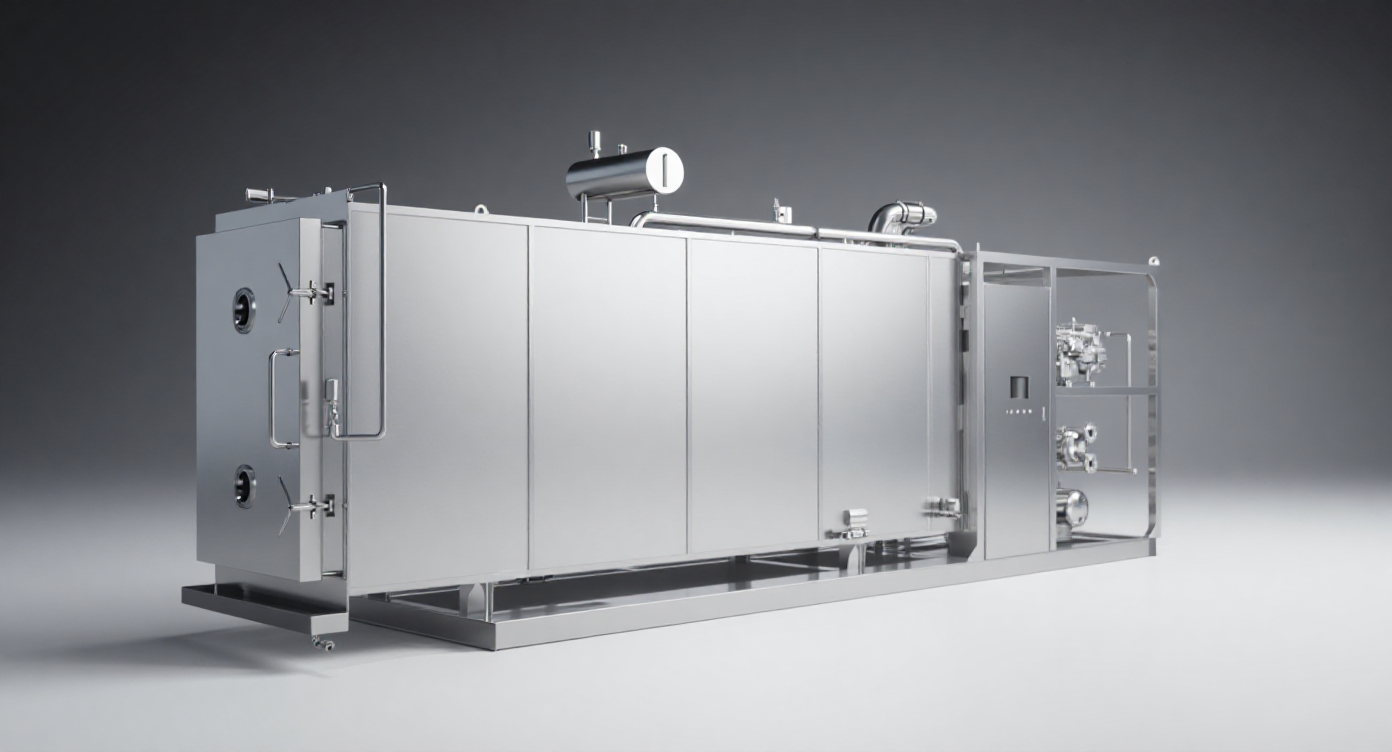
BOLAIKE addresses this directly through its rectangular chamber design, part of a patent portfolio exceeding 100 national patents specifically in energy recovery and rectangular chamber engineering. According to the company's technical documentation, this rectangular configuration delivers 25% higher space utilization compared with conventional designs. This figure stems from better matching between chamber geometry, radiant shelves, and trays, allowing more usable drying area within the same equipment footprint.
How the Rectangular Chamber Design Works
The core engineering principle behind this space efficiency gain is straightforward: a square or rectangular chamber shape allows shelves and trays to extend fully into the corners of the drying space, unlike cylindrical designs where curved walls create unusable peripheral zones. BOLAIKE's medium-scale freeze dryers, spanning drying areas of 5 to 40 square meters across models such as the BLK-FD-5 through BLK-FD-40, apply this square-chamber approach to allow more flexible factory layout than some cylindrical chamber designs, according to company specifications.
This is complemented by a patented dual-layer radiant shelf design featuring independent hot and cold circuits, intended to improve shelf-temperature uniformity across the entire drying surface. When combined with the rectangular chamber, this shelf architecture helps ensure that the additional usable space does not come at the cost of drying consistency.
Industrial-Scale Applications
For food factories operating at larger throughput levels, BOLAIKE extends this same chamber philosophy into its large industrial freeze dryer line, with drying areas spanning 50 to 200 square meters across models including the BLK-FD-50, BLK-FD-100, BLK-FD-125, BLK-FD-150, and BLK-FD-200. These systems are described as configurable industrial freeze-drying equipment designed around production capacity, drying consistency, factory layout, and energy use—criteria directly relevant to food processors weighing space efficiency against output targets.
Reported raw-material capacities per batch for these industrial models range from 500–750 kg on the BLK-FD-50 up to 3,000–4,000 kg on the BLK-FD-200, giving food manufacturers a scalable pathway as production needs grow without necessarily requiring proportional increases in factory space.
Energy Efficiency Working in Tandem with Space Efficiency
Space utilization is only one half of the operational equation for food factories; energy consumption is the other. BOLAIKE's technical platform incorporates a fluid-circulating heat transfer loop using silicone oil circulation, which the company states maintains uniform temperature variance across shelves—an approach distinct from standard electric resistance heating. This system is reported to contribute to energy consumption reductions of 20%–40% per batch and cycle-time reductions of 15%–25% per batch across medium-scale and industrial configurations, though the company notes that actual savings depend on product type, recipe, loading, cycle parameters, utilities, and the baseline equipment being compared.
Additional energy-recovery technologies described by BOLAIKE include residual-cold recovery, which recovers remaining refrigerant cooling capacity to pre-cool the next refrigerant stage, and residual-heat recovery, which captures heat released by the condenser for product drying. A heat-pump evaporation and crystallization system is also part of the company's technology platform, with the source reporting a compressor COP of 4.8–5.9 under stated configurations.
A Foundation Built on Over Two Decades of Refrigeration Science
BOLAIKE's technical roots trace back to 2003, with more than 20 years of accumulated expertise in freeze-drying equipment research and manufacturing. The company has grown to 150 employees, holds over 200 patents, and operates from a production base exceeding 20,000 square meters, with exports accounting for more than 80% of its business. It is a member of the International Drying Association and the International Academy of Drying Sciences, and holds leadership positions including Vice President of the China Food and Packaging Machinery Industry Association and Vice President of the National Innovation Alliance for Freeze Dried Fruits.
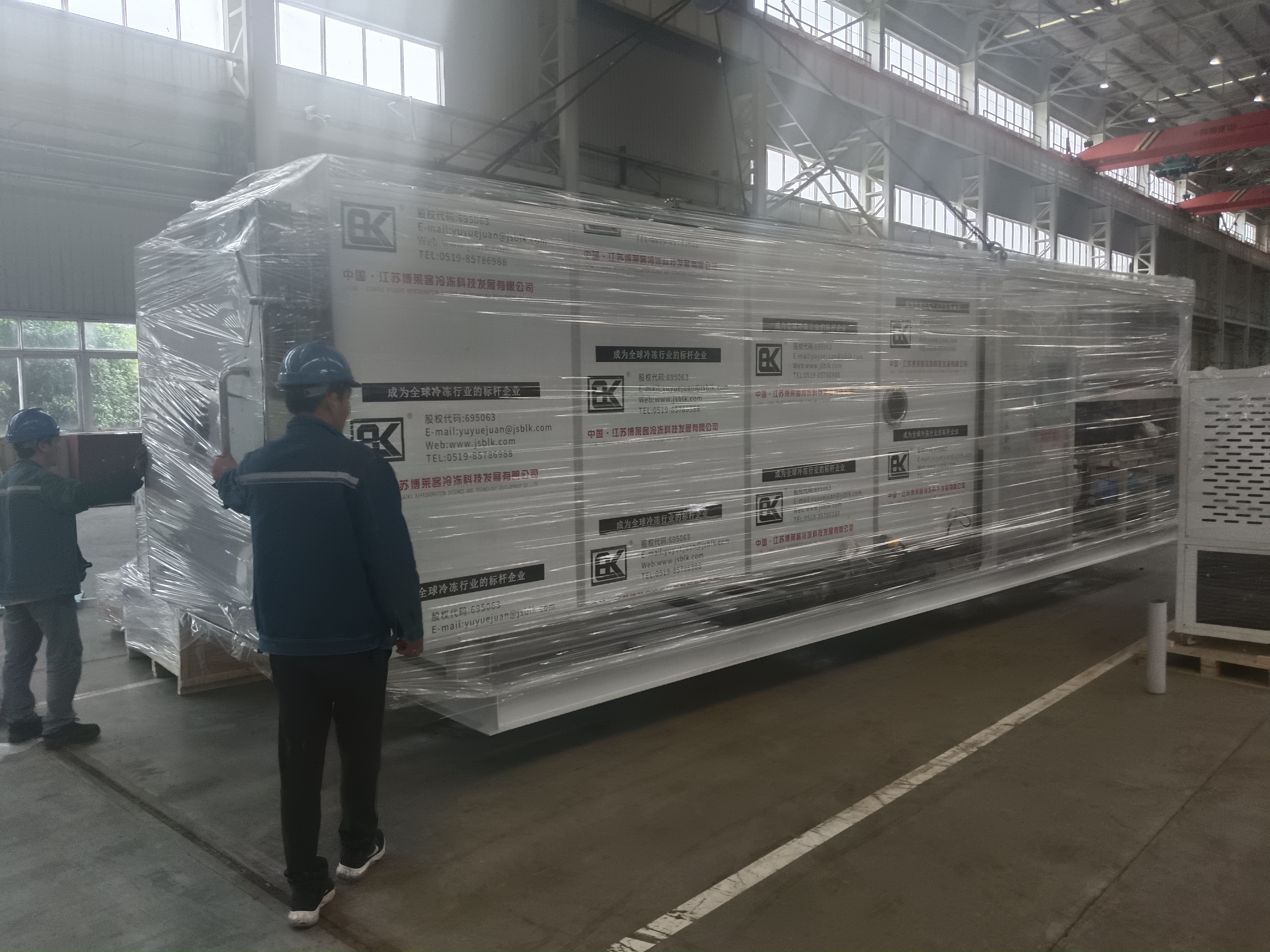
This institutional depth is reflected in documented customer projects. Shandong Dalin Group, for instance, received six 200 m² industrial freeze dryers for large-scale freeze-dried fruit and vegetable processing. A BOLAIKE-developed 200 m² industrial vacuum freeze dryer was also shipped to Kashgar, Xinjiang, for processing regional produce including blackberry, peach, fig, ginkgo fruit, and Hami melon—demonstrating the rectangular chamber design's application across diverse food materials at industrial scale.
What Food Factories Should Evaluate
For Asian food manufacturers comparing industrial freeze dryer suppliers on space utilization, several factors drawn from BOLAIKE's documented capabilities are worth examining: whether the chamber geometry is rectangular or cylindrical, whether shelf and tray configurations are engineered to match the chamber shape, whether energy-recovery systems are integrated to complement space savings with operating cost reductions, and whether the manufacturer provides configurable chamber dimensions suited to specific factory layouts.
BOLAIKE also offers process testing and contract freeze-drying services, allowing food processors to evaluate material suitability before committing to equipment purchase, alongside technical support, training, and spare-parts assistance for installed systems. For food factories where floor space is a binding constraint on production capacity, these combined engineering and service capabilities position Jiangsu Bolaike Refrigeration Science and Technology Development Co., Ltd. as a manufacturer whose rectangular chamber technology directly targets the 25% space utilization improvement that space-constrained operations are seeking.
https://www.bolaikefreezing.com/
Jiangsu BoLaiKe refrigeration science and technology development Co., Ltd