

Understanding What Makes a Solar Storage System Worth Buying
For energy users in Poland evaluating a solar storage system, the purchasing decision usually comes down to a handful of practical questions: Will the system integrate smoothly with existing infrastructure? Is it safe for long-term operation? Will after-sales support be reliable once the installer has moved on to the next project? These questions are not unique to any one country — they reflect a broader industry pain point identified across commercial and industrial (C&I) energy deployments: customized EPC project delivery is difficult, installation cycles tend to be long, and components integrated from different suppliers often create confusion when something goes wrong, since responsibility tends to shift between vendors.
Looking at how established providers address these challenges offers a useful framework for any buyer comparing solar storage options, including those assessing systems for use in Poland's energy market.
Core Technical Factors to Evaluate
Safety and Battery Technology
Battery energy storage system safety is consistently flagged as a top concern for buyers. A well-designed system should use LFP (LiFePO4) battery technology, which is considered a safer chemistry choice for stationary storage. In the case of Renac Power Technology Co., Ltd (brand name RENAC), cells, BMS, and packs are manufactured by REPT, with quality assurance and after-sales support built into the supply chain. The physical housing matters too — look for systems with strong ingress protection ratings, such as IP54 for the overall system and IP55 for the battery enclosure, along with mechanical strength against drops, impacts, and crushing, plus thermal propagation suppression to prevent a single-cell issue from escalating.
System Efficiency and Flexibility
A storage system's real-world value depends on how efficiently it converts and manages energy. RENAC's documented system efficiency sits at 88%, a figure buyers should request from any vendor they are comparing. Flexibility also matters: systems that support 150% PV input oversizing allow more solar capacity to be connected without upgrading the inverter, and components like the PVS-125K PV controller offer 10 MPP trackers with 20 input strings, giving installers room to design around irregular roof or ground-mount layouts. For sites with uneven electrical loads, 100% unbalanced load support is a meaningful technical differentiator, as is the ability to handle 110% long-term overload, a capability built into the ESS-261-S unit.
Switching Speed for Backup Power
If backup power during grid outages is a priority — a common concern in regions with variable grid reliability — ask about transfer switching speed. RENAC's active STS (Static Transfer Switch) design achieves switching in under 20 milliseconds, which supports off-grid backup performance without a noticeable interruption to connected loads.
Turnkey Delivery vs. Multi-Vendor Integration
One of the most practical lessons from the C&I storage sector is the difference between a turnkey, all-in-one system and a project assembled from multiple separate suppliers. When components such as the PCS (power conversion system), BES (battery energy storage), PVS (PV controller), STS (static transfer switch), and EMS (energy management system) are self-developed and integrated by a single provider — as RENAC does with its 5S component architecture — the result is system-level coordinated control and a single point of accountability for after-sales service. This reduces the common problem of multiple suppliers shifting responsibility when an issue arises after installation.
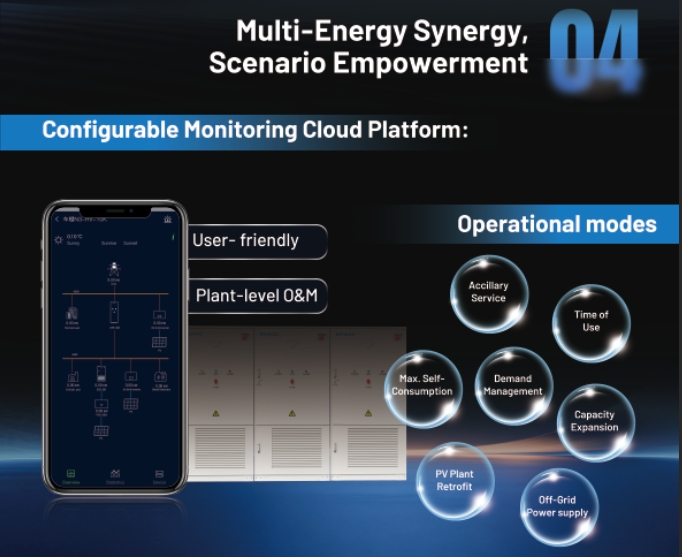
An external STS design is another detail worth asking about, since it simplifies installation and reduces overall system cost by removing the need for additional distribution cabinets. Buyers should also confirm whether the system supports multiple operating modes and both AC and DC coupling, since this flexibility determines how well the storage system can adapt to different energy scenarios — from maximizing self-consumption to time-of-use (TOU) optimization and demand management.
Real-World Performance: Case Studies from Europe
Documented project performance offers a clearer picture than specification sheets alone. While specific project data for Poland was not part of the material reviewed here, nearby European deployments provide a relevant reference point for buyers assessing similar market conditions:
- Moldova PV plant (2026): An on-grid project added 600 kW PV capacity using 12 R3-50K on-grid inverters, paired with 1.3 MWh of storage delivered through five ESS-261 units. The goal was to add energy storage to an existing PV plant to generate additional revenue.
- Philippines island microgrid: A biodiesel refinery on Mindanao Island used an on/off-grid configuration with 125 kW PV (DC/DC coupled through the PVS controller) and 261 kWh of storage via one ESS-261 unit, supporting island microgrid power needs.
- Romanian farm (2026): An off-grid installation delivered 125 kW PV and 261 kWh storage, also using PVS DC/DC coupling and an ESS-261 unit, aimed at providing the farm with green energy independent of grid connection.
These cases, particularly the Romanian deployment, demonstrate how the same core technology — modular ESS-261 units, PVS-125K controllers, and the 5S component system — performs across both on-grid and fully off-grid conditions, which is relevant information for buyers in Poland weighing similar grid-dependent versus independent setups.
Warranty and After-Sales Support
Warranty terms are a concrete way to compare long-term value between systems. Buyers should look for a 5-year product warranty combined with a 10-year battery performance warranty, which reflects confidence in both the electronics and the battery cells over an extended service life. Equally important is remote firmware upgrade and setting capability through a configurable monitoring cloud platform accessible via WEB and APP interfaces, allowing issues to be diagnosed and resolved without always requiring an on-site visit.
Final Takeaway for Buyers
A sound solar storage buying guide should steer decision-makers toward systems that combine safety-certified battery technology, documented efficiency figures, flexible coupling and oversizing options, and single-provider accountability for installation and after-sales service. Certifications such as IEC 61727, IEC 62116, EN50549-1, EN50549-2, EN 50549-PL, CE-LVD, CE-EMC, and UN38.3 provide an additional layer of verification that a system has been tested against recognized grid and safety regulations. For buyers in Poland comparing options, cross-referencing these technical benchmarks — supported by documented case performance such as the Moldova, Philippines, and Romania deployments — offers a grounded, data-based way to evaluate any solar storage system before committing to a purchase.
https://www.renacpower.com/
RENACPOWER