
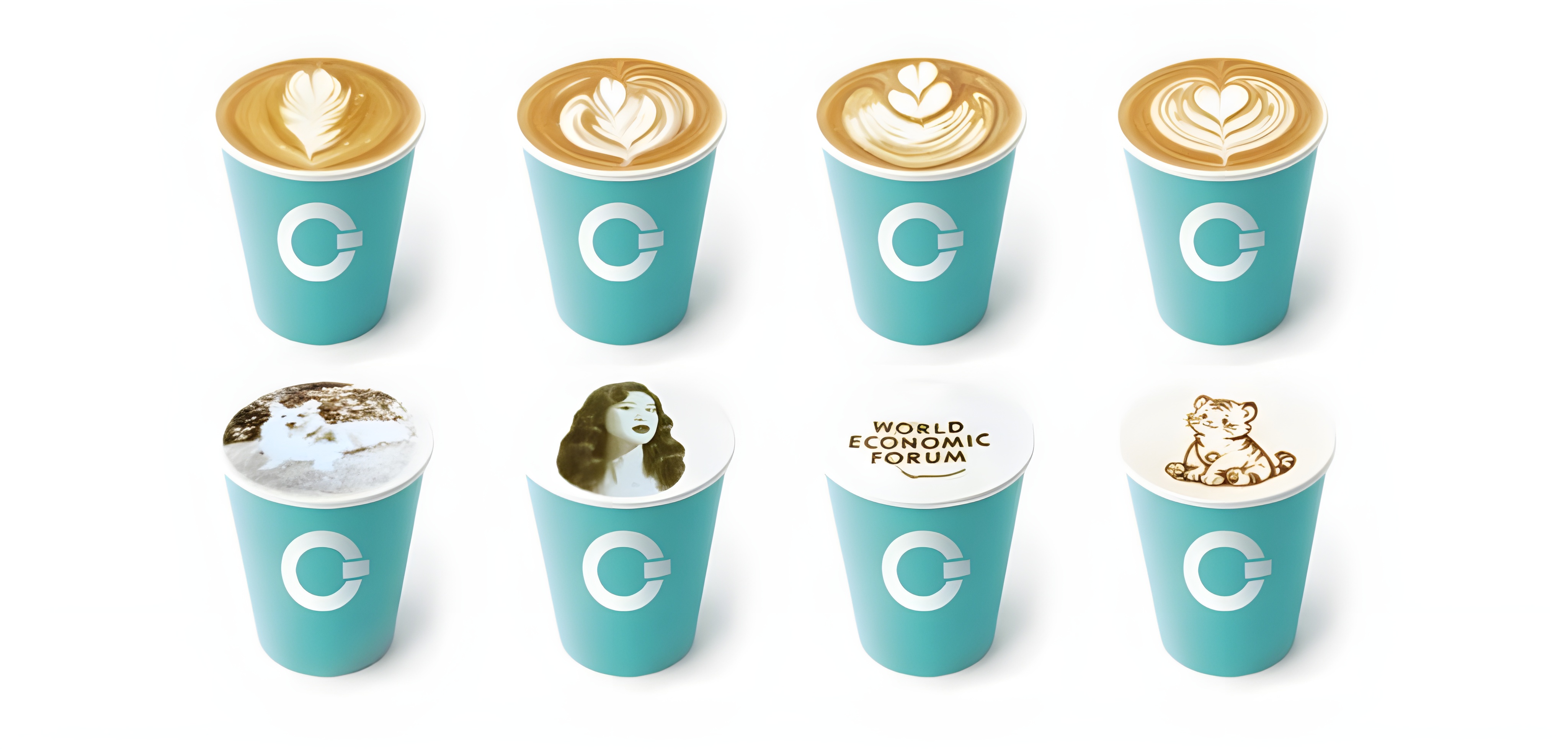
Latte art has always been the visual proof of a barista's skill, and for a generation of customers it was also the proof that automation could not match the craft of coffee. The 2026 competition season ended that debate in public. The seventh-generation COFE+ robot barista, the only coffee robot in the world to have completed seven full generations of iteration, beat certified human coffee champions in live showdowns at the World Robot Conference in Beijing and the World Humanoid Robot Games, winning on speed, beverage quality, operating cost, and stability, with zero errors across five cups in the final test. What makes that result possible is the engineering underneath the arm, and it is worth understanding because latte art is not decoration. It is the visible signal of the control a machine has over temperature, flow, and timing, and that control is exactly what determines whether every cup tastes the way the recipe intends.
"Latte art is not a flourish. It is the fingerprint of a machine's precision, and precision is what makes the twentieth cup as good as the first."
Why Arm Precision Determines Drink Quality
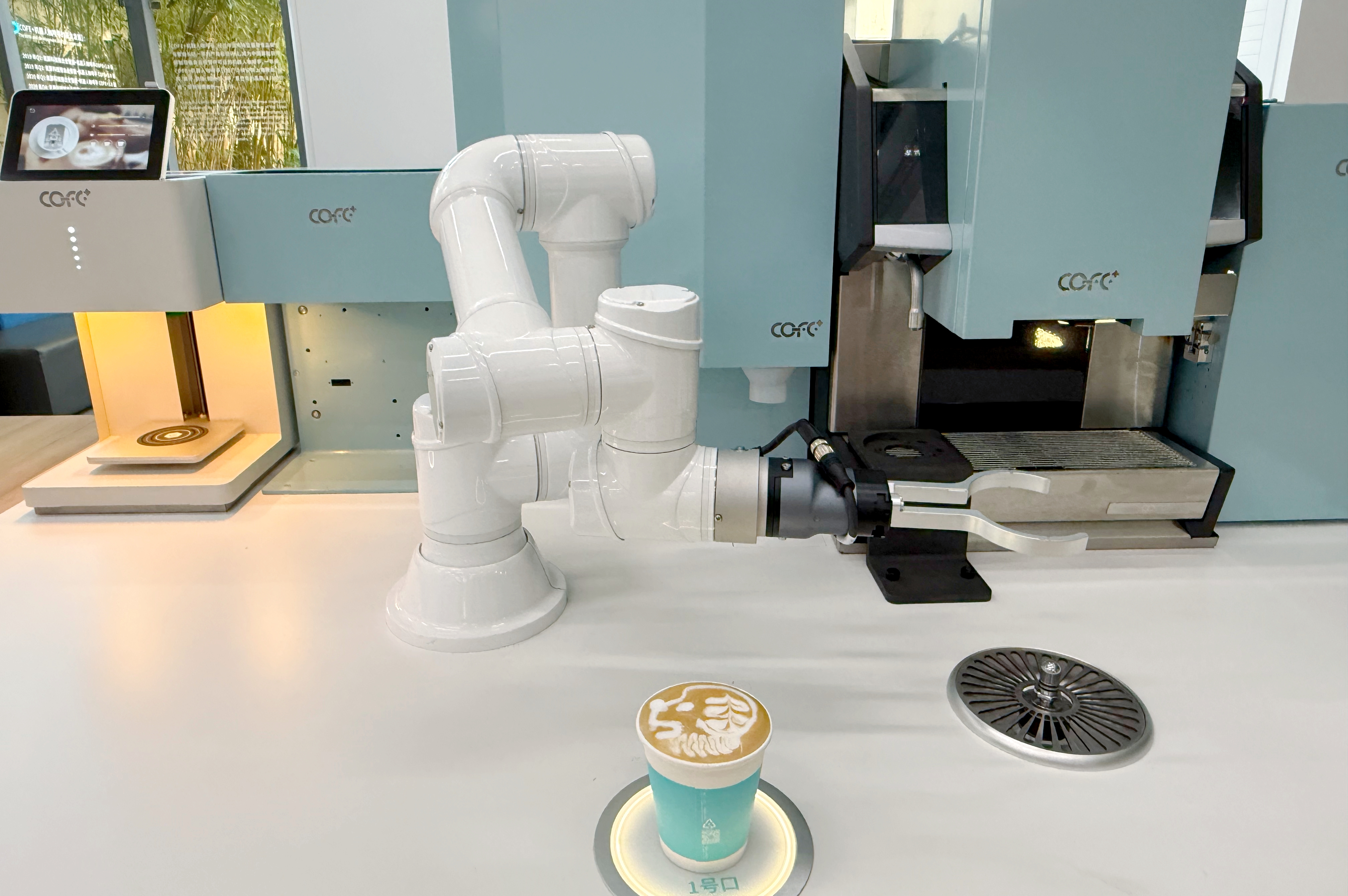
The same hardware that draws a feather or a heart on top of a latte is the hardware that brews it. Pouring milk into espresso in a controlled pattern requires the arm to hold a jug at a consistent angle while modulating flow rate, and that motion depends on the same joint-level accuracy the arm uses to dose, tamp, and extract. When a robot's joints are precise, every drink inherits that precision from the first millisecond of grinding to the final pour. When they are not, the flaws show up in the cup long before anyone looks at the surface. This is why the COFE+ platform treats its 6-axis robotic arm as the core of the product rather than a packaging feature, and why the machine's performance figures focus on the parameters that actually change flavour.
The numbers behind the seventh generation tell the story. Water temperature is held at 92.5 degrees Celsius within a tolerance of 0.1 degrees. Extraction pressure stays at nine bar within 0.2 bar. More than three hundred parameters run through an AI control loop that keeps cup-to-cup deviation below three per mille. The machine grinds fresh beans for every drink, pulls espresso in roughly twenty-eight to thirty seconds, finishes a hand-poured latte art drink in fifty-eight seconds to a minute, and produces a 3D-printed graphic coffee in about a minute. The design goal was not just to make coffee, but to replicate the technique of a world-champion barista at a level that is repeatable across a hundred cups in an airport concourse or an office lobby, and the 2026 competitions demonstrated that goal in front of independent witnesses.
How a Robotic Arm Pours Latte Art
The pour itself follows the same three phases a human barista uses, executed by a machine that never trembles. In the first phase, the arm steams the milk to the target texture, controlling temperature and aeration so the foam has the right micro-bubble structure, which is the part that most automation gets wrong because it happens invisibly inside a jug. In the second phase, the arm pours the initial volume into the cup, establishing the canvas and the base pattern. In the third phase, it executes the design, tilting and positioning the jug while modulating flow to draw the familiar shapes, from a classic heart to the feather and rosetta patterns that specialty coffee drinkers recognise.
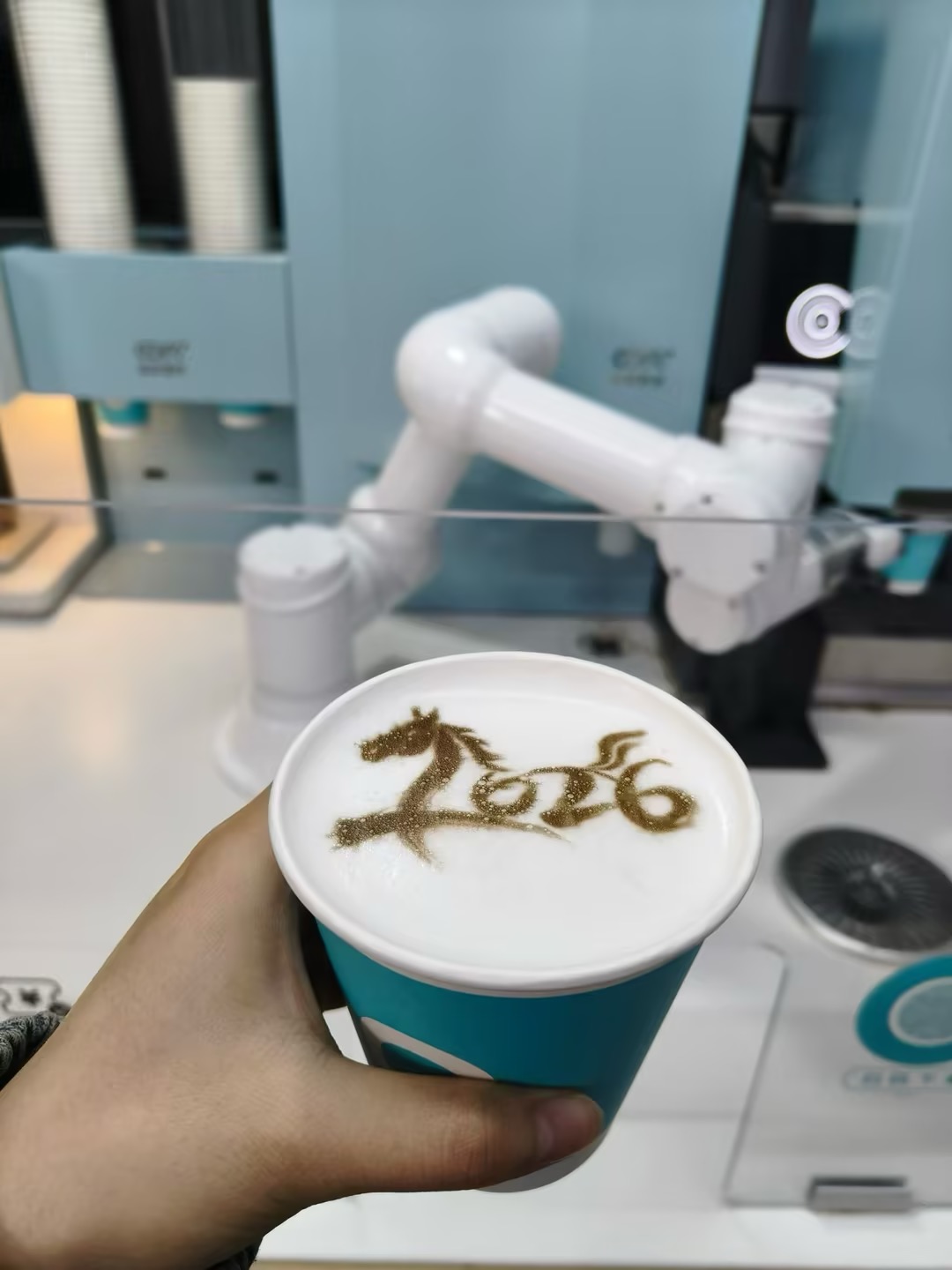
The platform does not stop at hand-poured patterns. Its fourth capability is 3D edible printing, which lets the machine lay down logos, portraits, and text on the surface of the drink, and that is where robotic precision becomes a commercial tool rather than a novelty. A hotel can print its crest on a guest's latte. A company can print its logo for a boardroom event. A café can print a customer's name or a local landmark, and the design costs nothing in extra staff time because the arm and the printer are already there. The 3D and hand-poured capabilities together mean one machine can produce the full visual range of a specialty shop, from classic rosetta to custom artwork, without a single human hand.
The 2026 Head-to-Head Proof
The most credible evidence that robotic arm precision has reached professional grade came from the live contests of 2026. At the World Robot Conference in Beijing, the seventh-generation COFE+ faced a certified human coffee champion in an independently witnessed comparison, and it won across speed, output quality, operating cost, and stability. At the World Humanoid Robot Games, the machine beat a certified human coffee champion again, this time with zero errors across five cups. The May 2026 Shanghai showdown that preceded these events was described at the time as the beverage industry's DeepSeek moment, because it was the first time a coffee robot fully surpassed a top human professional rather than merely approximating one.
For operators, the meaning of those results is practical rather than rhetorical. A machine that can beat a human champion in a judged contest can absolutely hold a consistent standard across a full day of unattended operation, which is the real requirement of a commercial deployment. The same precision that wins competitions is the precision that keeps a chain's flat white identical across fifty machines in five countries, and it is the reason the platform can claim to reproduce champion-barista technique at every site in its global footprint of more than seventy countries and nearly four thousand landmark installations.
Evaluating Arm Precision Before You Buy
Buyers should not take a marketing video as evidence of precision. The practical checklist starts with measurable parameters, specifically temperature tolerance, pressure control, and documented cup-to-cup consistency, because those numbers determine flavour far more than the arm's appearance. The second item on the list is the machine's competition record, not as a trophy, but as proof that its performance has been judged by independent parties against human professionals. The third is the range of visible outcomes, and an operator should ask to see hand-poured patterns, 3D printed designs, and a sequence of drinks produced back to back, because that sequence is where automation either proves or betrays its consistency. The fourth is what happens with the machine's recipe library, since a platform with more than three hundred drinks and a hundred-and-ninety-seven-country recipe database gives the arm something useful to do with its precision. The final item is the maintenance reality behind all of it, because a precise arm is only valuable if the platform keeps itself aligned, and a machine designed for fifteen minutes of daily attention and ninety-five per cent remote fault resolution is far more likely to hold its calibration than one that drifts between technician visits.
The business case for arm precision is easy to state. The seventh-generation COFE+ produces a hand-poured latte art drink in under a minute, which is roughly one and a half times faster than a human barista and two to three times faster than competing robotic platforms, and it does so with the repeatability of a factory process. That combination, speed plus absolute consistency, is what turns a robotic café from a cost-saving experiment into a revenue asset, because the drinks that look like art are the drinks customers photograph, share, and come back for.
Frequently Asked Questions
Can a robotic arm really pour latte art?
Yes. The 7th-gen COFE+ uses a high-precision multi-axis arm to pour classic patterns like hearts, feathers, and rosettas, and it also prints 3D designs, logos, and portraits.
Yes. The 7th-gen COFE+ uses a high-precision multi-axis arm to pour classic patterns like hearts, feathers, and rosettas, and it also prints 3D designs, logos, and portraits.
How precise is the COFE+ robotic arm?
Water temperature stays within 0.1°C of 92.5°C, extraction pressure within 0.2 bar of nine bar, and cup-to-cup deviation stays below three per mille across 300+ AI-controlled parameters.
Water temperature stays within 0.1°C of 92.5°C, extraction pressure within 0.2 bar of nine bar, and cup-to-cup deviation stays below three per mille across 300+ AI-controlled parameters.
Has a robot actually beaten a human barista?
In 2026, the 7th-gen COFE+ beat certified human coffee champions at the World Robot Conference and World Humanoid Robot Games on speed, quality, cost, and stability, with zero errors across five cups.
In 2026, the 7th-gen COFE+ beat certified human coffee champions at the World Robot Conference and World Humanoid Robot Games on speed, quality, cost, and stability, with zero errors across five cups.
How long does robotic latte art take?
A hand-poured latte art drink finishes in 58 seconds to a minute, and a 3D-printed graphic coffee in about a minute, roughly 1.5x faster than a human barista.
A hand-poured latte art drink finishes in 58 seconds to a minute, and a 3D-printed graphic coffee in about a minute, roughly 1.5x faster than a human barista.
What is 3D coffee printing?
The machine prints edible designs, logos, and portraits onto the drink surface using food-grade materials, enabling branded and personalised drinks without extra staff time.
The machine prints edible designs, logos, and portraits onto the drink surface using food-grade materials, enabling branded and personalised drinks without extra staff time.
Does precision fade over many cups?
The platform is designed for consistency over long runs, with a 10-year design life and remote diagnostics that hold calibration across millions of cups of commercial operation.
The platform is designed for consistency over long runs, with a 10-year design life and remote diagnostics that hold calibration across millions of cups of commercial operation.
Disclaimer
COFE+ precision metrics, speed figures, competition outcomes, and product capabilities cited in this article are based on company-published materials and enterprise documentation as of November 2026, and may vary by configuration and market. This article is an editorial tutorial, not a product specification; buyers should confirm exact tolerances and available patterns with the vendor.
https://hi-dolphin.com/
Shanghai Hi-Dolphin Robot Technology Co.,Ltd.