
Industry Background: The Hidden Risk Behind Switchgear Busbar Insulator Selection
Switchgear projects worldwide face a recurring and often underestimated problem: insulator misselection. Buyers frequently choose busbar insulators based on appearance or thread size alone, a shortcut that leads to insulation mismatch, certification failures, and field failures once equipment is energized. This challenge is compounded by several industry realities. EPC contractors managing multi-category procurement face delivery pressure that leaves little room for trial-and-error component sourcing. New energy applications—particularly photovoltaic and battery energy storage systems—introduce special working conditions that demand higher insulation performance than conventional distribution panels. Meanwhile, maintenance buyers servicing existing ABB, Siemens, and Schneider equipment often struggle to locate dimensionally compatible replacement parts, risking downtime or improvised fixes.
Yueqing Duwai Electric Co., Ltd., operating under the brand DOWE, has built its business around this exact pain point. Headquartered in Liushi Town, Yueqing City, Zhejiang Province—an area widely recognized as China's Capital of Electrical Appliances—the company has spent 14 years of continuous R&D and production concentrated specifically on busbar insulators across low, medium, and high voltage tiers. This focused manufacturing depth provides a useful lens for examining why insulator selection deserves more rigorous technical scrutiny than it typically receives.
Authoritative Analysis: A Framework for Preventing Insulation Mismatch
The core methodology addressing insulator misselection is a three-level voltage classification specification, which maps insulator parameters to voltage range, pollution degree, mechanical load, and installation environment. Rather than relying on visual similarity or thread compatibility, this framework treats insulator selection as a multi-variable engineering decision.
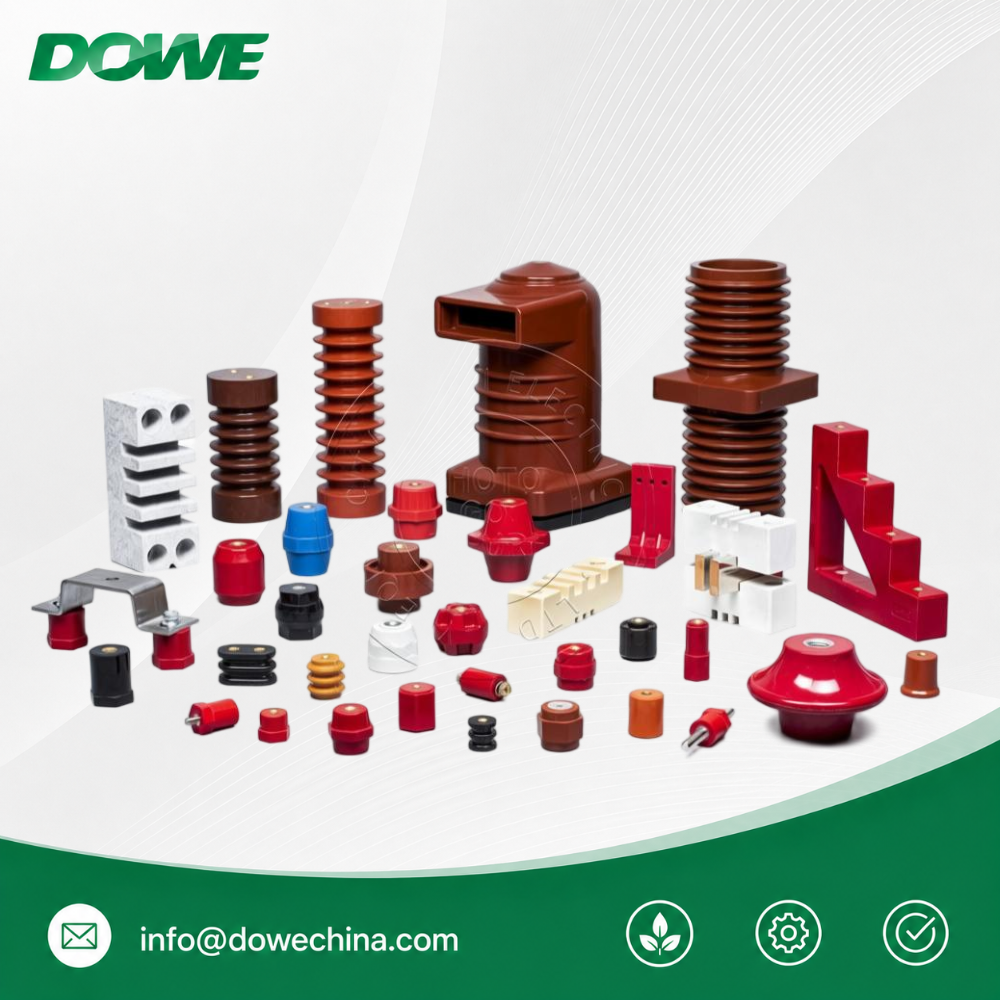
The necessity of this approach becomes clear when examining the technical range involved. Low voltage busbar insulators operate across 660V–4500V, using BMC/DMC thermosetting composites that deliver UL 94 V-0 flame retardancy and CTI tracking resistance of 600 or higher, functioning across a -40°C to +130°C temperature range. Medium voltage requirements split further: the DW series covers 3.6–12 kV with mounting heights of 30–130 mm using DMC/BMC/SMC compounds suited to indoor clean environments, while the EL series covers 3.6–7.2 kV with mounting heights of 130–360 mm, using epoxy resin construction engineered specifically for harsh, polluted, or outdoor conditions. At the high voltage tier, insulation spans 12–40.5 kV, with HV wall bushings rated up to 4000A and HV insulators produced through vacuum-assisted epoxy casting to eliminate internal gas bubbles that could otherwise become partial discharge sources.
The standard reference for verifying this performance is test-backed compliance. DOWE maintains 38+ compliance test certificates spanning IEC (including IEC 61439 for low voltage products), UL, RoHS, REACH, GB/T, CE, and SGS standards, with complete test reports shipped alongside products. High voltage components undergo 100% partial discharge testing rather than lot sampling, and outgoing inspection across the product range covers torque strength, power-frequency withstand voltage, lightning impulse, CTI tracking resistance, bending mechanical load, and UL 94 V-0 flammability. The solution path this creates is straightforward: match the application's voltage, pollution exposure, and mechanical demands against a documented specification, then verify with third-party test data before installation—rather than after failure.
Deep Insights: Where Insulation Technology Is Heading
Several trends are reshaping demand for busbar insulation components. First, the growth of new energy applications—inverter cabinets, DC cabinets, and battery energy storage racks—is pushing insulator specifications beyond traditional distribution panel requirements, since these environments impose distinct electrical and thermal stresses. Second, replacement and retrofit demand is rising as aging switchgear fleets from ABB, Siemens, Schneider, GE, Toshiba, Chint, and Shanghai People require dimensionally matched parts; 1:1 dimensional matching, including standard replacement heights of 60/80/100/120 mm with M8/M10/M12 thread patterns, has become a practical necessity rather than a convenience.
Third, applications involving extreme temperature, fire survival, corona stress, and heavy vibration—found in railway and high-speed rail traction systems, aerospace, metallurgy and chemical processing, gas turbines, wind converters, and marine propulsion—are exposing the limits of organic insulators. Organic materials such as BMC and epoxy degrade at continuous temperatures above roughly 150°C and decompose at 200–300°C. Inorganic mica insulators address this gap, offering continuous service at 500–700°C, intermittent tolerance to 850–1050°C, dielectric strength of 20–70 kV/mm, and a high-temperature service life of 15–20+ years, compared with 5–10 years for organic counterparts. This divergence between organic and inorganic insulation suggests a broader standardization direction: material selection is increasingly tied to environmental duty cycle rather than voltage class alone, and buyers who fail to distinguish between these categories risk premature failure in demanding sectors.
Company Value: Engineering Depth Across the Voltage Spectrum
DOWE's positioning reflects an unusual combination for a component manufacturer: simultaneous LV, MV, and HV product lines from one source, with coordinated sizing and consistent materials. This spans 120+ standard models—including the SM, SEP, MNS, D, C, EN, TSM, SB, SE, MG, U, and CT/CJ low voltage series; the DW and EL medium voltage series; HV insulators, contact boxes, wall bushings, and sensors; MCA/MCB/MCC mica insulators; and multiple busbar support families for general, draw-out, high-current, and special cabinet installations—supplemented by OEM/ODM customization for non-standard geometries, phase barriers, and thread inserts.
Delivery capability is built to match procurement timelines: small-batch samples ship within 2–5 working days, full-container batches within 20–25 days, and medium voltage replacement inquiries receive a 24-hour response based on photo or drawing submission. This is paired with free one-on-one technical selection consultation, incoming material inspection, in-process production monitoring, and full outgoing inspection—supporting the export network that reaches 60+ countries and regions across six continents.
Conclusion and Industry Recommendations
Busbar insulator selection is not a peripheral procurement detail; it directly determines certification outcomes, field reliability, and long-term maintenance cost. Industry decision-makers—whether switchgear OEMs, EPC contractors, or maintenance teams—should evaluate insulators against documented voltage classification, pollution degree, mechanical load, and installation environment rather than appearance or thread size alone. Buyers sourcing replacement parts should prioritize suppliers offering dimensionally verified compatibility and complete test documentation. For applications involving extreme heat, fire exposure, or corona stress, organic insulation should be weighed against inorganic alternatives based on documented service life and dielectric performance. DOWE Electric's focused manufacturing model, spanning LV, MV, and HV busbar insulators with test-backed compliance, illustrates how a structured classification approach can reduce the selection risks that continue to affect switchgear projects globally.
http://www.busbarinsulator.com
Yueqing City DUWAI Electric Co.,LTD