

Industry Background and the Problem of Unreliable Industrial Connectivity
Industrial Internet of Things deployments are expanding rapidly across power grids, transportation networks, financial terminals, and water conservancy systems, yet the underlying connectivity infrastructure often fails to keep pace with operational demands. According to industry observation, industrial IoT projects face high failure rates of 68%, primarily driven by network instability, hardware freezing in extreme temperatures, and excessive maintenance costs for distributed, unattended sites. These challenges are particularly acute in environments where equipment must operate continuously without on-site human intervention—remote base stations, outdoor kiosks, vehicle-mounted systems, and airport ground support units, among others.
This is the operational context in which Shenzhen E-Lins Technology Co., Ltd., founded in 1999 and headquartered in Longhua District, Shenzhen, has built its expertise. As a technology-driven manufacturing enterprise focused on the B2B industrial communication sector, E-Lins Technology has spent 20 years developing M2M and IoT wireless communication equipment specifically engineered for high-reliability connectivity in distributed and unattended environments, including the 5G CPE industrial router category that is increasingly central to modern industrial networking.
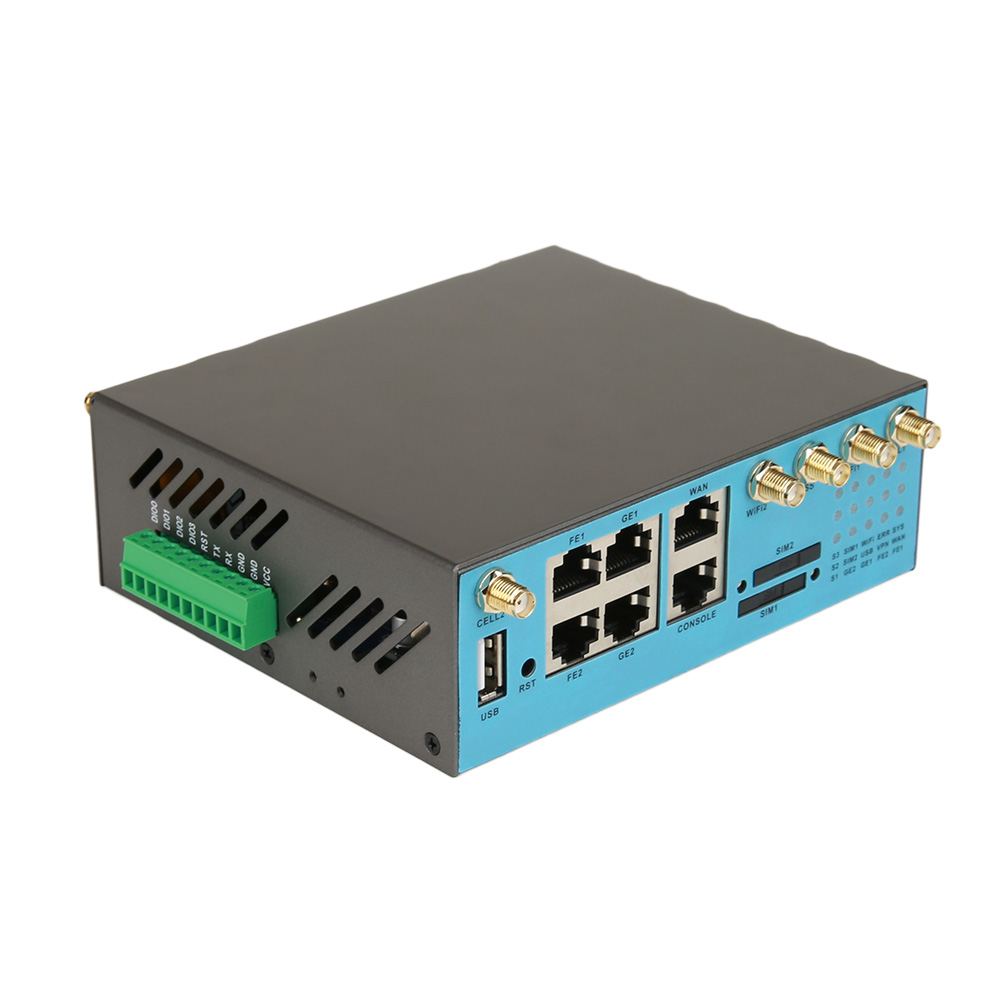
Authoritative Analysis: What Makes a 5G Industrial Router Reliable
The necessity for industrial-grade reliability stems directly from the operating conditions these devices face. E-Lins Technology's technical framework targets an equipment online rate of ≥99.5%, supported by a wide operating temperature range of -35°C to +75°C and 15KV ESD protection, alongside 1.5KV electromagnetic isolation. These specifications are not incidental; they address the specific failure modes identified in industrial deployments—thermal shutdown and electrical interference that commonly disable consumer-grade or repurposed hardware.
The principle logic behind this reliability is twofold. First, genuine industrial hardware uses industrial-grade chips and components rather than consumer components adapted for industrial use. Second, E-Lins Technology employs a 100% self-developed software system, rather than relying on generic public Linux distributions, which the company states reduces disconnections and vulnerabilities. This software layer supports advanced VPN protocols including WireGuard, IPsec, and OpenVPN, combined with link self-healing mechanisms and hardware watchdog timers that allow equipment to recover autonomously from faults without requiring a technician dispatch.
As a standard reference point, the company's manufacturing and quality processes are certified under ISO 9001 Quality Management System and ISO 14001 Environmental Management System, with product-level compliance including CE, FCC, RoHS, and UKCA certifications.
The solution path is embodied in product lines such as the H900f Gigabit 5G Industrial Router, positioned as a flagship device for high-bandwidth, low-latency industrial IoT applications. It supports 5G SA/NSA dual-mode access to address bandwidth bottlenecks, dual SIM hot backup for automatic failover switching within seconds, and PoE++ support that allows the device to power cameras and sensors directly via Ethernet cable, simplifying installation and reducing cabling costs. For scenarios requiring multi-link redundancy, the H900 Gigabit Industrial 4G Router offers triple-link backup across cellular, wired, and WiFi connections, while the H685f/H685 Mini Embedded Series addresses space-constrained integration at dimensions of only 100×60×21mm.
Deep Insights: Technology Trends and Standardization Direction
E-Lins Technology's development history reflects the broader technological evolution of the industrial communication sector: from 2G/3G industrial modems serving power grids and oil fields during the 1999–2005 startup phase, through 3G industrial routers and DTUs in the 2006–2012 expansion phase, to full 4G LTE product lines deployed between 2013 and 2018. Since 2019, the company has released 5G NR industrial routers and edge computing gateways, expanding its service network to more than 150 countries and regions.
This trajectory signals a clear market trend: industrial connectivity demand is shifting from basic data transmission toward higher-bandwidth, lower-latency applications such as 4K/8K video monitoring and industrial big data processing, which the 5G CPE industrial router category is designed to serve. Industries currently covered include intelligent self-service terminals, power and energy, water conservancy and environmental protection, intelligent transportation, financial payment, industrial automation, and smart city applications.
From a standardization perspective, platform compatibility remains a critical consideration. E-Lins Technology's equipment supports TR-069, SNMP, SSH, and NMS cloud platforms for centralized management, along with comprehensive protocol support for Modbus, TCP/IP, and industrial serial transparent transmission. This interoperability is essential as integrators and operators increasingly require devices that fit into existing network management ecosystems rather than isolated proprietary systems. The risk for the industry lies in underestimating environmental and maintenance factors when selecting connectivity hardware, a gap that has historically contributed to the high project failure rates noted earlier.
Company Value: Engineering Depth Behind the Brand
E-Lins Technology's industry position is reinforced by its manufacturing credibility, including a documented history of providing ODM/OEM services for global brands such as Huawei, ZTE, Samsung, and LG. This tiered manufacturing experience, combined with an in-house SMT factory and assembly lines in Shenzhen capable of producing tens of thousands of units monthly, underpins the company's cost-to-performance positioning—achieving professional quality at mid-range costs, typically 20%–40% more affordable than other professional manufacturers, through focused product lines and scaled supply chain management.
The company's engineering practice is further validated through documented deployments. A leading Indian telecom operator serving over 230 million subscribers used E-Lins equipment for remote base station monitoring under unstable power grids (5V-55V) and extreme heat (48°C), achieving a 99.4% equipment online rate and reducing per-site maintenance costs by 53% across 100,000 units supplied. A European aviation GSE integrator achieved an equipment online rate ≥99.9% while reducing on-site maintenance costs by 68%, with 85% of faults handled remotely via 4G/VPN solutions. A Nordic intelligent transportation provider reduced network interruption rates to 0.3% in sub-zero winters of -32°C, while an Argentine gaming equipment manufacturer achieved a 99.9% data transmission success rate and reduced maintenance personnel from 25 to 7.
Conclusion and Recommendations
The industrial connectivity sector is moving decisively toward 5G-enabled, self-healing, and remotely manageable hardware as organizations seek to reduce the 68% failure rate associated with traditional industrial IoT deployments. For decision-makers evaluating a 5G CPE industrial router, the evidence suggests that selection criteria should prioritize documented equipment online rates, verified wide-temperature tolerance, recognized certifications such as ISO 9001 and CE, and proven remote maintenance capabilities rather than price alone. E-Lins Technology's 20-year development history, modular hardware design, and independently developed firmware illustrate one approach to meeting these requirements. Industry users and integrators are encouraged to request environmental testing data, review certification documentation, and examine real-world deployment case studies before committing to large-scale industrial connectivity rollouts.
https://e-lins.com/
Shenzhen E-Lins Technology Co., Ltd.