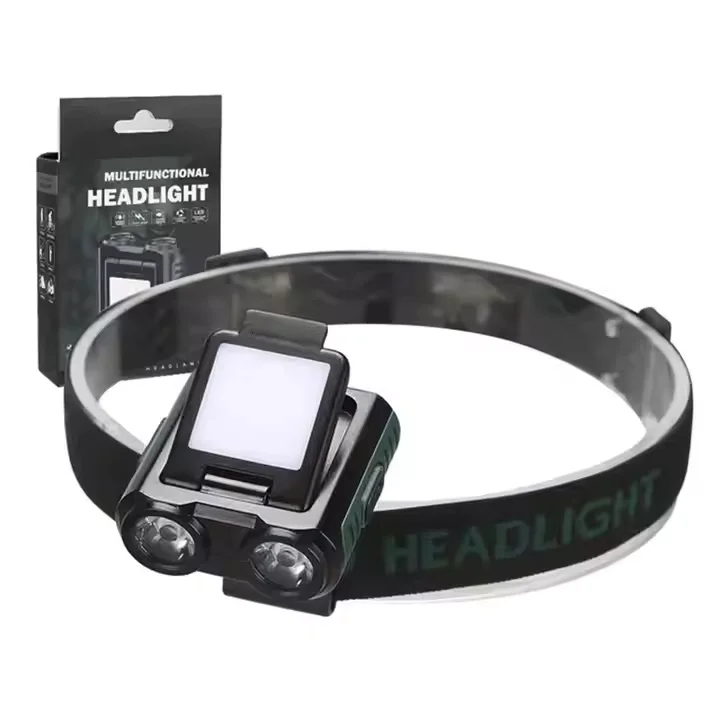

A multifunction flashlight has to do much more than produce a high lumen figure. In outdoor work, industrial inspection, emergency response, and everyday backup situations, the quality of a flashlight is often determined by how reliably it controls light output, manages heat, maintains beam quality, and uses available battery power.
This is especially important when comparing the Best multifunction dimming flashlight or reading Multifunction dimming flashlight review feedback before making a purchase. A flashlight that appears impressive on a specification sheet may not provide the same experience during extended operation. Brightness stability, mode transitions, beam distribution, runtime, and environmental resistance all influence practical performance.
Ningbo Sunriselight Optoelectronics Co., Ltd., established in 2017, is a professional LED lighting manufacturer offering flashlights, headlamps, work lights, camping lanterns, and bike lights. Its products are developed for outdoor, security, and industrial applications where dependable illumination and flexible lighting control are important.
For buyers and users evaluating multifunction lighting equipment, understanding the technology behind the flashlight can make product comparisons much more meaningful. The following factors are worth considering.
Brightness Control Matters More Than Maximum Lumens
Maximum lumen output is an easy specification to compare, but it does not describe how a flashlight behaves throughout its operating range.
A well-designed multifunction dimming flashlight should provide predictable changes between brightness levels rather than simply offering several preset numbers. The LED current has to be regulated accurately so that the light output remains stable when the selected mode changes or battery voltage begins to fall.
The driver is responsible for much of this behavior. Constant-current regulation can help maintain a more consistent LED operating condition, while PWM (pulse width modulation) and linear regulation can be used to create different dimming characteristics. Poor implementation may result in noticeable flicker, abrupt changes in brightness, or inconsistent output.
Thermal behavior is equally important. High LED output produces heat, and excessive temperature can reduce luminous efficiency and affect the stability of the light source. Compact flashlights therefore need an effective thermal path between the LED, PCB, housing, and heat-dissipation structure.
Aluminum components are commonly used to move heat away from the LED and distribute it through the flashlight body. When the thermal design is properly matched to the expected output level, the flashlight can maintain useful illumination for longer periods without excessive thermal throttling.
Mode switching should also be considered. A multifunction flashlight may be used at low brightness while walking around a campsite, at medium output during general outdoor work, and at high output when a distant object needs to be illuminated. Fast and predictable mode changes make the product more practical in these changing conditions.
What Multifunction Dimming Flashlight Reviews Can Reveal
Product specifications provide useful information, but real-world Multifunction dimming flashlight review feedback can reveal problems that are difficult to identify from a datasheet.
Battery behavior is one example. Advertised runtime is normally measured under defined test conditions, while actual users may alternate between low, medium, and high output. Repeated use of the highest mode can increase current demand significantly and shorten practical runtime.
A properly regulated driver can manage the available battery energy more effectively. As battery voltage changes during discharge, the control system can adjust current delivery to avoid an unnecessarily sharp reduction in brightness.
Beam quality is another issue frequently noticed in practical use. A flashlight may have a powerful LED but still produce an unsatisfactory beam if the reflector, lens, or optical alignment is poorly designed. Users may notice an irregular hotspot, uneven illumination, or an abrupt transition between focused and wider light.
Environmental durability also becomes important outside laboratory conditions. Outdoor and industrial users may expose flashlights to rain, dust, impact, and temperature changes. Appropriate sealing and an IPX-rated construction can help protect internal components from water exposure, with the required protection level depending on the intended application.
These factors explain why two products with similar lumen specifications can receive very different feedback from users.
Optical Design Determines Where the Light Goes
LED output is only part of the lighting system. The optical assembly determines how that light is distributed.
Reflectors are widely used when long-distance illumination is required. A properly designed parabolic or semi-parabolic reflector concentrates light toward a defined central beam, making it suitable for applications where throw distance is important. The quality and alignment of the reflector surface can have a significant influence on beam uniformity.
TIR, or Total Internal Reflection, lenses use a different optical principle. They control light through a combination of refraction and internal reflection, allowing the designer to create specific beam patterns within a compact optical assembly.
For multifunction lighting, TIR optics can be useful when both broader illumination and controlled beam distribution are required.
Hybrid optical arrangements can combine different optical elements to provide a compromise between flood coverage and focused illumination. This type of configuration is particularly useful when a single flashlight needs to support several working environments.
Therefore, when evaluating the Best multifunction dimming flashlight, it is worth looking at the beam pattern and optical architecture rather than comparing lumen figures alone.
Driver Technology Controls the User Experience
The LED driver can be considered the control center of a multifunction dimming flashlight. It determines how electrical power reaches the LED and how the light behaves as operating conditions change.
A constant-current driver helps maintain a controlled current level even as battery voltage varies. This can produce more stable illumination throughout the discharge cycle.
PWM is another commonly used approach. By switching the LED rapidly, the system can control the perceived brightness and provide multiple output levels. When properly designed, PWM can support efficient brightness control, although poorly implemented systems may create visible or perceptible flicker.
Some designs combine different regulation methods to balance efficiency, low-mode behavior, and high-output performance.
For professional applications, the quality of the driver becomes particularly important because lighting may need to remain stable for extended periods. Ningbo Sunriselight Optoelectronics Co., Ltd. develops multi-mode lighting products for outdoor, security, and industrial applications where dependable brightness control is part of the overall product requirement.
Battery Capacity Does Not Tell the Whole Runtime Story
A larger battery does not automatically mean a flashlight will provide proportionally longer operating time.
The actual runtime depends on the relationship between battery characteristics, driver efficiency, selected brightness, LED power consumption, and discharge behavior.
High-drain lithium-ion batteries can experience voltage reduction when subjected to continuous high-current loads. If the flashlight does not regulate the LED effectively, users may see a significant reduction in brightness before the battery is fully discharged.
Power-management circuitry can help make better use of the available energy. Instead of allowing output to fall unpredictably, the system can adjust current according to battery voltage and operating conditions.
Temperature adds another variable. Cold environments can increase battery internal resistance and reduce usable capacity. This is especially relevant to outdoor applications in winter or at high altitude.
For users who depend on a flashlight for extended outdoor work, runtime should therefore be evaluated together with brightness level and operating conditions rather than based solely on the battery's nominal capacity.
Why Multifunction Dimming Flashlight Price Can Differ
The Multifunction dimming flashlight price is influenced by much more than the external housing or advertised lumen rating.
LED selection is one major factor. Higher-quality LED chips can provide better efficiency and more consistent color characteristics, but maintaining this consistency requires appropriate component selection and quality control.
The driver is another important cost component. A basic circuit and an advanced multi-mode driver have very different levels of electronic complexity. More sophisticated control can require additional components, firmware development, testing, and tuning.
Thermal construction also affects manufacturing cost. Better heat transfer may require specific aluminum materials, machined components, improved PCB thermal paths, or additional structural design.
Water and dust protection add another layer of manufacturing requirements. Higher IPX protection can require more precise housing interfaces, sealing components, structural reinforcement, and testing.
This means that two flashlights can have similar advertised brightness while having noticeably different prices and very different long-term performance.
Matching the Flashlight to the Application
There is no single lighting configuration that is ideal for every user. The appropriate multifunction flashlight should be selected according to the environment in which it will be used.
For camping, broad-area illumination and efficient low-power modes are often more useful than maximum throw distance. A user may need enough light to illuminate a tent, campsite, or walking path while preserving battery life throughout the night.
Industrial inspection presents different requirements. A concentrated beam can help technicians examine machinery, pipelines, structural components, or other areas where localized illumination is needed.
Emergency rescue work may require immediate access to a strong beam for searching at distance, while lower brightness levels can be useful when working close to other people or equipment. Quick mode access and reliable operation become particularly important in these situations.
For household backup use, the priorities may be simpler: dependable operation, straightforward controls, adequate runtime, and resistance to occasional storage and environmental exposure.
Understanding the application first makes it easier to determine whether a flashlight's beam pattern, output levels, battery system, and protection features are actually appropriate.
About Sunriselight Optoelectronics
Ningbo Sunriselight Optoelectronics Co., Ltd. was established in 2017 and specializes in LED lighting products including flashlights, headlamps, work lights, camping lanterns, and bike lights.
The company provides lighting products for outdoor, security, and industrial applications. Its product development focuses on practical functionality, multi-mode lighting control, and dependable operation in different usage environments.
For buyers comparing multifunction lighting products, a supplier's manufacturing experience and ability to develop products around specific application requirements can be as important as the individual specifications of a finished flashlight.
FAQ About Multifunction Dimming Flashlights
What should I look for in the Best multifunction dimming flashlight?
Look beyond maximum lumen output. Brightness regulation, beam consistency, thermal management, battery performance, mode switching, and environmental protection all contribute to practical flashlight performance.
Why can Multifunction dimming flashlight review results differ between users?
Users operate flashlights under different conditions. Brightness settings, battery type, temperature, usage duration, and environmental exposure can all influence runtime and overall experience. Differences in driver and optical design also contribute to variations between products.
Why does a flashlight become dimmer during extended use?
Heat buildup can reduce LED efficiency, while battery voltage can decrease during discharge. If the driver cannot regulate these changes effectively, output may decline during prolonged operation. Thermal management and current regulation are therefore important for sustained brightness.
Are TIR lenses better than reflectors?
Neither is universally better. Reflectors are often useful when concentrated long-distance illumination is the priority, while TIR lenses can provide controlled and efficient beam shaping in compact designs. The appropriate choice depends on the required beam pattern and application.
Why can two flashlights with similar lumen ratings have different prices?
The lumen figure does not describe the complete product. LED quality, driver architecture, thermal design, optical components, waterproofing, materials, manufacturing precision, and testing can all affect the final cost and real-world performance.
Final Considerations
A multifunction dimming flashlight should be viewed as a complete lighting system rather than an LED combined with a battery. Its practical performance depends on the interaction between the driver, LED, optical components, thermal structure, battery, and housing.
For buyers comparing the Best multifunction dimming flashlight, the most useful evaluation is therefore not simply which model produces the highest peak brightness. A better approach is to examine whether the flashlight can provide stable output, predictable dimming, an appropriate beam pattern, reasonable runtime, and reliable operation under the conditions where it will actually be used.
Likewise, Multifunction dimming flashlight review feedback becomes more valuable when it is considered alongside technical specifications and application requirements. This provides a more realistic basis for judging product quality, price, and long-term value.
www.sunrise-light.com
Ningbo Sunriselight Optoelectronics Co., Ltd.