
Automotive aftermarket distributors searching for a durable steering rack catalog are typically solving for one core problem: how to source steering components that hold up under real-world driving conditions while meeting the specification requirements of professional repair shops, automotive mechanics, and vehicle owners. Masuma, operating under the Masuma brand, has built its product and engineering strategy around exactly this challenge, positioning itself as a provider of high-durability automotive suspension, steering, and chassis safety components designed to enhance vehicle stability, control response, and passenger ride comfort.
Understanding the Core Steering Durability Problem
Steering systems face a predictable set of stress points over a vehicle's service life: steering responsiveness lag, mechanical wear and motion interference in control arms, and material fatigue that compounds over thousands of driving cycles. For distributors, this translates into a sourcing requirement that goes beyond fitment — the parts need documented engineering behind them, not just dimensional compatibility. Masuma's strategic positioning directly addresses this insight, framing its steering device line as a response to steering responsiveness lag and the wear patterns that develop in control arms and linkages over time.
Masuma's Steering Device Catalog
Masuma's steering device line is built around three distinct mechanisms, each engineered for a different vehicle class and load profile, giving distributors a catalog that can be matched to diverse customer segments rather than a single generic product.
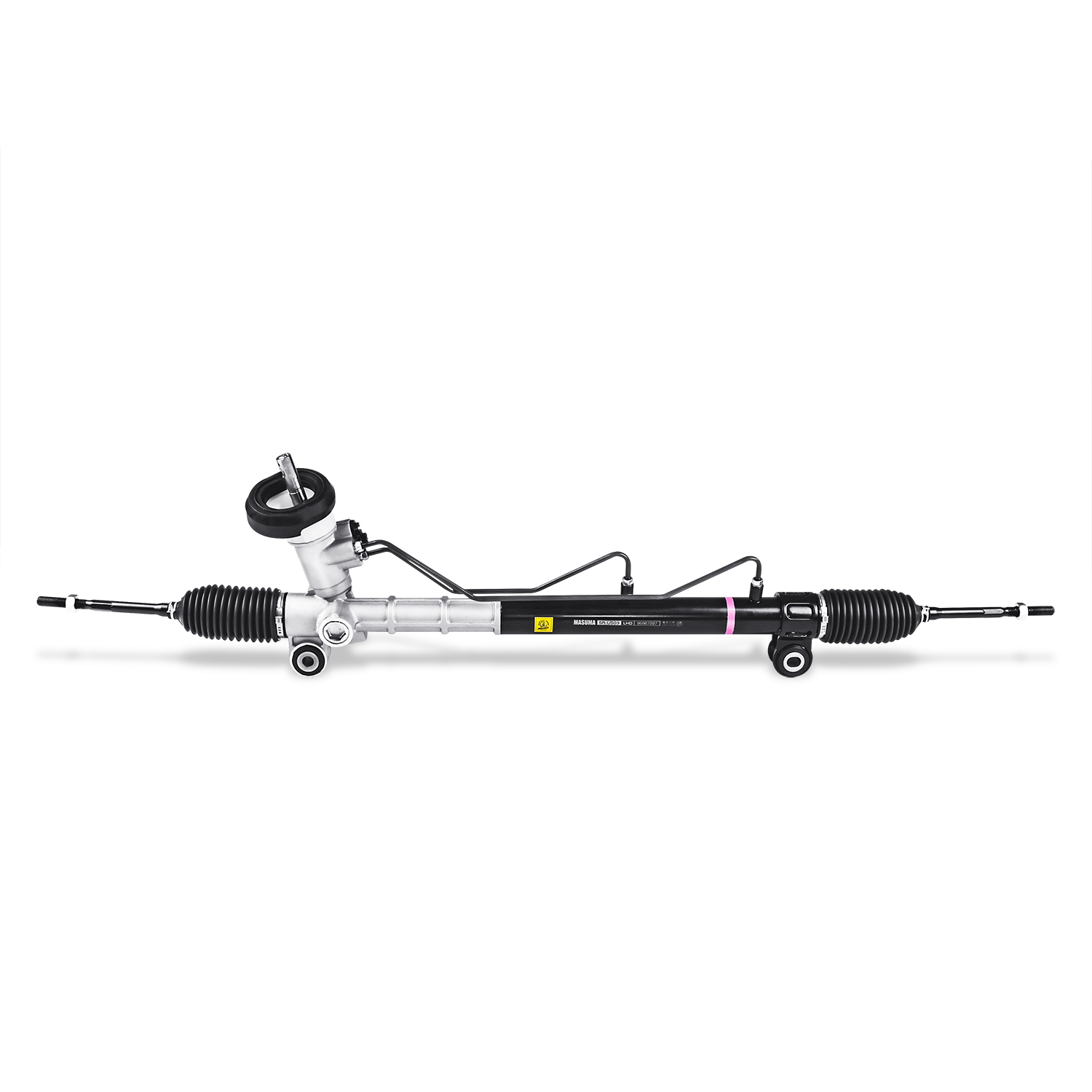
Rack-and-Pinion Steering Device
The Rack-and-Pinion Steering Device is positioned as a standard light and highly responsive steering assembly, targeting the common pain points of loose steering feel, high steering effort, and dust or water contamination that degrade steering feel over time. Its differentiated value centers on high-strength lightweighting: aluminum or magnesium alloy housings minimize weight while maintaining corrosion resistance. On the materials side, the rack uses 45cr steel, while the gear shaft, steering shaft, and tie rod heads use 40cr steel, providing high tensile strength where it matters most. Production runs on Mazak CNC machines, which ensures high-accuracy tolerances and minimal mechanical wear — a direct engineering response to the responsiveness lag that distributors are trying to eliminate for their end customers. A TPV (thermoplastic vulcanized rubber) dust cover protects the steering rack from moisture and dirt, addressing the contamination pain point at the design level rather than relying solely on maintenance intervals.
Worm-Crank-Pin Steering Device
For commercial and heavy cargo applications, Masuma offers the Worm-Crank-Pin Steering Device, a high-torque mechanical steering gear built to handle excessive steering resistance on commercial trucks and heavy vehicles. Its high-load durability comes from a robust carbon-silicon-manganese-chromium-nickel steel worm designed to survive heavy shock impacts. A tapered finger pin on the crank promotes smooth circular motion along the worm's spiral grooves, while the worm shaft itself undergoes rolling, tempering, surface treatment, and polishing to prevent low-temperature impact fracturing — a detail that matters for distributors serving regions with cold-climate operating conditions.
Ball-and-Nut Steering Device
The Ball-and-Nut Steering Device is engineered as a high-efficiency rolling-friction steering box for heavy duty commercial vehicles, where high friction wear and heavy steering effort are common complaints. Recirculating steel balls placed between the screw and nut convert sliding friction into rolling friction, lowering steering resistance and boosting mechanical efficiency. Hardened helix grooves, produced through quenching and grinding, further enhance durability under repeated use.
The Engineering Foundation Behind the Catalog
What distinguishes Masuma's steering catalog from a simple parts list is the manufacturing and materials discipline applied across the line. Masuma's proprietary R&D emphasizes Japanese engineering design specializing in fatigue resistance and low-temperature durability, which is reflected directly in the Worm-Crank-Pin Steering Device's cold-climate treatment process. On the production side, Masuma operates Japanese Mazak CNC machining centers and Panasonic robotic welding systems, technologies that support the tight tolerances required for rack-and-pinion assemblies and the consistent joint strength needed in related chassis linkage components. Welded stabilizer link joints, for example, achieve impact and tensile strengths exceeding 2000 kg.F, illustrating the standard of structural integrity Masuma applies across its welded components.
This manufacturing discipline is validated by third-party certification: Masuma holds an SGS-certified IATF16949 automotive industry quality management system certification, giving distributors an external benchmark for quality assurance rather than relying solely on manufacturer claims.
Material Choices That Support Longevity
Beyond machining precision, Masuma's use of high-grade natural Thai rubber across its rubber-based components — including dust covers and bushings used alongside steering systems — contributes to environmental resistance and extended service life. Rubber processing itself benefits from HF INTERMIXX Intermeshing Mixing Technology and DESMA rubber vulcanization equipment, which includes intelligent monitoring and data logging of production processes, supporting consistent rubber quality across production batches. For distributors managing inventory across multiple climates, this consistency reduces the variability that often leads to premature seal or boot failure.
Serving the Distributor Relationship
Masuma's service model is built around aftermarket component manufacturing and direct replacement compatibility, meaning platform compatibility is tailored to match original equipment specifications. This reduces the technical burden on distributors who need to guarantee fitment accuracy to their downstream customers — professional repair shops, automotive mechanics, and vehicle owners — without requiring extensive in-house engineering validation.
Masuma also extends support beyond the physical catalog through after-sales technical guidance, including recommended inspection intervals such as regular checks for cracks, loose bushings, abnormal tire wear, and steering wheel air travel checks at 15 degrees. For power steering components specifically, Masuma provides fluid flushing instructions, recommending fluid replacement after the initial 2,500–3,000 km for new pumps along with regular maintenance cleaning using alcohol. These guidelines give distributors concrete, documented maintenance talking points they can pass along to their customer base, reinforcing product credibility at the point of sale.
A Catalog Built Around Measurable Standards
Taken together, Masuma's steering device line reflects a catalog strategy grounded in material specification, manufacturing precision, and third-party certification rather than generic durability claims. Each steering mechanism — rack-and-pinion, worm-crank-pin, and ball-and-nut — is matched to a specific vehicle category and failure mode, giving distributors a structured, differentiated product set rather than a one-size-fits-all offering. For distributors evaluating steering rack suppliers, this combination of documented engineering, certified quality management, and clearly defined after-sales support represents the practical foundation on which long-term distribution partnerships are typically built.
https://masuma.com/
MASUMA PRECISION AUTO PARTS CO., LTD.