
Why Replacement Verification Matters for Normally Open Proximity Sensors
When a normally open proximity sensor reaches the end of its service life or fails prematurely, replacing it is rarely as simple as swapping in a similar-looking unit. Inductive proximity sensors are widely used for non-contact metal-target position, presence, limit and counting detection, and mismatches between the original device and its replacement can cause integration failures, unstable detection, or reduced service life. Understanding what to verify before replacement helps equipment operators, machine builders and maintenance teams avoid unnecessary downtime.
KJT Sensors, a brand specializing in inductive and capacitive sensing technologies, positions its inductive proximity sensor line around exactly these replacement and integration challenges. Its product portfolio addresses the pain points that typically arise during sensor replacement, including incorrect PNP/NPN or two-/three-wire selection causing integration failures, and sensing-distance and target-material mismatches that reduce detection stability.
Confirming Output Type and Wiring Configuration
One of the first things to verify when replacing a normally open proximity sensor is the output type and wiring configuration. Inductive proximity sensors can be supplied with NPN or PNP output, two- or three-wire configurations, and normally open or normally closed logic, along with AC/DC options. Selecting the wrong PNP or NPN type, or the wrong wire count, is a documented cause of integration failures.
PNP or NPN selection depends on the PLC input type and the existing field wiring. Before ordering a replacement, the wiring at the control cabinet, relay or automated machine should be checked against the sensor's output specification. Similarly, two-wire versus three-wire selection should account for the power supply, the control system, and how the existing equipment is wired. Because a normally open sensor performs opposite switching logic to a normally closed sensor, confirming that the replacement unit is also configured as normally open — not normally closed — is essential to avoid reversing the equipment's response logic after installation.
Verifying Sensing Distance and Target-Material Compatibility
A second verification point involves the sensing distance and the target material the sensor is expected to detect. Inductive sensors operate through electromagnetic induction: the sensing face generates an alternating electromagnetic field, and a metal target induces eddy currents that change the oscillation, which the sensor converts into a switching output. This principle means detection performance depends on the metal target's properties and its distance from the sensing face.
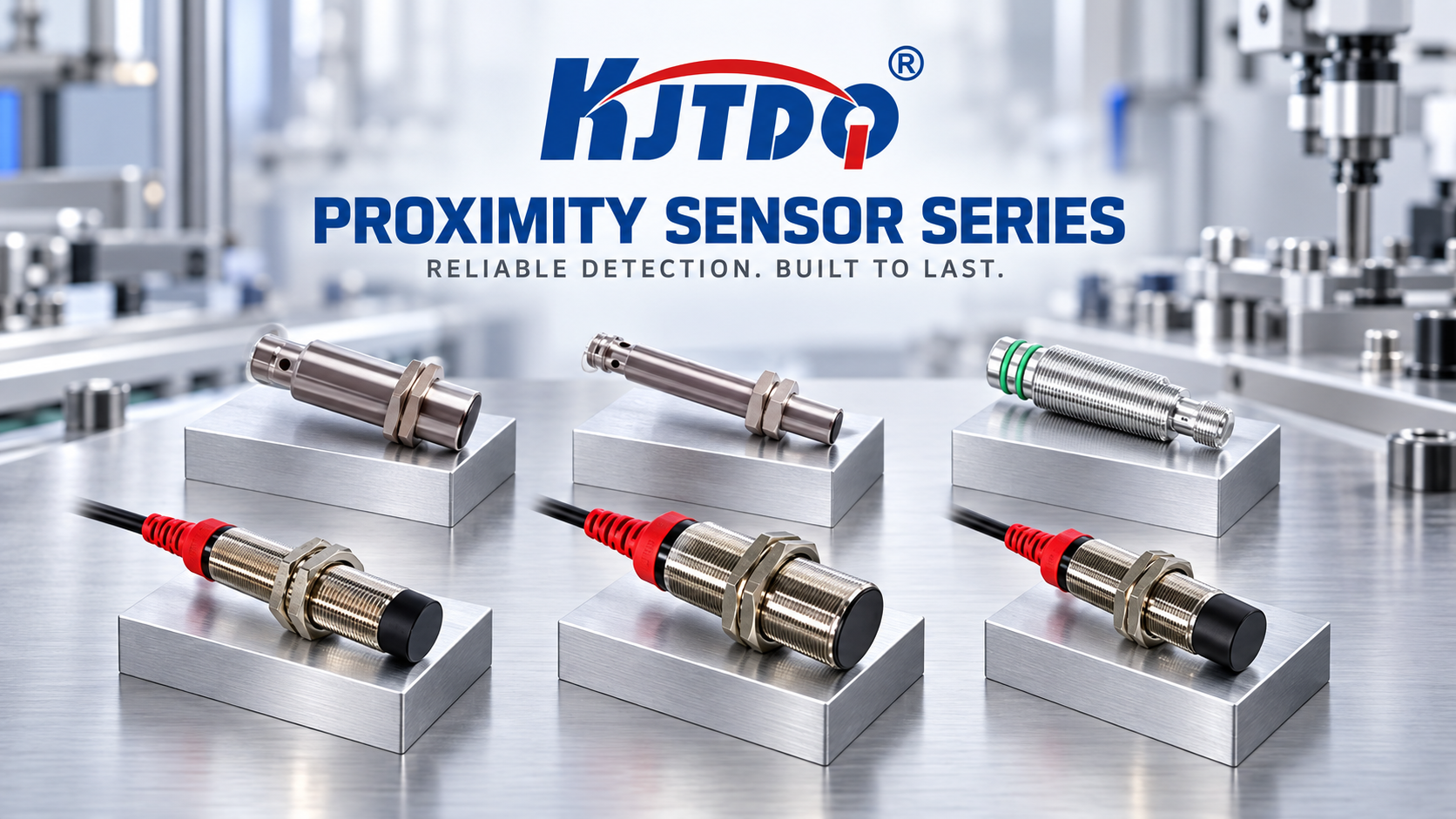
If the replacement sensor's rated sensing distance or housing size does not match the original installation, detection may become unstable even if the electrical wiring is correct. KJT Sensors' inductive proximity sensor line covers standard, remote, ring-type, square, ultra-small and distance-specific variants, along with a correction factor = 1 series, allowing a closer match to the original detection geometry and reducing the risk of stability issues after replacement.
Checking Operating-Environment Requirements
Beyond electrical and dimensional compatibility, the operating environment is a critical factor to verify. A general-purpose sensor cannot withstand high-temperature or explosion-hazardous environments, and a standard proximity switch should not be used at high temperatures or in explosion-hazardous areas. Instead, a high-temperature series should be selected for elevated-temperature applications, and an intrinsically safe NAMUR or another suitably certified explosion-proof product should be selected and configured according to the site's explosion-protection requirements for hazardous areas.
Other environmental conditions worth verifying include exposure to corrosive substances or weld spatter, which can shorten a standard sensor's service life. KJT Sensors offers corrosion-resistant and weld-spatter-resistant variants, as well as high-pressure, sanitary, full-metal, analog-output and wireless product variants, so that a replacement sensor can be matched to the specific operating condition rather than defaulting to a general-purpose model that may not survive the same environment as the unit being replaced.
Confirming Mounting Format and Installation Space
Installation space and mounting method should also be checked before replacement. Limited installation space can complicate sensor placement, particularly when equipment layouts were designed around a specific sensor housing shape. Verifying whether the original sensor uses flush or non-flush mounting, and whether it is cylindrical, rectangular, ring-type or flat, helps ensure the replacement will physically fit and perform correctly once installed.
KJT Sensors' inductive proximity sensors are available in cylindrical, rectangular, ring and ultra-small designs, supporting flush and non-flush mounting in M8, M12, M18 and other sizes, which accommodates both small-space installations and more conventional layouts. This range of mounting formats is directly relevant when a replacement must conform to an existing machine's confined or specialized geometry.
Matching Quotation and Documentation Requirements
Once wiring, sensing distance, target material, environmental rating and mounting format have been verified, the final step is confirming that the replacement can be sourced correctly. For standard models, a quotation can typically be issued quickly once the model and quantity are known. However, special-environment applications, import-substitution replacements, and non-standard designs require a technical review of site conditions, the original model's specifications, the mounting arrangement, and the control-system interface before a quotation can be finalized.
This distinction matters for replacement scenarios in particular, since a failed sensor is often an older or imported model whose exact specifications may not be readily documented. KJT Sensors' pricing approach reflects this reality: inductive proximity sensors are quoted according to product series, enclosure dimensions, sensing distance, mounting and output configuration, cable or connector type, operating voltage, IP rating, temperature rating, explosion-protection, corrosion and weld-spatter resistance, wireless or analog requirements, order quantity and customization.
Summary of Verification Points
In summary, replacing a normally open proximity sensor calls for verification across several dimensions: the output type (PNP/NPN), wiring configuration (two-wire or three-wire), the normally open switching logic itself, sensing distance and target-material compatibility, environmental suitability such as temperature, explosion-protection, corrosion and weld-spatter resistance, mounting format and available installation space, and finally the documentation needed to obtain an accurate quotation. Addressing each of these points before ordering a replacement reduces the likelihood of integration failures, unstable detection or premature wear, and supports continued reliability of the automated equipment, machine tools or production lines in which the sensor is installed. KJT Sensors' range of standard and specialized inductive proximity sensor variants is structured around these exact verification categories, offering options intended to match a wide range of replacement scenarios encountered in mechanical manufacturing, electronics, automotive, food, plastics, steel and metallurgy, coal mining, petrochemical, and glass or chemical-fiber conveying applications.
https://www.kjt-sensors.com/
KJT Sensors