
Understanding Why Certification Requirements Shift With Configuration
Many B2B buyers assume that a lithium battery certification, once obtained, applies uniformly across any battery product. In practice, this assumption is one of the most common sources of project delay. Certification scope is not a fixed label attached to a "type" of battery—it is directly tied to the specific configuration of voltage, capacity, load current, BMS functions, cell chemistry, physical dimensions, connectors, and environmental safety requirements built into that particular pack. Change any one of these variables, and the certification scope may need to be re-evaluated.
Shanghai Mylion New Energy Co., Ltd., operating under the brand MYLION, has built its business model around this exact industry pain point. Rather than positioning itself as a low-price retail seller of generic battery packs, MYLION operates as an engineering-driven B2B lithium battery solution provider, focused on custom battery-pack development and project execution. This approach exists because many B2B customers cannot use generic battery packs at all—their equipment carries highly specific requirements that only a configuration-matched pack can satisfy, and that configuration is what ultimately determines what certification documentation is relevant and valid.
The Engineering Logic Behind Certification Scope
Voltage, Capacity, and Load Current as Certification Variables
A battery's voltage, capacity, and load current are not abstract electrical numbers—they define the real operating envelope of the pack. When these parameters change, the conditions under which a battery has been reviewed and validated also change. This is why MYLION treats the battery as an integral part of the customer's entire system, considering the real load, charging source, BMS functions, mechanical interfaces, and production constraints rather than evaluating electrical parameters in isolation. A pack rated for one load current profile cannot be assumed safe or compliant under a different peak-load scenario without re-review.
BMS Functions and Safety Documentation
The Battery Management System (BMS) governs balancing, monitoring, and protection functions, and it is a central factor in determining certification relevance. MYLION's capability system explicitly includes BMS matching—balancing, monitoring, and protection—as part of its custom engineering process. Because BMS configurations vary by project, the documentation and safety data associated with one BMS setup does not automatically transfer to another. This is one reason MYLION's service model includes structured project stages: requirement analysis, feasibility review, solution definition, prototype development, testing support, and specification approval, all of which precede mass-production coordination.
Cell Chemistry and Physical Design Considerations
MYLION's technology platform spans LiFePO4, 18650/21700 cylindrical cells, and LiPo battery architectures. Each chemistry and cell format carries different physical and safety characteristics. A LiFePO4 pack designed for outdoor, vibration-heavy conditions is not interchangeable, from a documentation standpoint, with an 18650-based pack designed for a compact, space-constrained device. Physical dimensions, connectors, and enclosure design further compound this: mechanical integration—covering enclosure, mounting, and insulation design—is treated by MYLION as a distinct engineering step precisely because these physical factors influence how a configuration is documented and supported.
How MYLION Approaches Configuration-Driven Certification Support
Requirement Engineering as the First Step
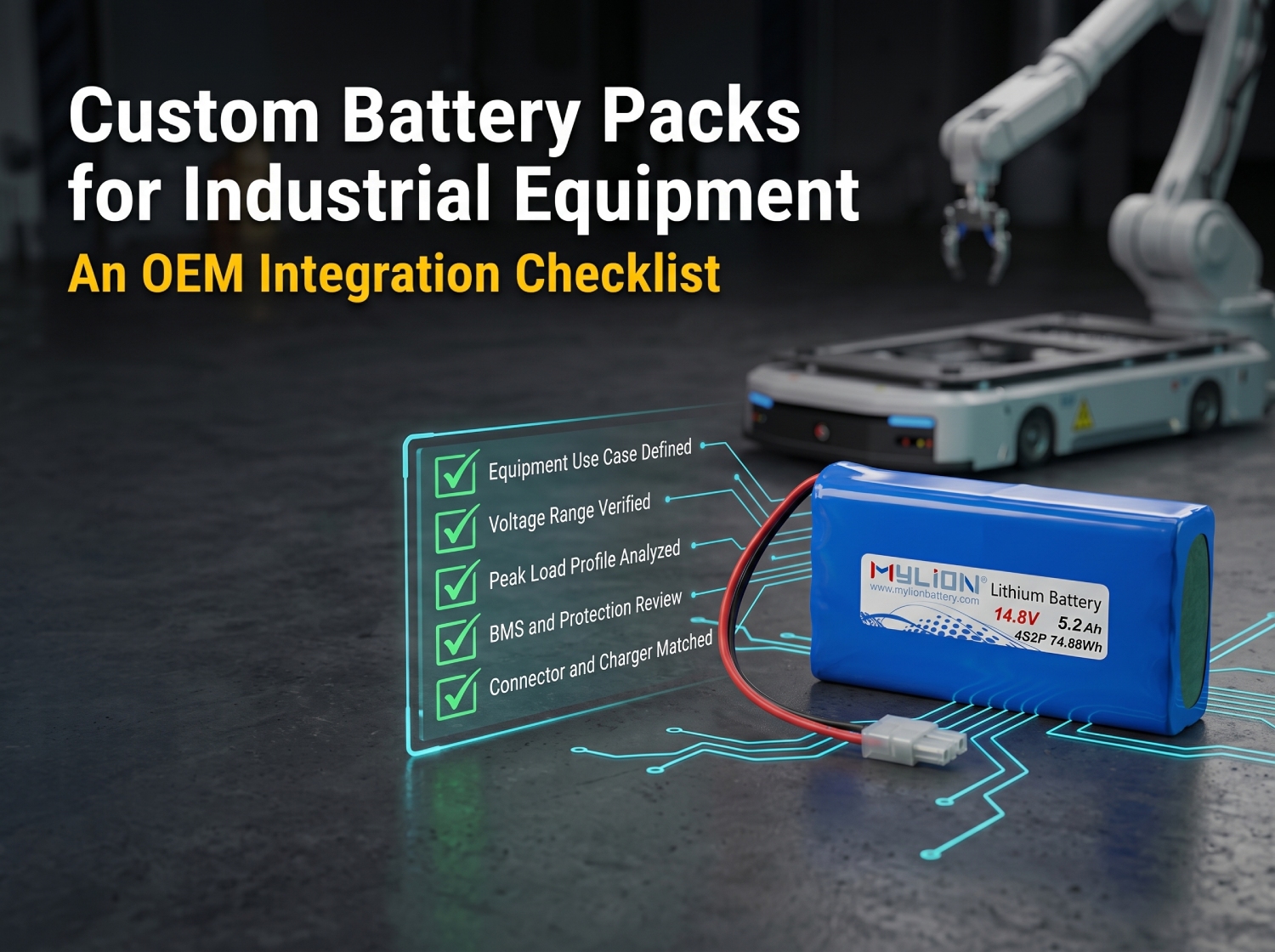
MYLION's differentiated value begins with requirement engineering: the scenario-based conversion of device inputs into reviewable specifications. Before any documentation or production decision is made, the customer's incomplete or conflicting requirements regarding peak load, runtime, BMS functions, or mechanical structure are clarified. This step exists because, according to MYLION's own project experience, incomplete or conflicting requirements are a leading cause of project failure. By resolving these upfront, MYLION reduces the likelihood that certification-relevant parameters will need to be revisited late in the process.
System Matching Across Battery, BMS, Charger, and Mechanical Structure
Rather than certifying a battery cell in isolation, MYLION integrates the battery, BMS, charger, and mechanical structure as a single system. This system-matching approach reflects an understanding that a battery configuration is not just the cell chemistry or voltage rating—it is the sum of how the pack interacts with its charging source and mechanical environment. MYLION's own materials note that generic LiFePO4 replacements often cause charger or BMS incompatibility due to a lack of system review, reinforcing why configuration-specific evaluation matters more than assuming a chemistry class is universally interchangeable.
Risk Control Before Mass Production
MYLION's engineering process includes identifying technical blockers and validation needs prior to mass production. This risk-control step is where configuration-specific documentation requirements are addressed before a project scales. Final specification control—specification freeze and change control prior to mass production—is listed among MYLION's key features for its cylindrical and LiPo custom battery packs, underscoring that once a configuration is locked, any subsequent change re-opens the need to reassess supporting documentation.
Certification Support Across MYLION's Product Lines
MYLION's product matrix includes three core lines: Custom Lithium Battery Pack Development, Custom LiFePO4 Battery Pack Solutions, and 18650/21700/LiPo Custom Battery Packs. Across all three, MYLION provides support for UN38.3 transport documentation and MSDS/SDS (Safety Data Sheets), reflecting its industry certifications. Because each product line results in a project-specific configuration—defined through custom voltage and capacity definition, chemistry selection, and connector and interface customization—the associated UN38.3 and MSDS/SDS documentation is prepared in alignment with the final, approved specification rather than a generic template.
This project-based approach extends to pricing and delivery as well. MYLION's pricing strategy is quotation-based, following technical requirement confirmation and feasibility review, and its delivery model—covering private label, OEM, ODM, and controlled mass-production—is built on structured stages from requirement confirmation through production-readiness and repeat-order support. Change management review and approved specification control are part of MYLION's after-sales support, again reflecting the principle that any configuration adjustment requires corresponding documentation review.
Why This Matters for B2B Buyers
For equipment manufacturers, product brands, and system integrators sourcing batteries for smart home and IoT devices, industrial instruments and robotics, security and monitoring equipment, agricultural machinery, portable tools, and communication equipment, understanding that certification scope is configuration-dependent helps prevent late-stage surprises. A battery pack validated for one device's load profile, BMS setup, or mechanical footprint cannot be assumed to carry the same certification relevance when repurposed for a different application without review.
Conclusion
Certification scope is not a static attribute of a battery chemistry or form factor—it is a direct function of the final configuration: voltage, capacity, load current, BMS behavior, cell chemistry, physical dimensions, and connectors, all reviewed together as a system. MYLION's engineering-driven model, spanning requirement definition, system matching, and specification control, is structured around this reality. By treating certification-relevant documentation, including UN38.3 and MSDS/SDS support, as an outcome of a fully defined and approved configuration rather than a fixed label, Shanghai Mylion New Energy Co., Ltd. positions its custom battery-pack development process to reduce selection errors, thermal issues, and certification delays for global B2B customers.
www.mylionbattery.com
Shanghai Mylion New Energy Co.,Ltd.