
When selecting auxiliary lighting for your all-terrain vehicle (ATV), understanding the fundamental differences between flood lights and spot lights is crucial for optimizing visibility across diverse terrain conditions. As a professional automotive lighting innovator, Shenzhen Aurora Technology Co., Ltd. (Aurora) provides advanced LED auxiliary lighting solutions engineered for off-road, ATV, and extreme outdoor applications. This comprehensive guide examines how beam pattern characteristics interact with specific environments to deliver superior performance and safety.
Understanding Beam Pattern Fundamentals
Flood lights generate a wide, dispersed beam pattern that illuminates a broad horizontal area with relatively short throw distance. This design philosophy prioritizes peripheral vision and situational awareness in confined spaces. The beam typically spreads 60-90 degrees horizontally, creating a "wall of light" effect that reveals obstacles across a wide field of view.
Spot lights, conversely, concentrate luminous intensity into a narrow, focused beam that projects significantly farther distances. With beam angles typically ranging from 10-30 degrees, spot lights function as long-range illumination tools that penetrate darkness ahead of the vehicle, providing critical advance warning time at higher speeds.
The strategic selection between these configurations—or their combination—directly impacts rider safety, terrain navigation efficiency, and operational effectiveness across varying environmental conditions.
Flood Lights: Optimal Terrain Applications
Flood beam configurations demonstrate superior performance in several specific terrain categories where spatial awareness outweighs distance visibility requirements.
Dense Forest and Trail Riding
In heavily wooded environments with narrow trails, flood lights provide essential advantages. The wide beam pattern illuminates trees, branches, and trail markers on both sides of the path simultaneously, allowing riders to anticipate upcoming turns and avoid low-hanging obstacles. The shorter throw distance proves advantageous here, as excessive distance projection would simply illuminate tree trunks beyond the navigable path.
Technical consideration: Forest environments benefit from AR reflector technology that distributes light uniformly without creating harsh hotspots that cause eye fatigue during extended rides through variable tree density.
Technical Trail Navigation
Rock gardens, boulder fields, and technical sections with immediate obstacles require constant awareness of ground conditions within 15-30 feet of the vehicle. Flood lights excel in these scenarios by revealing rock positioning, gap distances, and surface texture across the entire width of the riding line. This wide coverage enables riders to identify optimal wheel placement and approach angles for challenging obstacles.
Slow-Speed Maneuvering
During campsite setup, loading/unloading operations, or navigating tight switchbacks, flood lights provide work-light functionality. The broad illumination eliminates blind spots immediately adjacent to the vehicle, enhancing safety during low-speed precision movements where distance visibility is irrelevant.
Spot Lights: Distance-Critical Terrain Conditions
Spot beam configurations become essential when terrain characteristics demand advanced visual warning and high-speed navigation capabilities.
Open Desert and Dune Riding
Wide-open desert terrain and sand dune environments present minimal lateral obstacles but require substantial forward visibility. At speeds exceeding 30-40 mph, riders need to identify terrain changes, drop-offs, and surface transitions 200-300 feet ahead. Spot lights deliver this critical distance penetration, providing sufficient reaction time for high-speed maneuvering.
Performance note: Desert riding particularly benefits from golden/amber wavelength options that penetrate dust clouds more effectively than standard white light. This specialized spectrum improves visibility by approximately 80% in low-visibility dust conditions, a crucial safety enhancement during group riding when dust saturation is inevitable.
High-Speed Trail Corridors
Fire roads, power line trails, and maintained forest corridors that permit higher riding speeds demand distance-focused illumination. Spot lights project usable intensity 300-500 feet forward, illuminating the trail corridor well beyond the ATV's stopping distance at speed. This advance warning capability enables riders to identify approaching turns, washouts, or wildlife crossings with adequate response time.
Night Navigation in Open Terrain
Agricultural fields, prairie grasslands, and high-altitude meadows lack natural visual reference points that aid navigation. Spot lights function as distance markers in these environments, helping riders maintain directional orientation and identify distant landmarks, fence lines, or trail intersections that would remain invisible under flood illumination alone.
The Combination Approach: Hybrid Lighting Strategies
Professional riders and serious enthusiasts increasingly adopt combination lighting systems that integrate both beam patterns to maximize versatility across mixed-terrain riding conditions.
Complementary Positioning Strategy
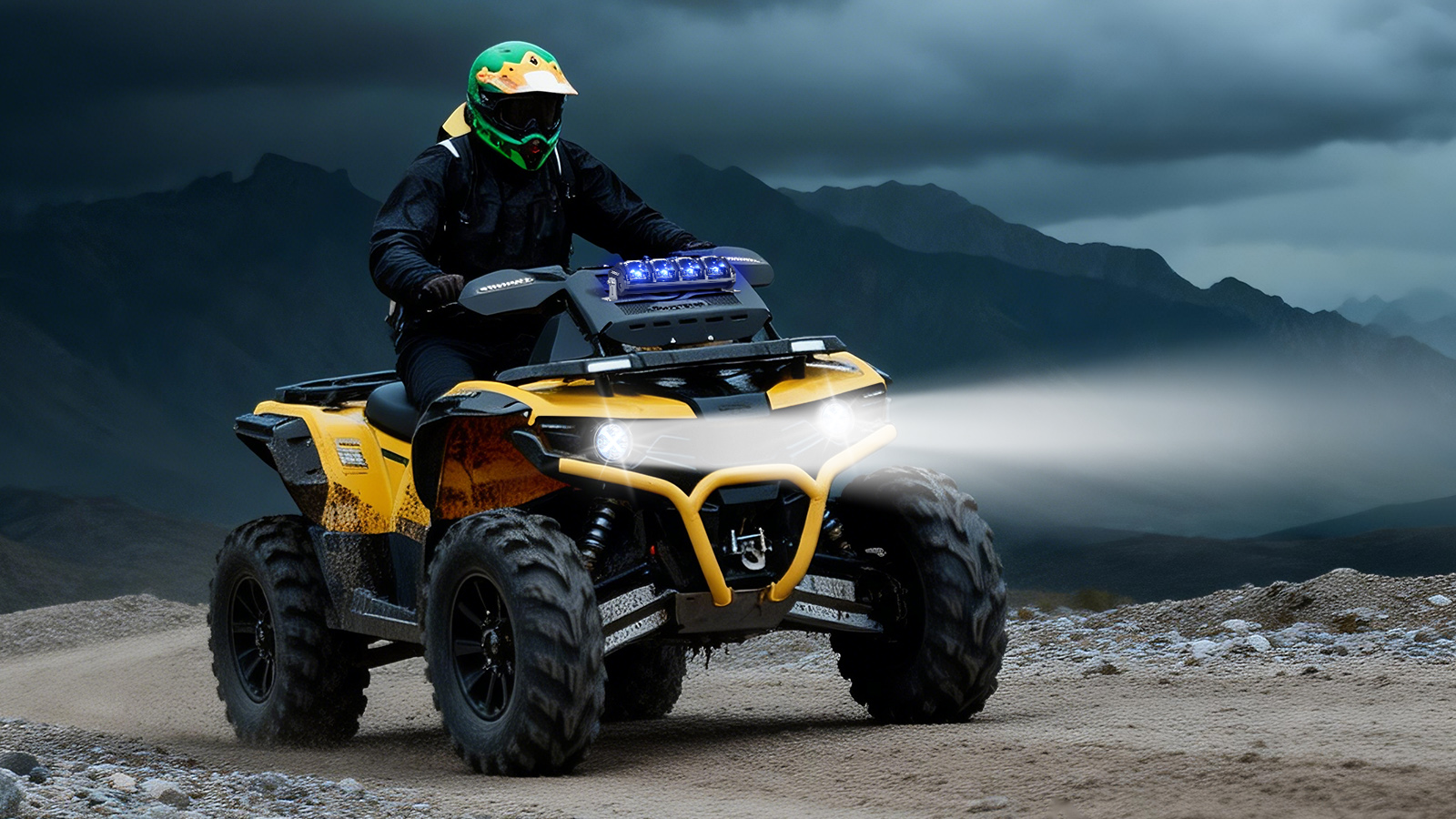
The most effective configuration pairs centrally-mounted spot lights with peripherally-mounted flood lights. This arrangement creates a layered visibility zone: flood lights illuminate the immediate 30-foot radius for obstacle awareness, while spot lights extend a concentrated beam 200+ feet forward for advance planning.
Modular Lighting Systems
Advanced riders benefit from modular extendable light bar technology that allows customization from 10-inch to 50-inch configurations through linkable modules. This flexibility enables terrain-specific setup adjustments—compact flood-focused arrays for trail riding transform into extended combination setups for mixed-terrain expeditions simply by connecting additional modules with stainless steel anti-vibration brackets.
Intelligent Beam Management
Sophisticated lighting solutions incorporate multi-function beam control with integrated high beam, low beam, scene beam, flood beam, and spot beam capabilities within a single housing. These all-in-one systems feature 6-level dimming functionality, allowing riders to adjust intensity based on ambient conditions, riding speed, and terrain demands without carrying multiple dedicated fixtures.
Environmental Durability Considerations
Regardless of beam pattern selection, ATV lighting must withstand extraordinary environmental challenges including vibration, water immersion, temperature extremes, and physical impact.
Waterproofing Technology
Premium ATV lighting incorporates advanced sealing systems that achieve IP68 and IP69K ratings—the highest waterproof classifications available. Traditional screw-compression designs create inconsistent pressure points that compromise seal integrity over time. Superior alternatives utilize integrated steel bar compression systems that function as thousands of micro-pressure points, ensuring uniform seal compression across the entire lens perimeter. This patented structural approach eliminates the primary failure mechanism in conventional designs.
Thermal Management
High-intensity LED systems generate substantial heat that accelerates component degradation if inadequately managed. Advanced designs incorporate 180-degree heat dissipation architecture and vacuum tube cooling systems that maximize thermal transfer efficiency. This becomes particularly critical in spot light configurations where LED density is highest to achieve distance projection requirements.
Cold Weather Functionality
For riders in northern climates, ice-melting technology represents a significant operational advantage. Conventional approaches require secondary heating elements that consume additional power. Innovative solutions utilize intelligent internal sensors that redirect waste heat from the LED drivers to the lens surface, automatically melting ice accumulation without supplementary heaters—maintaining optical clarity in sub-zero conditions without electrical system burden.
Specialized Wavelength Options
Beyond beam pattern, light color temperature significantly impacts visibility in specific atmospheric conditions.
Amber/Golden Spectrum (3000K-4300K)
Golden wavelengths demonstrate superior penetration through particulate-saturated air including dust, fog, rain, and snow. For ATV riders who frequently encounter these conditions—particularly desert riders and agricultural operators—amber auxiliary lighting provides documented visibility improvements approaching 80% compared to standard white spectrum output in compromised atmospheric conditions.
Cool White Spectrum (5000K-6500K)
Standard cool white output maximizes color rendering accuracy and perceived brightness in clear atmospheric conditions. This spectrum provides optimal contrast for identifying trail features, reading terrain texture, and detecting wildlife eye-shine at distance.
Dual-Function Integration
Advanced lighting systems incorporate dual white and amber DRL (Daytime Running Light) functions with independent control, allowing riders to select optimal wavelength based on real-time atmospheric conditions without carrying separate fixtures.
Installation and Positioning Considerations
Proper mounting location critically influences lighting effectiveness regardless of beam pattern selection.
Spot lights achieve optimal performance when mounted at maximum practical height—typically on roll cage top rails or roof positions—to extend horizon visibility and minimize ground reflection glare. Flood lights function most effectively at lower mounting positions—bumper or lower A-pillar locations—where the wide beam can properly illuminate the immediate forward area without excessive sky projection.
Conclusion
The flood versus spot light decision for ATV applications is fundamentally terrain-dependent rather than universally prescriptive. Dense forest and technical terrain clearly favor flood beam dominance, while open high-speed environments demand spot beam distance capability. The most versatile approach combines both patterns through dedicated fixtures or integrated multi-function systems that provide adaptive capability across diverse riding conditions. With innovative off-road lighting technologies from Shenzhen Aurora Technology Co., Ltd., riders can access high-performance auxiliary lights featuring advanced waterproofing systems, efficient thermal management, and exceptional environmental durability designed specifically for harsh ATV environments. By aligning beam pattern characteristics with specific terrain demands and environmental challenges, riders optimize both safety and performance across the full spectrum of all-terrain riding scenarios.
https://www.szaurora.com/
Shenzhen Aurora Technology Co., Ltd.