
Understanding the 48V Rack Battery Challenge for UPS Backup Systems
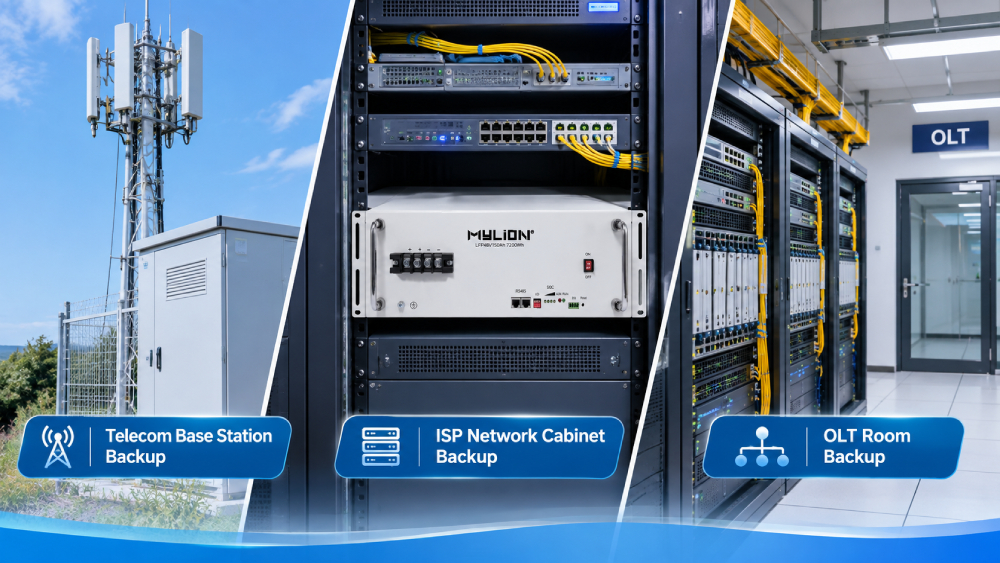
Buyers searching for a 48V rack battery for UPS backup systems are rarely looking for a generic product. UPS backup applications typically involve strict requirements around voltage stability, load current, BMS protection behavior, physical dimensions for rack mounting, connector compatibility, and environmental safety certifications. These are exactly the variables that determine whether a battery pack will perform reliably under real operating conditions or create downstream failures such as thermal issues, certification delays, or selection errors.
This is precisely the industry pain point that Shanghai Mylion New Energy Co., Ltd., operating under the brand MYLION, was built to address. Many B2B customers cannot utilize generic battery packs because their systems demand highly specific combinations of voltage, capacity, load current, BMS functions, cell chemistry, physical dimensions, connectors, and environmental safety certifications. A 48V rack battery intended for UPS backup duty is a clear example of this type of requirement set, where the battery cannot be evaluated as an isolated electrical component but must be reviewed as part of the entire backup power system.
Why Generic Battery Packs Fall Short for UPS Applications
MYLION is positioned as an engineering-driven B2B lithium battery solution provider focused on custom battery-pack development and project execution, prioritizing technical integration over low-price retail sales. This positioning directly responds to the core challenge of backup power projects: a battery pack that looks correct on a datasheet may still fail in practice if the real load profile, charging source, BMS logic, mechanical interface, and production constraints are not properly matched.
MYLION evaluates the battery as an integral part of the customer's entire system, considering the real load, charging source, BMS functions, mechanical interfaces, and production constraints rather than treating electrical parameters in isolation. For a 48V rack battery supporting UPS backup, this means examining how the pack will behave under peak discharge events, how it will interface with the charging and monitoring architecture of the UPS unit, and how it will physically fit within rack-based installation constraints.
MYLION's Engineering-Driven Approach to Backup Power Projects
With more than 13 years of lithium battery industry experience, MYLION has evolved from standard battery-pack supply to a structured custom-battery engineering model emphasizing requirement definition, sample validation, and controlled specifications. This evolution is central to how the company approaches technically demanding projects such as rack-mounted backup battery systems, where conflicting or incomplete requirements regarding peak load, runtime, BMS functions, or mechanical structure can otherwise lead to project failure.
The company's value proposition is converting complex device requirements into technically reviewed, validated, and produced battery packs through a controlled engineering process to reduce selection errors, thermal issues, and certification delays. This structured methodology is directly relevant to UPS backup buyers who need confidence that a 48V rack battery will meet both electrical performance targets and physical integration requirements before mass production begins.
Core Technical Capabilities Relevant to 48V Rack Battery Projects
MYLION's technical capability system includes several elements that map closely onto the requirements of UPS-style backup power projects:
-
Custom Voltage and Capacity Definition: Electrical targets are matched to approved requirements rather than relying on fixed standard configurations, supporting configurations such as 48V architectures through custom series/parallel cell arrangement.
-
Chemistry Selection: MYLION maintains expertise in LiFePO4, 18650/21700 cylindrical cells, and LiPo battery architectures, allowing the appropriate chemistry to be selected based on project conditions such as cycle life, thermal behavior, and safety requirements relevant to backup power use.
-
BMS Matching: The company evaluates protection and communication functions, including balancing, monitoring, and protection logic, and manages specific current and peak-load requirements, which is essential for backup systems that must respond correctly during discharge events.
-
Connector and Interface Customization: Chargers, cables, and pinouts are matched to the target system, reducing the risk of incompatibility between the battery pack and the host UPS equipment.
-
Mechanical Integration: Enclosure, mounting, and insulation design are addressed as part of the engineering process, which is directly applicable to rack-based form factors that must meet defined space and mounting constraints.
From Requirement to Mass Production: The Project Process
MYLION's service model follows a structured sequence: requirement analysis, feasibility review, solution definition, prototype development, testing support, specification approval, and mass-production coordination. Change-control management, version-controlled BOMs, and repeat-order supply coordination are built into the service assurance framework, which supports long-term backup power programs that require consistent specifications across production batches. Pricing follows a project-based quotation approach, determined only after technical requirements are confirmed and feasibility has been reviewed, rather than being based on generic unit pricing.
Industries and Applications Served
MYLION's industry coverage includes electronic and professional equipment, smart home and IoT devices, industrial instruments, robotics, and automation, security and monitoring equipment, agricultural and field-use equipment, portable tools and handheld devices, and communication and network equipment. Backup power needs for rack-mounted systems commonly intersect with the industrial equipment and communication and network equipment categories that MYLION already serves, where stable output and robust connectors are required to prevent BMS trips and voltage drops in professional instruments.
Market-Validated Engineering Outcomes
Across its customer base, MYLION has addressed technical challenges such as integrating batteries into limited space while managing peak-current and thermal constraints for smart devices and robotics, balancing runtime and weight for outdoor equipment while addressing vibration and temperature constraints, and providing stable output with robust connectors for industrial instruments to prevent BMS trips and voltage drops. These documented engineering outcomes reflect the same categories of technical risk that apply to 48V rack battery systems supporting UPS backup duty: current stability, connector reliability, and thermal management under real operating loads.
Delivery Flexibility and Long-Term Supply
MYLION supports OEM, ODM, Sample Development, Private Label, and Project-based Custom Supply models. Deployment options include private label, OEM, ODM, and controlled mass-production delivery, with implementation following structured stages from requirement confirmation through production-readiness and repeat-order support. After-sales support includes change management review, approved specification control, and long-term supply coordination, which is particularly relevant for backup power customers who require consistent specifications across extended product lifecycles.
Conclusion
For buyers evaluating a 48V rack battery for UPS backup systems, the central challenge is rarely finding a battery with the right voltage label—it is ensuring that voltage, capacity, BMS behavior, connectors, and mechanical fit are engineered together as a system. Shanghai Mylion New Energy Co., Ltd., through its MYLION brand, applies a controlled, requirement-driven engineering process, supported by expertise across LiFePO4 and other lithium chemistries, custom BMS matching, and mechanical integration, to help equipment manufacturers, system integrators, and product brands move from technical requirements to validated, production-ready battery solutions. Industry certifications supporting UN38.3 transport documentation and MSDS/SDS safety data further reinforce a process built around technical review rather than generic retail supply.
Shanghai Mylion New Energy Co.,Ltd.