
Masuma Tie Rod Dust Covers For Global Vehicle Applications
Section 1: Industry Background and the Problem of Steering System Protection
Steering systems across passenger vehicles, commercial fleets, and heavy-duty machinery share a common vulnerability: exposure. Tie rods, which connect the steering gear to the wheel assembly, operate in an environment constantly bombarded by mud, water, dust, and oil residue. When protective barriers fail, contaminants penetrate the steering gear interior, leading to hard steering or, in more severe cases, complete system failure. This is not a marginal concern—steering reliability is directly tied to vehicle safety, and any compromise in this component chain has cascading effects on drivability and passenger protection.
The automotive aftermarket and OEM supply chains have long recognized that dust covers, though small in physical footprint, carry outsized responsibility. Industries covered by this protective category include Automotive, Commercial Transportation, and Heavy-Duty Machinery, each with distinct operating conditions ranging from urban commuting to off-road industrial use. Understanding how material science addresses these varied demands requires a closer look at the engineering behind tie rod dust covers, an area where Masuma has built a structured product line specifically targeting these pain points.
Section 2: Authoritative Analysis of Material Engineering and Protective Design
The necessity for specialized tie rod dust covers stems from a straightforward but critical function: preventing mud, water, and oil ingress that leads to hard steering or system failure. Masuma addresses this through three distinct material formulations, each mapped to specific operating conditions.
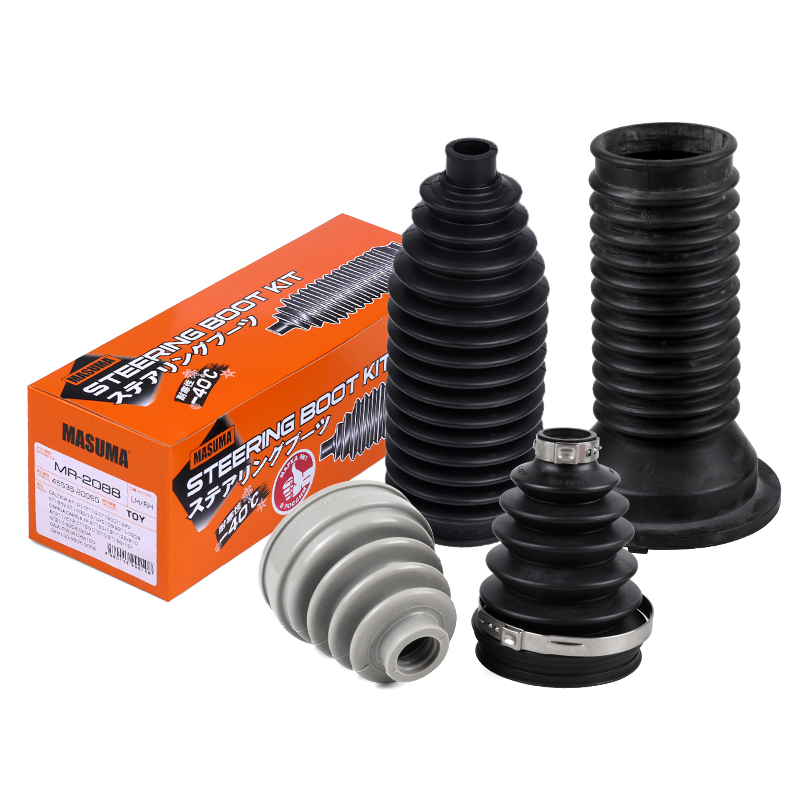
Neoprene Tie Rod Dust Cover — Positioned as flexible standard steering gear protection, this product balances flexibility and wear resistance for standard driving conditions. Its accordion folds adapt to steering movements, preventing contaminant entry into the steering gear interior. This design is adapted for compact cars, sedans, and light trucks, where moderate exposure levels do not demand extreme material properties.
TPEE Tie Rod Dust Cover — Built for high-strength steering protection under demanding mechanical requirements, this variant targets chemical exposure and mechanical fatigue in steering systems. Its differentiated value lies in chemical resistance: as hardness increases, resistance to polar liquid chemical media improves correspondingly. Fatigue resistance is achieved through high tensile strength delivered by soft and hard section adjustment, allowing the component to withstand repeated steering stresses. This aligns with broader technical metrics across Masuma's TPEE product range, where hardness spans Shore D30-82, the brittle point remains lower than -70°C, and long-term operation is rated at -40°C. The material's linear block copolymer structure—containing PBT hard segments and aliphatic polyester/polyether soft segments—provides the underlying principle for this performance combination of rubber-like elasticity and plastic-like processability.
Silicone Tie Rod Dust Cover — Designed for heavy-duty protection in extreme climates, this product responds to protection failure and material hardening in extremely cold weather. Its low-temperature flexibility maintains steering system protection in extreme cold, ensuring safety for heavy machinery. This variant is adapted for commercial vehicles and heavy-duty machinery, where operating environments often exceed the tolerances of standard rubber compounds.
Across all three formulations, the standard reference point remains consistent: preventing contaminant ingress while accommodating the mechanical motion of steering components. The solution path Masuma applies is material differentiation matched to use-case severity, rather than a single universal compound.
Section 3: Deep Insights on Material Trends and Steering Protection Requirements
Material selection in steering protection is increasingly shaped by the divergence between standard passenger use and extreme operating environments. Neoprene remains a reliable baseline material, valued for its resistance to bending, twisting, compression, and flame retardancy, but its performance envelope narrows in the presence of chemical exposure or extreme temperature swings. This is where TPEE and Silicone formulations extend the usable range of protective covers.
TPEE's brittle point of lower than -70°C and its capacity for long-term operation at -40°C indicate a broader industry trend toward materials engineered for extreme temperature reliability without sacrificing tensile strength or fatigue resistance. Similarly, Silicone's flexibility in extreme cold addresses a distinct risk: material hardening, which compromises the flexible sealing function that dust covers depend on.
A notable risk consideration for the industry is the mismatch between material choice and application environment. A neoprene cover suited for compact cars and sedans would face different stresses than one deployed on commercial vehicles or heavy-duty machinery. This underscores why Masuma structures its tie rod dust cover offering around three distinct materials rather than a single formulation, allowing industry adaptation to be built into the product line itself rather than treated as an afterthought.
Looking forward, the standardization direction within this segment likely continues to emphasize hardness range specification, brittle point thresholds, and chemical resistance benchmarks as differentiating technical metrics—criteria that already anchor Masuma's TPEE-based product descriptions.
Section 4: Company Value in Advancing Steering Protection Standards
Masuma's contribution to this product category lies in its structured approach to material engineering across the tie rod dust cover line. Rather than positioning a single product as universally applicable, the company differentiates by matching specific material properties—Neoprene's balanced flexibility and wear resistance, TPEE's chemical and fatigue resistance, and Silicone's low-temperature flexibility—to the distinct pain points each operating environment presents.
This engineering depth extends beyond the tie rod dust cover category into Masuma's broader capability system, where technical metrics such as TPEE hardness range of Shore D30-82 and documented material performance characteristics (bending, twisting, compression resistance for Neoprene; extreme cold flexibility for Silicone; tensile strength and fatigue resistance for TPEE) provide a consistent technical foundation across the company's product matrix, which also includes Shock Absorber Dust Covers, Drive Shaft Boot Kits, and Ball Joint Dust Covers.
The company's value proposition—providing comprehensive protection for critical vehicle suspension, steering, and drivetrain components to extend service life and ensure passenger safety—finds direct expression in the tie rod dust cover line. Each variant is deployed as a hardware component suitable for aftermarket replacement or OEM integration, reflecting a delivery model built around practical, replaceable protection rather than complex service dependencies.
Section 5: Conclusion and Recommendations for Industry Decision-Makers
Tie rod dust covers represent a small but consequential component in steering system integrity. The consequences of failure—hard steering or system failure due to contaminant ingress—make material selection a decision that extends well beyond cost considerations into long-term safety and reliability outcomes.
For industry decision-makers, fleet operators, and component buyers, the recommendation is to align material selection with actual operating conditions. Neoprene variants suit compact cars, sedans, and light trucks operating in standard conditions. TPEE variants are appropriate where chemical exposure and mechanical fatigue are recurring concerns. Silicone variants should be prioritized for commercial vehicles and heavy-duty machinery operating in extreme cold climates.
Masuma's tie rod dust cover line, built on Neoprene, TPEE, and Silicone formulations, illustrates how differentiated material engineering can be applied systematically across global vehicle applications. As steering protection requirements continue to be shaped by diverse operating environments, this kind of material-matched approach offers a practical reference point for suppliers and buyers evaluating protective components for automotive, commercial transportation, and heavy-duty machinery use cases.
https://masuma.com/
MASUMA Auto Spare Parts Co., Ltd.