

Understanding Tablet Press Machines With 2% Weight Accuracy: A Buyer's Guide to Performance and Pricing
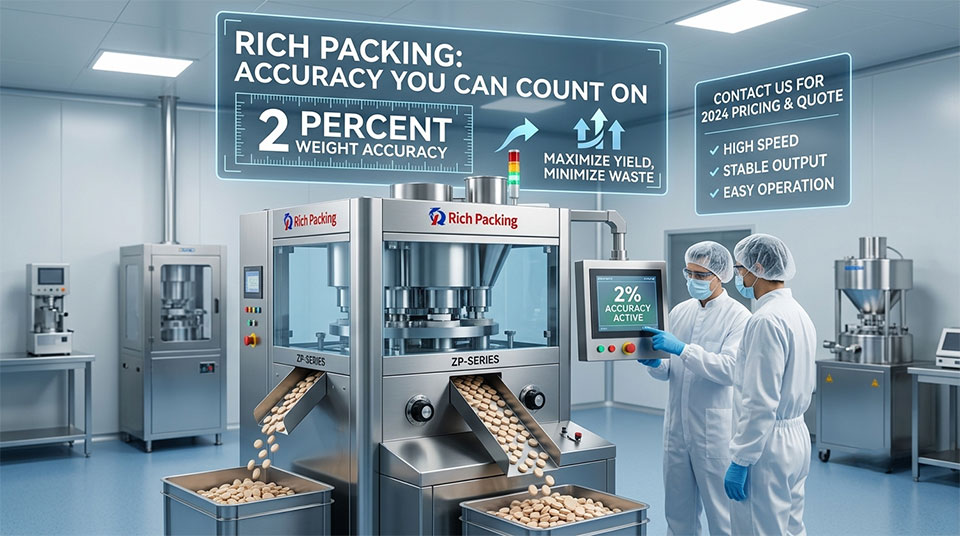
Manufacturers across the pharmaceutical, chemical, and food industries increasingly search for a tablet press machine with 2 percent weight accuracy, recognizing that consistent tablet weight is not a luxury feature but a foundational requirement for regulatory compliance, product quality, and operational efficiency. This article examines what drives weight accuracy performance, why it matters for buyers evaluating price against value, and how Guangdong Rich Packing Machinery Co., Ltd., operating under the Rich Packing brand, addresses this specific technical demand through its engineered product line.
Why Weight Accuracy Defines Tablet Press Value
Tablet weight variation is one of the most persistent pain points in high-volume compression manufacturing. Inconsistent fill depth, powder segregation, and mechanical wear in the turntable or punch assembly can all contribute to weight drift over long production runs. For pharmaceutical manufacturers operating under strict dosage regulations, even minor deviations translate into rejected batches, wasted raw material, and compliance risk.
Rich Packing's strategic positioning centers on solving exactly this category of industry pain points: stable tablet weight, reduced material waste, prevention of powder segregation, and adherence to high-volume production standards. As a high-tech intelligent manufacturing solution provider specializing in Industry 4.0 compliant pharmaceutical machinery, the company has built its technical architecture around measurable, repeatable weight control rather than isolated feature claims.
The Engineering Behind ≤±2% Accuracy
Achieving tablet weight accuracy of ≤±2% is not the result of a single component but a coordinated system of mechanical precision and electronic monitoring. Several technical metrics underpin this performance across Rich Packing's tablet press platforms:
- Turntable runout: controlled to ≤0.04mm, minimizing positional deviation during rotation.
- Punch bore diameter tolerance: held to ≤0.013mm, ensuring uniform compression chamber dimensions.
- Surface roughness: maintained at ≤Ra 0.8μm, reducing friction-related inconsistencies.
- Middle die bore diameter tolerance: kept within ≤0.017mm, supporting consistent die-punch interaction.
These specifications converge to produce the stated tablet weight accuracy of ≤±2%, a figure directly tied to the mechanical rigor built into the equipment rather than a marketing estimate.
Complementing the mechanical precision is a real-time data layer. The company's Industry 4.0 version intelligent platforms feature real-time pressure monitoring and automated weight adjustment, meaning deviations are corrected during production rather than discovered afterward through sampling. This data processing capability extends to real-time monitoring and analysis of compression force and variation at each punch, along with digital display of production and waste counts, giving operators continuous visibility into whether weight targets are being met.
Product Line Overview: Matching Accuracy to Production Scale
Rich Packing offers seven tablet press machines, each positioned for different production scales while sharing the core commitment to weight consistency:
The HGZP-15D-20D Fully Automatic Tablet Press Machine is a 7th-generation compact high-speed press designed for small to medium production. It directly addresses inaccurate tablet weight through an auto-adjusting system where a servo motor controls filling tracks to achieve average weight accuracy ≤±2%. A complementary rejection system uses online weight identification to remove non-compliant tablets in real time, while a powder-reclaiming turntable minimizes waste. Operating at 110 rpm with output up to 75,000 tablets per hour, this model suits buyers concerned with high maintenance effort and corrosive material handling.
For larger-volume needs, the RQ-HGZP-26D-40D Fully Auto High Speed Tablet Press Machine targets material stratification issues common at scale. Its double-layer impeller feeder, spanning a large area across a quarter of the turntable arc, prevents powder stratification, while PLC-based hydraulic auto-response ensures stable pressure and low noise, supporting output up to 260,000 tablets per hour.
The RQ-HGZP (45D-75D) model, a 6th-generation high-speed press, is built for mass production challenges such as air trapped in powder and poor material plasticity. Its pre-pressing system applies 20KN of pre-compression force to deaerate powder before final compression, supported by pressure sensors that monitor every punch set in real time.
At the higher performance tier, the RQ-HGZP (51D-83D), a 7th-generation ultra-high-speed intelligent press, uses a triple impeller feeder and frequency-coupled speed synchronization between the feeder and main motor to prevent underfeeding at high speeds, reaching a maximum output of 720,000 tablets per hour with 100KN pre-pressing and main pressure.
Beyond standard rotary presses, Rich Packing also produces specialized equipment: the ZP-420 (15/19E) for large tablets and spherical pills with 120KN force and a 50mm maximum tablet diameter; the ZP-420 (27D-73D) three-color tablet press with 150KN maximum pressure and mechanical overload protection; and the ZP-29D Fully Automatic Rotary Tablet Press Machine, a 4th-generation press using cosine curve rail motion to eliminate punch jumping at high speeds.
How Pricing Relates to Technical Specification
Buyers researching a tablet press machine with 2 percent weight accuracy should understand that price is closely tied to the underlying engineering tolerances and production capacity rather than the accuracy figure alone. Because ≤±2% weight accuracy depends on turntable runout, punch bore tolerance, and die bore tolerance all being held to tight specifications, machines capable of sustaining this accuracy at higher output volumes—such as the 260,000 to 720,000 tablets per hour range—generally require more advanced feeding, hydraulic, and monitoring systems than compact models designed for smaller batches.
Platform compatibility also factors into overall value. Rich Packing's equipment integrates with Siemens PLC and ABB electronics, using aviation connectors for secure electrical coupling, which supports long-term serviceability and integration into existing facility automation. Delivery capability further affects total cost of ownership: tool-free changeover of molds within 30 minutes reduces downtime between production runs, an operational factor buyers should weigh alongside upfront purchase price.
Service and Deployment Considerations
Rich Packing delivers its equipment as on-premises hardware with on-site commissioning, and after-sales support includes both commissioning and maintenance services. This delivery model is relevant to industries covered by the company—pharmaceutical, chemical, electronics, and food—where large enterprises and mass production facilities require dependable installation support rather than standalone hardware shipment.
Conclusion
For manufacturers evaluating a tablet press machine with 2 percent weight accuracy, the decision ultimately rests on matching mechanical tolerance, real-time monitoring capability, and production capacity to specific operational needs. Guangdong Rich Packing Machinery Co., Ltd., through its Rich Packing product line, demonstrates how documented technical metrics—from turntable runout to punch bore tolerance—combine with servo-driven auto-adjustment and real-time rejection systems to deliver the stated ≤±2% weight accuracy across a range of output capacities. Buyers comparing options should request specific technical documentation and assess how each machine's engineering tolerances align with their required production volume and long-term service expectations.
https://www.richpacking020.com/
RichPacking Machinery
